


This year, the CKS Cultural Center has added a new event to the cultural calendar with its World View Series, which aims to bring the best of international theater to Taipei. Getting the series off to a splendid start will be a showcase of British theater -- which hardly comes as a surprise given Taiwan's current infatuation with Britain's creative industries concept and energetic promotion by the British Council.
The British Theater World View Series actually only incorporates three shows, all in the tradition of the much admired fringe theater mold. The opening act is the highly acclaimed Bobby Baker with Box Story, originally designed for performance at St. Luke's Church in North London in 2001.

PHOTO COURTESY OF ANDRES WHITTUCK
Taiwan has become familiar with many British performers who have brought skills to the stage from outside the traditional drama establishment, most notably from the circus and street performances.

Bobby Baker trained as a painter, but later turned to more physically expressive media, and while she now performs regularly in theaters, much of her work up to now has been designed for specific venues, most famously in Kitchen Show, in which she opened her own kitchen to serve as a performance venue.
Indeed, much of Baker's work is intimately connected with her life and the daily round of British domestic life. That she is able to see the profound issues that lie beneath the most mundane of existences has brought her rave reviews such as Time Out's "touching, deliciously batty and seriously revealing."
"Most of my work has been based on my own experience or observations," Baker said in an interview with Taipei Times. "I am not really acting the show, I am just being me, only slightly exaggerated."
But at the same time, Baker denies that her work is autobiographical, for she creates strange, funny and surreal situations with the aim of making people reflect on their own lives rather than simply taking in her experience.
This attitude is part of a breaking down of traditional ideas of drama, part of Baker's own rebellion against the traditions that still bound mainstream theater in the 1960s and 1970s. Talking about why British drama has proved so popular, she pointed to the incredible openness to other styles and approaches that performance art has shown over the last couple of decades. "We have been so enriched by this, and it shows in the work."
This richness is the icing on the cake of a long and established theatrical tradition -- but this tradition, for Baker, is something, which she has accepted in her own way.
"The fact that I trained as a painter meant I lacked awareness of this tradition and later [after becoming a performer], I had to discover it for myself. My training as an artist also gives me a more visual orientation, which probably puts a different spin on my shows," she said.
Probably the most unusual aspect of the show is its emphasis on food, which is part and parcel of the dramatic performance. Food is made into art, and also provides the materials from which Baker makes a complete mess of herself in her show.
Box Story is in fact the last in a quintet of performances titled Daily Life, a project first commissioned by the London International Festival of Theater, an organization that Baker credits for much of the vitality of contemporary English theater. Her next work, How To Live, will be the first work designed for a formal theater setting but will remain a one-woman show ... with a large cast of peas.
Although Baker's forte is comedy, it is the kind of comedy that manages to encompass and make us think about life's tragedies. In Box Story, Baker tackles the issue of death, one of the multiplicity of meanings derived from the title "box."
The show has toured extensively but this is the first time it has been brought to Asia. While the spoken word plays an important part in the show, there is also plenty of spectacle, mostly the intricately choreographed body language that Baker has worked out with long-time collaborator Polonca Baloh Brown. A synopsis is available for non-English speakers to provide a framework for an understanding of the story.
Bobby Baker's Box Story will be followed by Thebans by Theater Babel, a contemporary take on the Greek tragedies of Oedipus, Jokasta and Antigone, and Roadmetal, Sweetbread by Station House Opera, which has gained international renown for its uniquely physical and visual style.
These three very different shows are a taste of the rich performance culture that is coming out of the UK and it is hoped that it will lead the way to more major foreign acts visiting Taiwan. Though the CKS Cultural Center says that France may be the target of the next World View Series.
All shows will be performed at the Experimental Theater of the National Theater in Taipei. Tickets are NT$500.
Box Story by Bobby Baker
Today and tomorrow at 7:30pm; tomorrow and Sunday at
2:30pm.
Thebans by Theater Babel
Sept. 19 and 20 at 7:30pm; Sept. 20 and 21 at 2:30pm.
Roadmetal, Sweetbread by Station House Opera
Oct. 3 and 4 at 7:30pm; Oct. 4 and 5 at 2:30pm.
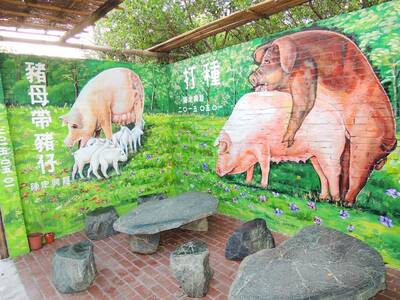
May 6 to May 12 Those who follow the Chinese-language news may have noticed the usage of the term zhuge (豬哥, literally ‘pig brother,’ a male pig raised for breeding purposes) in reports concerning the ongoing #Metoo scandal in the entertainment industry. The term’s modern connotations can range from womanizer or lecher to sexual predator, but it once referred to an important rural trade. Until the 1970s, it was a common sight to see a breeder herding a single “zhuge” down a rustic path with a bamboo whip, often traveling large distances over rugged terrain to service local families. Not only
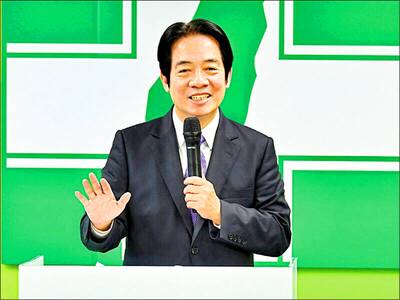
Ahead of incoming president William Lai’s (賴清德) inauguration on May 20 there appear to be signs that he is signaling to the Chinese Communist Party (CCP) and that the Chinese side is also signaling to the Taiwan side. This raises a lot of questions, including what is the CCP up to, who are they signaling to, what are they signaling, how with the various actors in Taiwan respond and where this could ultimately go. In the last column, published on May 2, we examined the curious case of Democratic Progressive Party (DPP) heavyweight Tseng Wen-tsan (鄭文燦) — currently vice premier
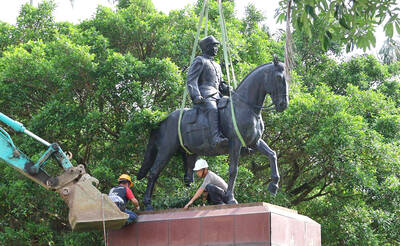
The last time Mrs Hsieh came to Cihu Park in Taoyuan was almost 50 years ago, on a school trip to the grave of Taiwan’s recently deceased dictator. Busloads of children were brought in to pay their respects to Chiang Kai-shek (蔣中正), known as Generalissimo, who had died at 87, after decades ruling Taiwan under brutal martial law. “There were a lot of buses, and there was a long queue,” Hsieh recalled. “It was a school rule. We had to bow, and then we went home.” Chiang’s body is still there, under guard in a mausoleum at the end of a path

Last week the Directorate-General of Budget, Accounting and Statistics (DGBAS) released a set of very strange numbers on Taiwan’s wealth distribution. Duly quoted in the Taipei Times, the report said that “The Gini coefficient for Taiwanese households… was 0.606 at the end of 2021, lower than Australia’s 0.611, the UK’s 0.620, Japan’s 0.678, France’s 0.676 and Germany’s 0.727, the agency said in a report.” The Gini coefficient is a measure of relative inequality, usually of wealth or income, though it can be used to evaluate other forms of inequality. However, for most nations it is a number from .25 to .50


 RSS
RSS