


After 60 years the Chinese crested tern -- nicknamed the "mythical bird" for its elusiveness -- is a myth no more.
One thousand copies of the documentary The Bird of Myth: Chinese Crested Tern (神話之鳥: 黑嘴端鳳頭燕鷗) were released to bird societies worldwide last Saturday and they are expected to revive interest in the species, which was previously thought extinct.
For the Executive Yuan's Council of Agriculture (農委會) and Lienchiang County Government, who commissioned the Taiwan Wild Bird Federation (中華民國野鳥學會) to make the film, it's an exhilarating milestone for conservation work in the Matsu Tern Conservation Area (馬祖列島燕鷗保護區).
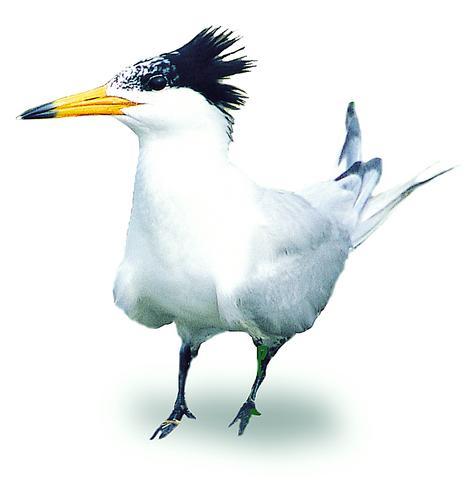
PHOTO COURTESY: LIENCHIAG COUNTY GOVERNMENT CONSTRUCTION BUREAU
The Chinese crested tern is the latest addition to the 30 species of birds, mostly crested terns, spending their summer in the conservation area.
The International Red Paper for Conservation, which lists species that need special preservation, has listed the Chinese crested tern as a class-A endangered species since 1937. Compared with the better-known black-faced spoonbill, also a class-A endangered species in Taiwan, the Chinese crested tern is even rarer, numbering an estimated 100, while the spoonbill population is roughly 1,000.
According to Liu Hsiao-ru (劉小如), a research fellow at Academia Sinica's Insitute of Zoology who confirmed the discovery of the Chinese crested tern after it was first discovered in China in 1863, there have been just five sightings, some of which were uncertain.

The last confirmed sighting was in China's Sandong province in 1937. The most recent, but unconfirmed sighting, was of three terns in the Yellow River Delta Area in 1991. Most people thought the bird was already extinct.
Filmmaker Liang Chiei-de (梁皆得) came across the bird when making another Liengchiang County Government-commissioned documentary on crested terns in the Matsu Tern Conservation Area in 2000 and passed the information on to Birdlife International, a league of bird associations from over 100 countries. The organization asked for bird societies worldwide to search through their data to see if anyone had caught the rare bird on celluloid.
Taiwan Wild Bird Association researcher Won Rong-hsuei (翁榮炫) found among his 1998 photos four terns, which suggested the birds passed by the Pachang Creek inlet in Chiayi in their migrations. Chang Sho-hua (張壽華), the chief of the Matsu Construction Bureau (連江縣政府建設局) and general director of the Matsu Wild Bird Society, found one tern among his 1997 photos of the Matsu Conservation Area.
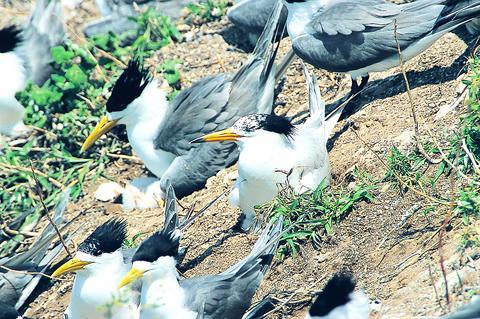
Chang believes there are more sightings of the terns which went unrecorded because few bird-watchers can identify the species.
"They look very similar to other crested terns, except for the patch of black color around the tip of their beak. Also, they like to blend in with other crested terns, making them hard to recognize for the untrained eye," Chang said.
In the documentary, which covers three years, there are four couples of terns mating and breeding on two of the eight islets which compose the conservation area.
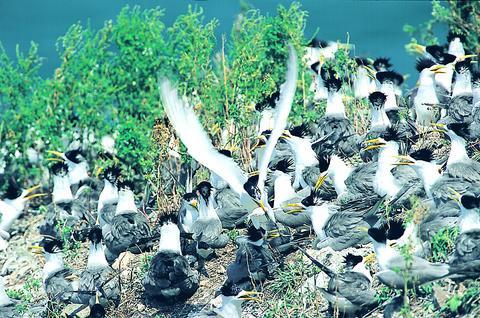
Although the reasons for the near-extinction of the tern have not been pinned down, Chang found from his observations that the bird is probably not a skillful feeder.
"We often saw the tern coming back from its food trip with nothing in its beak, while other terns had brought home big meals," Chang said, adding that his findings are not conclusive as the colony is small.
Chinese medicine

The biggest threat to the survival of Chinese crested terns is human beings, as the bird is high up in the food chain. Like other crested terns, Chinese crested terns like to lay eggs under Crossostephium Chinense, a medicinal plant particular to Matsu which is believed to be able to cure arthritis. "Some years ago, when Matsu fishermen were suffering from poverty, they would go to the desert island looking for the plant to treat their illness. This practice caused great harm to the crested tern colonies there.
"Fortunately, as their living standards rose and an available garden variety of the plant was introduced, fishermen no longer have to do that," Chang said.
In recent years, the biggest threat to the bird has come from the other side of the islets. Chinese fishermen from China's Lienchiang County used tow-nets and explosives when fishing near the conservation area, seriously reducing the amount of food for the crested terns. Of the hundreds of boats fishing near the conservation area, Chang said, roughly a dozen are at work each day. "Fortunately, since the opening of the `small three links' [with China] we have been able to negotiate with the other Lienchiang County Government for their help in stopping the practice.
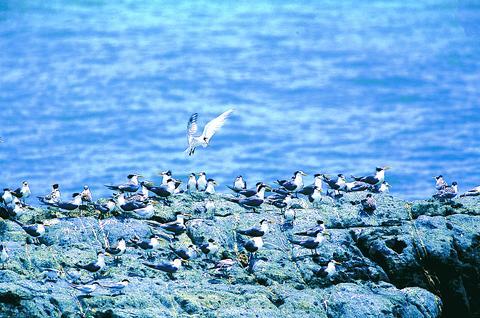
"Our coast guard regularly have the fishermen steered away from the islands," Chang said.
Occasionally, however, Chinese fishermen disembark from their boats to pick tern eggs in the conservation area. Tern eggs are far from a delicacy, but are precious food for destitute fishermen.
"It's hard to stem the onslaught of egg-pickers because our coast guard needs over an hour to get to the area, while fishermen can reach the area within 30 minutes from the fishing towns," Chang said.
According to a regional newspaper, the Matsu Daily (馬祖日報), coast guard has driven away 363 Chinese fishing boats from the conservation area, since May. In June, the number of crested terns on the islets was found to drop by half compared with previous years. The coast guard later found two fishing boats and the fishermen admitted picking eggs on the islands despite the annual May to September ban on fishing which the Chinese government had imposed.
Since then, the number has risen to the normal level of around 7,000, according to the Construction Bureau.
"Chinese crested terns, as well as other crested terns, are extremely sensitive. If they see humans on their habitat before the breeding season, they will flee and never come back. Therefore we have to refrain from doing anything that risks the slightest disturbance to them," Chang said.
This makes filming them a tough job. Liang said that keeping a long distance from the Chinese crested tern was the greatest obstacle to making The Bird of Myth. He said the film was the most difficult documentary to make in the 14 years he has been doing so.
"Filming on the desert island was hard enough because of its rugged topography. Setting up equipment was a major problem," Liang said.
The weather was hostile too. He had to wait for long stretches of time for the waves to calm down enough for boat trips to the islets. "I had to film them from a great distance. ... I had to be as careful as possible. Usually I stayed at a 40m to 50m distance. Considering the islets are tiny, finding a location for the camera was extremely difficult. Sometimes the terns lay eggs right under a cliff, so that even though I can see them with my eyes, I can't set my camera on them," Liang said.
Most of his time in the conservation area, he said, was spent locating the birds.
"I really understand now why they call it the mythical bird. Most often, people trying to find this rare bird will not succeed. The bird is too elusive. They can only hope they will some day come across them," Liang said.
After first catching one tern on film in 2000, Liang returned in 2001, hoping to find more, but found none. Only last summer did he spot the tern again. This time, there were three couples. A closer examination of their nests was difficult and Liang could only guess that the pairs had successfully bred three young birds.
Liang recalled the surprise when he found the tern. "I was glancing through a pile of footage when I noticed that one bird was slightly different from the rest. So I looked up some information material and found that it might have been the `mythical bird.' But I also knew it was thought to be extinct. Only after I consulted Academia Sinica was I sure that I had found an almost extinct species. At first I couldn't believe it, but it was so great to be the first to come across something so rare. I was so happy, and I'm still so happy now," Liang said. "This is a once-in-a-lifetime occurrence."
Even so, Liang was also first the first in Taiwan to discover wild bird species previously thought to exist only abroad, such as the tristram bunting and oriental plover.
"Finding these birds was important because it shows that Taiwan's wild bird resources are actually larger [than expected] or are becoming large. But finding Chinese crested terns was more significant because you can't find them elsewhere," Liang said.
Discovery channel
He said he expected that more people will discover wild birds unknown to the country. "I'm sure that new discoveries of wild birds will happen more often because the bird-watching population is continuously on the increase."
Bird-watching has been a burgeoning form of tourism in Matsu since the establishment of the conservation area. In the past four years since the National Matsu Scenic Area Administration(
"Transportation hassles in touring out-lying islands naturally prohibited some people. Although we would like the tourism in Matsu to make progress, too many tourists can be a burden on ecology. We do not want that," Chang said.
"Our goals are conservation. While eco-tourism may help public knowledge of rare species, rushing in too many people in a short time ... is not the way to do things. We still find tourists littering or feeding the fish. Although tourists are fenced off from the birds, their noisy chattering can be heard from afar."
The top priority at present is new research on the bird, which the county government is working on. "We hope that when the Chinese crested tern comes here next summer, we'll have a special team to study them so that people can know the bird better," Chang said.

In late October of 1873 the government of Japan decided against sending a military expedition to Korea to force that nation to open trade relations. Across the government supporters of the expedition resigned immediately. The spectacle of revolt by disaffected samurai began to loom over Japanese politics. In January of 1874 disaffected samurai attacked a senior minister in Tokyo. A month later, a group of pro-Korea expedition and anti-foreign elements from Saga prefecture in Kyushu revolted, driven in part by high food prices stemming from poor harvests. Their leader, according to Edward Drea’s classic Japan’s Imperial Army, was a samurai

The following three paragraphs are just some of what the local Chinese-language press is reporting on breathlessly and following every twist and turn with the eagerness of a soap opera fan. For many English-language readers, it probably comes across as incomprehensibly opaque, so bear with me briefly dear reader: To the surprise of many, former pop singer and Democratic Progressive Party (DPP) ex-lawmaker Yu Tien (余天) of the Taiwan Normal Country Promotion Association (TNCPA) at the last minute dropped out of the running for committee chair of the DPP’s New Taipei City chapter, paving the way for DPP legislator Su

It’s hard to know where to begin with Mark Tovell’s Taiwan: Roads Above the Clouds. Having published a travelogue myself, as well as having contributed to several guidebooks, at first glance Tovell’s book appears to inhabit a middle ground — the kind of hard-to-sell nowheresville publishers detest. Leaf through the pages and you’ll find them suffuse with the purple prose best associated with travel literature: “When the sun is low on a warm, clear morning, and with the heat already rising, we stand at the riverside bike path leading south from Sanxia’s old cobble streets.” Hardly the stuff of your

Located down a sideroad in old Wanhua District (萬華區), Waley Art (水谷藝術) has an established reputation for curating some of the more provocative indie art exhibitions in Taipei. And this month is no exception. Beyond the innocuous facade of a shophouse, the full three stories of the gallery space (including the basement) have been taken over by photographs, installation videos and abstract images courtesy of two creatives who hail from the opposite ends of the earth, Taiwan’s Hsu Yi-ting (許懿婷) and Germany’s Benjamin Janzen. “In 2019, I had an art residency in Europe,” Hsu says. “I met Benjamin in the lobby


 RSS
RSS