


This should give you an idea about how clear a director's vision can be," the film producer Gale Anne Hurd said as she pulled a small painting off a shelf in her Beverly Hills office one day last week.
There, airbrushed in muted shades of brown and black, was Arnold Schwarzenegger as the title character in The Terminator, one red eye glowing as half his scalp had been peeled away to expose a metal plate underneath. The image, a conceptual rendering for use by the makeup and costume designers, was painted more than 20 years ago by her husband at the time, James Cameron, who co-wrote the 1984 Schwarzenegger science fiction epic with Hurd and directed it.

PHOTO: NY TIMES
Cameron moved on to other spouses and other films, including the 1997 blockbuster Titanic. But Hurd is still specializing in science fiction action spectacles like Hulk, which opens in Taiwan next weekend. Special effects, though, have come a long way.
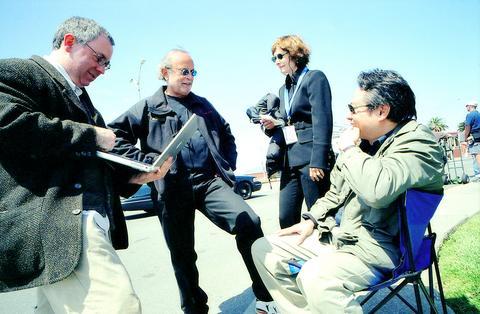
PHOTO: NY TIMES
Bruce Banner, the film's protagonist, turns from an impassive scientist, when threatened, into an angry green monster. And rather than airbrush renderings, the monster was created solely on a computer. Long before filming began, the movie's director, Ang Lee, donned an electronic suit and acted out a number of scenes to provide the basis for what became the on-screen character, Hurd explained.
"With Jim, he had to draw," recalled Hurd, one of four producers on Hulk. Lee, on the other hand, had "the opportunity to make anything he can imagine in his mind real," she said.
Even as filmmaking technology has evolved, though, Hurd's interest in movie storytelling has been consistent throughout her producing career, which has focused on the supernatural and the fantastic, including the outer-space horror film, Aliens (1986), the undersea adventure, The Abyss (1989), and the earth-threatening asteroid spectacle, Armageddon (1998), on which she was one of three producers.
Only with rare exception does she stray from this path, as with the 1999 wacky comedy, Dick, a film she produced about a teenage girl with a crush on President Richard M. Nixon during the Watergate period.
"It's arrested development," said Hurd, who is 47. "You have to go back to the literature that consumed me as a child." That would include the Lord of the Rings trilogy, Ursula K. Le Guin's Wizard of Earthsea fantasy series and action hero comic books like Hulk, Spider-Man and the Fantastic Four."
"I liked books that took me places," she said. "I liked being transported."
As a result, she has been willing to exercise enormous patience in waiting for her projects to hit the screen. Hulk, she explained, was initially set up with Universal Studios in 1991. And the third installment of the Terminator series, Terminator 3: Rise of the Machines, of which she is an executive producer, is due in theaters next month -- 12 years after Terminator 2 and 19 years after the original.
"Perhaps the lesson in Hollywood I should have learned is not to resist, that when the wind is blowing in one direction you go with it," she said. But after pondering the notion, she added, "I don't want to learn that lesson."
Hurd was born in 1955 and graduated from Palm Springs High School in 1973 before heading off to Stanford, where she graduated Phi Beta Kappa four years later with majors in communications and economics.
She started in the industry working for Roger Corman, the B-movie maker, through whom she met Cameron. They were married for three years, but even after the divorce they collaborated on several films, including The Abyss.
Hurd's business and personal life are seldom separate. She is now married for her fourth time, to Jonathan Hensleigh, who is a screenwriter and will direct the crime thriller The Punisher, which Hurd is producing. (She met Hensleigh before they started working together, she said.)
One of her other former husbands is the director Brian De Palma, with whom she shares custody of their 11-year-old daughter, Lolita, who is named for Hurd's mother.
Hurd and De Palma met in 1990, when she invited him to dinner to try to persuade him, without success, to direct a film she wanted to make.
In all, she has produced 28 films for, among other studios, Universal Pictures, 20th Century Fox and Paramount Pictures.
"She has been down so many roads so many times that nothing fazes her," said Mary Parent, the president of production at Universal Pictures. "It's all in a day's work."
Hurd says it would be difficult to get a movie like The Terminator made today. "They would think of it as an US$80 million film -- not a US$6.4 million film, which is about what it cost," Hurd said. "With a first-time producer and director" -- as she and Cameron were then -- "it would be much harder to get people to believe we could do it."
And audiences and studio executives have grown to expect flashier, more spectacular special effects. She attributes that partly to the proliferation of video games and the stylized editing popularized in music videos on MTV, which she said, has left moviegoers wanting a more vivid experience.
"The intensity has changed the tone and the type of movies which get made," she said of today, compared with the early 1980s, when The Terminator was released. "The bar has been raised higher than ever, so even though the special effects hold up for its time, those effects would not have been good enough today."
But technology has also proved a threat to the studios, as it has gotten easier to appropriate those images and circulate them on the Internet. Recently, an early version of Hulk began circulating online, and several people who saw it panned the computer-generated image of the angry monster, saying it was too cartoonlike.
"The problem is, it is more difficult for us to safeguard prints," Hurd said. With digital editing and distribution, copies can too easily be siphoned off the network stream. "With anticipated films," she said, "this is going to happen a lot."
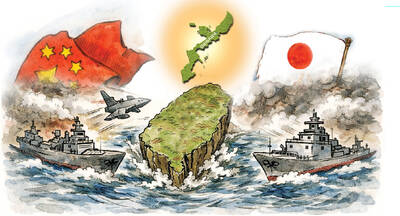
Beijing’s ironic, abusive tantrums aimed at Japan since Japanese Prime Minister Sanae Takaichi publicly stated that a Taiwan contingency would be an existential crisis for Japan, have revealed for all the world to see that the People’s Republic of China (PRC) lusts after Okinawa. We all owe Takaichi a debt of thanks for getting the PRC to make that public. The PRC and its netizens, taking their cue from the Chinese Communist Party (CCP), are presenting Okinawa by mirroring the claims about Taiwan. Official PRC propaganda organs began to wax lyrical about Okinawa’s “unsettled status” beginning last month. A Global

Dec. 22 to Dec. 28 About 200 years ago, a Taoist statue drifted down the Guizikeng River (貴子坑) and was retrieved by a resident of the Indigenous settlement of Kipatauw. Decades later, in the late 1800s, it’s said that a descendant of the original caretaker suddenly entered into a trance and identified the statue as a Wangye (Royal Lord) deity surnamed Chi (池府王爺). Lord Chi is widely revered across Taiwan for his healing powers, and following this revelation, some members of the Pan (潘) family began worshipping the deity. The century that followed was marked by repeated forced displacement and marginalization of

Music played in a wedding hall in western Japan as Yurina Noguchi, wearing a white gown and tiara, dabbed away tears, taking in the words of her husband-to-be: an AI-generated persona gazing out from a smartphone screen. “At first, Klaus was just someone to talk with, but we gradually became closer,” said the 32-year-old call center operator, referring to the artificial intelligence persona. “I started to have feelings for Klaus. We started dating and after a while he proposed to me. I accepted, and now we’re a couple.” Many in Japan, the birthplace of anime, have shown extreme devotion to fictional characters and

Youngdoung Tenzin is living history of modern Tibet. The Chinese government on Dec. 22 last year sanctioned him along with 19 other Canadians who were associated with the Canada Tibet Committee and the Uighur Rights Advocacy Project. A former political chair of the Canadian Tibetan Association of Ontario and community outreach manager for the Canada Tibet Committee, he is now a lecturer and researcher in Environmental Chemistry at the University of Toronto. “I was born into a nomadic Tibetan family in Tibet,” he says. “I came to India in 1999, when I was 11. I even met [His Holiness] the 14th the Dalai


 RSS
RSS