


Talk about performance anxiety.
It would be enough, one might think, to ask Le Le and Ya Ya, the two giant pandas who arrived to a delirious welcome at the zoo here a few weeks ago, to defy the spotty history of panda pregnancies in America and do what is supposed to come naturally.
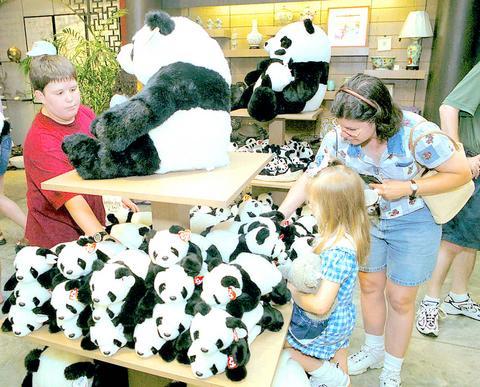
PHOTO: NY TIMES
Should the pandas perform, they could also make history: only one giant panda cub has been born and survived in captivity in the US -- Hua Mei, a female born in 1999 at the San Diego Zoo -- and she was conceived through artificial insemination.
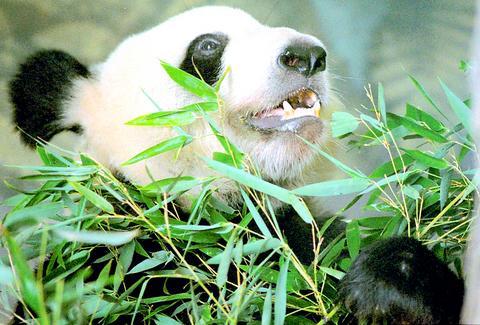
PHOTO: NY TIMES
Memphis, however, has even bigger hopes for its panda pair: a giant lift for its civic self-image on the order of securing another sports franchise and an infusion of cash from tourists eager to see the bamboo-gobbling pandas cavort in between their famously frequent snoozes.
"We need them to be healthy and active, and do their thing by bringing in people," said Karl A. Schledwitz, a politically connected zoo board member who came up with the idea of luring pandas to Memphis in 1996. "It's very important."
How important? A University of Memphis economist -- hired by the zoo, of course -- estimated that the two pandas could be responsible for upward of US$1.3 billion in added spending at local hotels, restaurants and other attractions, US$400 million in extra income, 23,000 new jobs and US$87 million in tax revenue.
Emphasis on the "could."
Yet to judge from the throngs of eager oglers at the zoo on Wednesday despite a downpour, the panda payday may not be entirely pie-in-the-sky.
As Le Le and Ya Ya lolled, taking turns playing with their trainers in exchange for bamboo leaves and grain-meal-and-apple mush treats, Suzanne Martin, 43, had her 3-year-old daughter, Grace, and another girl in tow. It was the other way around, really: Grace and her friend dashed back and forth from the glass-walled, air-conditioned apartments where the pandas had sought refuge to the carousel with a Chinese theme to the gift shop packed with stuffed pandas.
"They both know they're adopted from China," Martin, a Memphis resident, said of the two girls, "and they keep saying, `The pandas come from China like us,' so we keep coming back." This was their third trip.
In truth, this city caught panda fever years before the animals arrived. The zoo's former director, Roger Knox, suggested somewhat hyperbolically in 2000 that obtaining pandas from China could be "on the same level as getting an NFL team."
Knox, who was in the throes of raising money for the panda project, knew how to push his audience's buttons. Getting a professional football team has proven beyond Memphis' grasp in two tries, and remains a sore point for a city whose only major sports team is the Grizzlies of the NBA, late of Vancouver -- an import of somewhat lesser note.
Schledwitz, a real estate developer and associate of James R. Sasser, the Democrat and former senator who was named ambassador to China in 1995, headed the panda procurement effort after learning something from his friend about the delicate international politics involved.
Only about 1,000 pandas are believed to be in the wild in China, and no more than 110 are in zoos and nature centers around the world. In the US, there are three pandas at the San Diego Zoo, two at the National Zoo in Washington and two at Zoo Atlanta. Sojourns abroad are limited to 10 years, after which the coveted animals are returned to China. Several Chinese ministries must endorse a proposed loan, and in the end China's State Council must approve it.
The full-court diplomatic press that Memphis mounted included appeals from Bill Clinton and Al Gore, Senators Bill Frist and Fred Thompson of Tennessee, and Frederick K. Smith, the chairman of Federal Express, which has its headquarters locally.
Schledwitz said he also took a lesson from the city's ill-fated effort to obtain a football franchise. "I always felt, in hindsight, that had Memphis built a new football stadium as was requested, we'd have ended up with an NFL team," he said.
Indeed, the Memphis Zoo did not wait for the Chinese to approve its application before designing and building a US$15.5 million "China" exhibit, complete with pagodas, a crooked bridge and temperature-controlled artificial boulders to keep Le Le, 5, and his intended mate, 3-year-old Ya Ya, cool in the steamy Memphis summer and warm in the winter.
The investment paid off: Chinese diplomats who visited the zoo's new installation were impressed by the concern for authenticity, zoo officials said.
"They've done a phenomenal job," said David L. Towne, president of the Giant Panda Conservation Foundation. "It's a small zoo and a small community, but they really got behind this."
The city's unending push to become a "world-class city" took a leap forward on April 7, when the two pandas arrived aboard a specially decorated FedEx airliner to red-carpet treatment.
So far, zoo officials said, they could not be more pleased. In six weeks, attendance has jumped by 46 percent, and more than 150,000 people have paid an extra US$3 to see the pandas. The special fee helps defray a US$1.2 million annual payment to the Chinese government, and subsidizes other conservation programs including bamboo farms.
The impossible-to-miss gift shop at the end of the panda exhibit, meanwhile, has generated nearly US$300,000 more in that time, much of it for stuffed pandas, key rings, magnets and other trinkets that were made, appropriately enough, in China.
Hannah Purtle, 6, who had endured a two-hour car ride from Little Rock, Arkansas, was so moved by Ya Ya that she persuaded her parents to buy her a stuffed panda the same size as her well-worn koala. She instantly named it Cuddly and buried her blonde ringlets in its fur.
Despite the eye-catching economic impact projections and the buoyant early returns, the zoo's director, Charles Brady, said the zoo itself expects to lose a few million dollars on the pandas' 10-year stay in Memphis. Expenses -- not just bamboo, but salaries for four full-time zookeepers and two Chinese veterinarians -- will run about US$30 million. And after two years, Brady said, he expects the pandas' drawing power to fall off sharply.
Should nature take its course, however, the zoo could reap dividends, Schledwitz said. "There is pressure on them to perform," he said, "and certainly we're hoping down the road that they reproduce, because it'll be another wave of attention."
To that end, the zoo is exploiting the latest in panda procreation science -- a field that has seemingly tried everything, including hormone supplements for females, Viagra for males and videotapes of copulating pandas, generally with poor results.
Ya Ya is expected to reach sexual maturity later this year, meaning the earliest that she and Le Le could mate would be next spring, Brady said. He added that the zoo would give the pandas some time, perhaps two or three years, before resorting to artificial insemination.
Brady said he was loath to make any promises. After all, the pandas, who are from different parts of China, can smell and see each other through cage doors, but they have not been formally introduced yet.
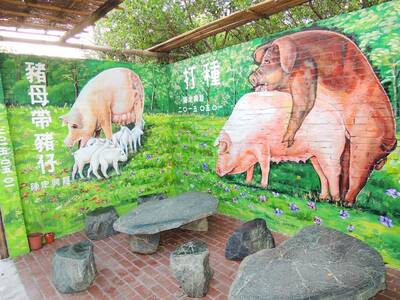
May 6 to May 12 Those who follow the Chinese-language news may have noticed the usage of the term zhuge (豬哥, literally ‘pig brother,’ a male pig raised for breeding purposes) in reports concerning the ongoing #Metoo scandal in the entertainment industry. The term’s modern connotations can range from womanizer or lecher to sexual predator, but it once referred to an important rural trade. Until the 1970s, it was a common sight to see a breeder herding a single “zhuge” down a rustic path with a bamboo whip, often traveling large distances over rugged terrain to service local families. Not only
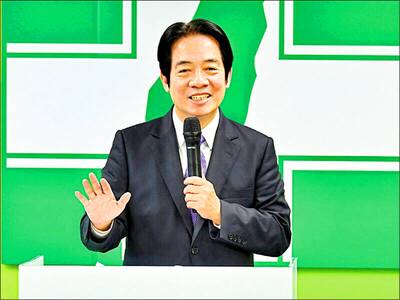
Ahead of incoming president William Lai’s (賴清德) inauguration on May 20 there appear to be signs that he is signaling to the Chinese Communist Party (CCP) and that the Chinese side is also signaling to the Taiwan side. This raises a lot of questions, including what is the CCP up to, who are they signaling to, what are they signaling, how with the various actors in Taiwan respond and where this could ultimately go. In the last column, published on May 2, we examined the curious case of Democratic Progressive Party (DPP) heavyweight Tseng Wen-tsan (鄭文燦) — currently vice premier
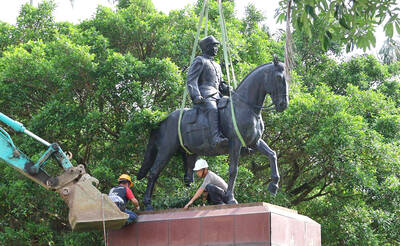
The last time Mrs Hsieh came to Cihu Park in Taoyuan was almost 50 years ago, on a school trip to the grave of Taiwan’s recently deceased dictator. Busloads of children were brought in to pay their respects to Chiang Kai-shek (蔣中正), known as Generalissimo, who had died at 87, after decades ruling Taiwan under brutal martial law. “There were a lot of buses, and there was a long queue,” Hsieh recalled. “It was a school rule. We had to bow, and then we went home.” Chiang’s body is still there, under guard in a mausoleum at the end of a path

Last week the Directorate-General of Budget, Accounting and Statistics (DGBAS) released a set of very strange numbers on Taiwan’s wealth distribution. Duly quoted in the Taipei Times, the report said that “The Gini coefficient for Taiwanese households… was 0.606 at the end of 2021, lower than Australia’s 0.611, the UK’s 0.620, Japan’s 0.678, France’s 0.676 and Germany’s 0.727, the agency said in a report.” The Gini coefficient is a measure of relative inequality, usually of wealth or income, though it can be used to evaluate other forms of inequality. However, for most nations it is a number from .25 to .50


 RSS
RSS