


Standing amidst the dilapidated buildings of the old Chiaotou Sugar Plant (橋頭糖廠), former employees recalled its past glory. "Sugar was the leading industry in Taiwan for decades. In the 1950s and 1960s, sugar was Taiwan's number one export, earning 74 percent of Taiwan's foreign currency revenues," said Chen Ming-fa (陳明發), once an executive at the plant. In 1998, Kaohsiung County government declared the old factory and its grounds a heritage site.
Although it was a bright and warm Saturday morning, the complex was virtually abandoned. The roughly 1,200-hectare field on Hsintang Road in Kaohsiung County's Chiaotou township (橋頭鄉) was host to a only a handful of elderly joggers, who all seemed to know each other. All were from Hsintang village (興糖村), which two years ago was incorporated into the neighboring village of Chiaonan (橋南村) because its population had declined to a mere 200 households.
Chen was one of a handful of former employees to remain in the nearby village of Hsintang (興糖村), which literally means "promoting sugar," after the sugar business fell on hard times in the 1980s and closed up shop for good in 1999.

PHOTO: VICO LEE, TAIPEI TIMES
If Kaohsiung City Government's Department of Rapid Transit (KMRT, 高雄市政府捷運工程局) has its way, this remnant of Taiwan's industrial history will soon become a station on the area's proposed rapid transit line. Two centuries-old camphor trees will be moved out of the way. And the complex's air-raid shelter, dormitory and temple, which date back to the mid-20th century, will be torn down.
In planning a station on a heritage site, the KMRT has unwittingly sparked a debate which pits it and many local residents against those interested in preserving the old sugar factory as a testimony of Taiwan's unique heritage.
The planned R22A station is to be the second-to-last stop on the northern end of the system's red line which crosses Kaohsiung, connecting Hsiaogang Airport and Kangshan Township. The KMRT claims the stop will bring jobs and revive sleepy Chiaotou township once it is completed at the end of 2006.
Not everyone is enthusiastic.
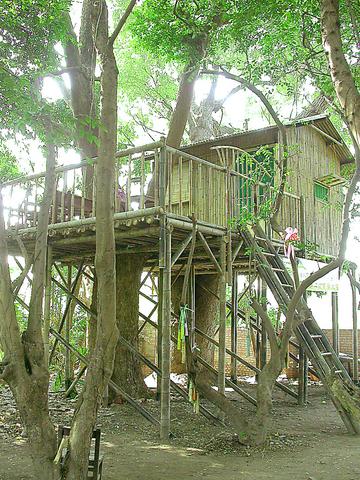
The Kio A Thau Culture Society (橋仔頭文史協會) launched a petition against the route's crossing the old sugar plant in late November, and gathered nearly 1,000 signatures in southern Taiwan. But the petition, first sent to the KMRT and then to the Executive Yuan in late January, did not achieve the desired effect. In protest, the society built tree houses in the two camphor trees to prevent them from being transplanted.
Industrail heritage
Set up by the Japanese in 1901, Chiaotou Sugar Plant was the first modern sugar mill in Taiwan. State-of-the-art sugar manufacturing technology from Japan sparked a boom for the industry.
"We admit that a KMRT stop would help develop Chiaotou village economically, but the route does not have to run directly through the plant," said Chiang Yiao-hsian (蔣耀賢), chief executive of the Kio A Thau Culture Society in a interview that took place in one of the plant's former dorms.
"Every KMRT station is to be surround by parking lots and wide roads. Setting up a station inside the complex will affect not only the location of the planned station but a much larger portion of the heritage site as well," Chiang said.
Facing the sugar factory on the other side of the proposed KMRT line is a traditional market and an old neighborhood. Construction there would have a negative affect on property values, so "pressure from the residents will force the parking lots and other facilities for the proposed station to be built on the heritage site," Chiang predicted. "The plant doesn't protest. People do."
Chiang went on to compare the Chiaotou section of the KMRT with the Taipei MRT's Tamsui Station, the terminus of the Tamshui line. Tamshi's main attraction is its old quarter, a 10-minute walk from Tamsui Station.
Chiaotou's old streets are also its main attraction, and could connect Chiaotou train station and the sugar plant. "The stop shouldn't be built at the sugar plant. ... If we were to build a big station to replace the historical site, what would visitors want to see here?" Chiang asked.
The KMRT's red line was planned back in 1994, well before the sugar plant was declared a heritage site. And even though construction on the transit system only began in 2001, the route was not changed to comply with the new arrangement.
"If the best-planned, most well preserved of Taiwan's 42 sugar plants is treated like this, how can we show people the most important episode in Taiwan's industrial development?" Chiang asked.
In an email, KMRT said it is sticking to the proposed route because it passes through vacant land. Over 70 percent of the land earmarked for the station belongs to Taiwan Sugar Corporation, who has agreed to the project. The rest belongs to the Chiaotou village office and residents.
Development first
Residents of the old neighborhood two blocks away from the sugar plant did not know about the KMRT's plans until six months ago, when the Kio A Thau Cultural Society distributed protest flyers. Lin Bo-chen (林伯政), Chiaonan village chief, who lives near the site of the proposed station, said he wouldn't mind trains passing near his house.
"There were only a small number of scholars who protested against the route. Most residents don't mind. After all, we are talking about dilapidated dormitories and abandoned air-raid shelters here," Lin said.
Other residents felt even less sorrow over the imminent loss of part of the heritage site.
"Good. That's good. It's surely a good thing," said Lee, an employee at a lottery shop. His response was typical of local residents, who downplayed the significance of the sugar plant. "Even if the MRT passed by my front door, I'd welcome it," he said.
The violation of the historical site was of no concern to him or his co-worker, although they discussed the issue at length with two customers and a middle-aged neighbor. The only thing they could remember about the plant was who had built it.
"It was built by the Japanese, not us Taiwanese. The factory was part of Japan's colonization of Taiwan. It's not something to preserve and feel proud about. Just tear it down," said one customer.
"If you say these are heritage sites, what about the Forbidden City in China? It's not like the plant is 300 years old," another customer chimed in. "What do we do with heritage sites? We want development," Lee concluded.
While he admitted that the route could have avoided the heritage site, the Chiaotou township commissioner was of a similar opinion -- that economic prosperity trumps everything else. "If the route goes through the town's center [which the society suggested] there would be strong opposition ... and we'd never see the KMRT operate," said Lu An-min,Chiaotou village commissioner.
According to many of the conservationists who signed the petition in November and continued to lobby for their cause, the residents may not know what is really at stake. The significance of the factory complex lies in part in its garden city space planning, in which factory employees were housed inside a factory complex where they enjoyed all the necessary amenities. At the turn of the 20th century, the Japanese decided to use the sugar plant as an experiment in social welfare.
"It is interesting that, under a colonial regime, Taiwan was at the forefront of the welfare trend. Whether you like the Japanese or not, it was part of Taiwan's past," said Tzeng Tzi-feng (曾子峰), dean of the graduate school of urban development and architecture at Kaohsiung University and a signatory of the petition. "With globalization, it's not commercial development but the preservation of local specialties that will make Chiaotou a more appealing place."
"History and geography courses in schools have made Taiwanese feel little for their hometowns," said Fu Chi-nan (傅志男), chief executive of the Kaohsiung City teachers' association's ecology education center and another signatory. "The site is not just composed of old trees and buildings, it signifies a unique period in industrial history and culture. It's sad that people make light of these things," Fu said.
Days before the Lunar New Year holiday, the society was told by the KMRT to tear down its tree houses. Members of the society refused.


Taiwan’s English education system is being pulled apart by three opposing forces. Bilingual Nation 2030 pulls students toward English and global communication. Artificial Intelligence (AI) readiness pulls them toward digital judgment, verification and AI-mediated work. But Taiwan’s old exam culture pulls them back toward memorization, grammar drills, timed reading and correct answers. If the education system keeps using old exams to define success, it risks producing graduates who are neither genuinely bilingual nor genuinely AI-ready, but trained for tasks machines can already perform. The first force is Bilingual Nation 2030. Launched in 2018, the policy aimed to “help Taiwan’s workforce connect

“Taiwan’s Opposition Leader Comes to US With a Message Straight Out of Beijing” read a May 31 headline in the Wall Street Journal. Top US administration officials and members of Congress almost certainly read the WSJ, and if there was a bullet point takeaway that people in Washington should absorb ahead of Chinese Nationalist Party (KMT) Chair Cheng Li-wun’s (鄭麗文) arrival in DC on June 9, that headline is it. The last few columns have discussed this very topic, and the timing is not coincidental. While those top officials likely do not read the Taipei Times, judging by the number
With weighty, anxiety-inducing geopolitical topics dominating the headlines, checking in on the wild and weird state of local politics can take some of the edge off. This November’s elections will determine who will be in charge of fixing potholes in your neighborhood, not the potholes in Taiwan’s complicated geopolitical space. Recently, after an online interview with a Taipei-based journalist, I commented that Taipei journalists never go further than the MRT can take them. He laughed and agreed. Naturally, the Taipei mayoral race is eating up much of the press attention. TAIPEI CITY Democratic Progressive Party (DPP) candidate Puma Shen (沈伯洋) has
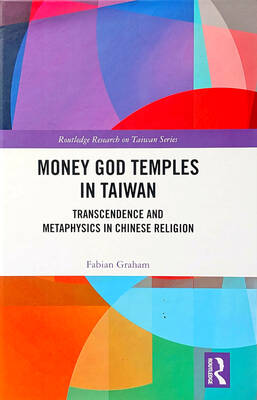
As someone who normally steers clear of books with “transcendence” or “metaphysics” in their subtitles, this reviewer — a casual observer of local belief systems since the 1990s — found Fabian Graham’s Money God Temples in Taiwan a challenging read. Those who’ve only dipped their toes into temple culture will likely need to parse several sections with special care if they’re to keep up with the author, a British ethnographic researcher whose previous books have investigated religious practices among ethnic Chinese in Southeast Asia. This scholarly volume examines a facet of Taiwan’s religious landscape that didn’t exist a century ago, and


 RSS
RSS