


French novelist Michel Houellebecq has recently caused a stir in the UK with the English publication of his novel Platform in which a travel agency specializing in sex tours to Thailand is enthusiastically described. We will review this as soon as it arrives in Taiwan. Meanwhile, this important earlier novel is selling well at FNAC outlets in Taipei, as is, apparently, the French edition of Platform.
The pages of Atomised alternate between near-impenetrable accounts of the latest discoveries in astrophysics and descriptions of sexual orgies in "couples' clubs," on nudist beaches, and in New Age hideaways in the south of France.
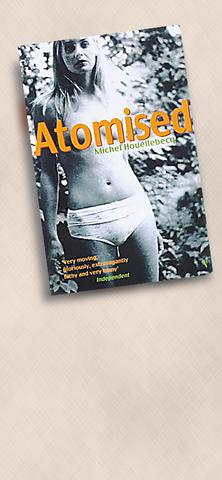
Behind the novel lies a thesis. A huge shift took place, the author argues, in the early 1970s. Before that we had a culture of romantic love, marriage, and the avoidance of any fear of death by belief in an afterlife. Now we have a situation characterized by temporary relationships or emotionless sexual encounters, with nothing to console us as death approaches. Houellebecq sees this as a massive change, equal in importance to the birth of Christianity, or the Scientific Revolution.
His portrayal of the world of modern France is chilling, even terrifying. It's a world where women are alone once their sexual allure fades, social contact is minimal, and few children have fathers (but biology doesn't recognize the idea of paternal love, he claims).
For men, too, life becomes increasingly empty. In this world of dazzling white shopping malls, towering apartment blocks, Internet chat rooms, and a wistfully beautiful -- but empty -- countryside, the future holds nothing except death, now seen simply as physical obliteration.
The young are displayed as understanding the new situation early. They enter the sexual world immediately, at puberty. In one scene a teacher called Bruno masturbates in wild frustration behind his desk as he watches two 13-year-old students feeling each other's bodies while sharing a book in his classroom. After school they use the Durex-dispensing machine quite openly in front of him, and he goes off home to immerse himself in alcohol, but not before exhibiting himself to a young girl in a spell of after-hours private tuition.
Bruno has a half brother, Miles. Both are the offspring of parents who embraced the 1960s sexual revolution, and, in Houellebecq's view, both are traumatized as a result. Miles reacts by becoming a recluse, researching at the frontiers of molecular biology, and ends up making a discovery that will allow humans to control evolution, including their own, in an EU-financed laboratory in remote western Ireland.
What both brothers lack is an ability to create loving relationships. But there's no turning back the clock. So -- is there a route out of this situation? Atomised suggests some possibilities -- Tibetan Buddhism, perhaps, or the mystical world represented by the ancient Irish illustrated manuscript The Book of Kells. But for the time being we are stuck with the stark, shadowless world of modern sexuality, and everything that follows from it.
This is not a very accomplished novel in the traditional sense. In places it feels as pasted together and haphazard (and as pornographic) as William Burrough's The Naked Lunch. Elsewhere it's more like an annotated tract. It's essentially a meditation on sex and death, with an appended vision of genetic engineering.
Houellebecq (pronounced "Welbeck," or "near enough") is, according to some sources, a depressive, even disturbed, figure. He has hair implants, and lives as a recluse on an island off the coast of Ireland. Born on the Ile de la Reunion, near Mauritius, he was neglected by his parents, brought up by his grandmother, and attended the same school his characters attend in the novel. This book thus appears a mixture of hellish autobiography, dense intellectuality, and manic erotic fantasy.
Houellebecq owes a lot to Aldous Huxley's Brave New World (1932) and Henri Barbusse's L'Enfer (1908). He discusses the former at length. Its vision of a society in which sexuality and reproduction are separate anticipates the coda that ends Atomised. There, a being of the future looks back on mankind, and on the violence-free race with an enhanced capacity for sexual pleasure that has largely replaced it, following Miles' groundbreaking work in eugenics.
Barbusse's book is also a clear influence, though Houellebecq doesn't mention it. In that novel the narrator watches a couple making love through a hole in a hotel bedroom wall, and there is also a protracted description of how corpses disintegrate with the help of a sequence of carrion-eating maggots. Both elements make a strong re-appearance in Atomised.
The book's title derives from sociology's conception of an "atomized" society in which everyone is alone, and family bonds, considered boring and artificial, have completely broken down.
Progressive liberals have hated this book, and they've hated Platform even more. Houellebecq even may be in need of police protection from angry Muslims after Platform, and here he takes the view that biology doesn't support the assumption that people, especially men, can be taught to be selfless and cooperative, the basis on which most democratic ideas rest. Neither book, then, endears him to the political mainstream.
But it's the sex that will draw many people to Atomised. It is very explicit, but the descriptions, because they're mostly of brief and unthinking acts, are strangely unemotional, typical of wounded and neurotic dispositions. Even so, semen marks these pages as lakes and mountains do the poetry of Wordsworth. This is post-porn-site literature, and readers are not expected to be shocked by anything.
What, then, are we to say about Houellebecq's hypothesis?
First, that dramatic dividing lines in history are attractive to minds subject to visions of apocalypse. Reality exhibits subtler modulations, often technological changes that merely give the illusion of novelty.
Second, debauched lifestyles have been seen in earlier times, usually in large cities and among the wealthy. Elsewhere life went on much as before.
Thirdly, many adolescents have probably always practiced a free-and-easy sex life, then settled down to more traditional ways. And lastly, the lives of French intellectuals aren't those of the rest of the world, or what the rest of the world will imitate.
It's true Houellebecq's two sexual systems can be seen in Taiwan's cities, but the "liberated" way has not come with any relaxation of religious and family codes.
The translation of Atomised, by Frank Wynne, is everywhere excellent. Equally at home whether the text is colloquial or poetic, pornographic, scientific or prophetic, he allows nothing to faze him.
This, then, is an intriguing publication, but not one to be intimidated by. The fuller implications of the author's outlook should be made clearer in Platform.

In late October of 1873 the government of Japan decided against sending a military expedition to Korea to force that nation to open trade relations. Across the government supporters of the expedition resigned immediately. The spectacle of revolt by disaffected samurai began to loom over Japanese politics. In January of 1874 disaffected samurai attacked a senior minister in Tokyo. A month later, a group of pro-Korea expedition and anti-foreign elements from Saga prefecture in Kyushu revolted, driven in part by high food prices stemming from poor harvests. Their leader, according to Edward Drea’s classic Japan’s Imperial Army, was a samurai

The following three paragraphs are just some of what the local Chinese-language press is reporting on breathlessly and following every twist and turn with the eagerness of a soap opera fan. For many English-language readers, it probably comes across as incomprehensibly opaque, so bear with me briefly dear reader: To the surprise of many, former pop singer and Democratic Progressive Party (DPP) ex-lawmaker Yu Tien (余天) of the Taiwan Normal Country Promotion Association (TNCPA) at the last minute dropped out of the running for committee chair of the DPP’s New Taipei City chapter, paving the way for DPP legislator Su
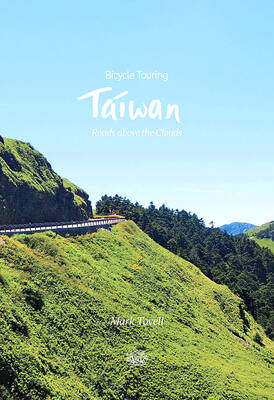
It’s hard to know where to begin with Mark Tovell’s Taiwan: Roads Above the Clouds. Having published a travelogue myself, as well as having contributed to several guidebooks, at first glance Tovell’s book appears to inhabit a middle ground — the kind of hard-to-sell nowheresville publishers detest. Leaf through the pages and you’ll find them suffuse with the purple prose best associated with travel literature: “When the sun is low on a warm, clear morning, and with the heat already rising, we stand at the riverside bike path leading south from Sanxia’s old cobble streets.” Hardly the stuff of your

Located down a sideroad in old Wanhua District (萬華區), Waley Art (水谷藝術) has an established reputation for curating some of the more provocative indie art exhibitions in Taipei. And this month is no exception. Beyond the innocuous facade of a shophouse, the full three stories of the gallery space (including the basement) have been taken over by photographs, installation videos and abstract images courtesy of two creatives who hail from the opposite ends of the earth, Taiwan’s Hsu Yi-ting (許懿婷) and Germany’s Benjamin Janzen. “In 2019, I had an art residency in Europe,” Hsu says. “I met Benjamin in the lobby


 RSS
RSS