


One damp night in January last year, a Taiwanese man we will call Jonas, then a 28-year-old sound engineer, was stopped at a roadside police check while riding on the back of a friend's scooter. It was fairly late and the officers suspected them of being drunk, so they asked to search the vehicle. When they did, they found a pipe used for smoking marijuana with traces of the drug inside, and Jonah took responsibility. It was enough reason to take him back to the police station and demand a urine sample. Half a day later, Jonas found himself on a bus headed from the police station to the Tucheng Corrections Center (土城觀察勒戒所), a special jail for the rehabilitation of drug users.
"I smoke pot and I'd done some other stuff, but not like the guys inside. They were all there for heroin, except two guys who were in for acid -- and they were bragging about it. There were only a few for marijuana," he said.
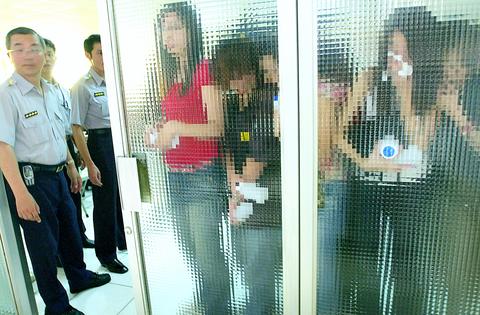
Cases like Jonas' have become more common over the past two years since the government has engaged in a full scale war against the drug MDMA, better known as ecstasy, along with other drugs of the nightlife scene, like marijuana and ketamine. The most publicized detention so far has been that of Hong Kong crooner William So (蘇永康), who entered Tucheng nine days ago after testing positive for MDMA in a June police raid of a Taipei nightclub.
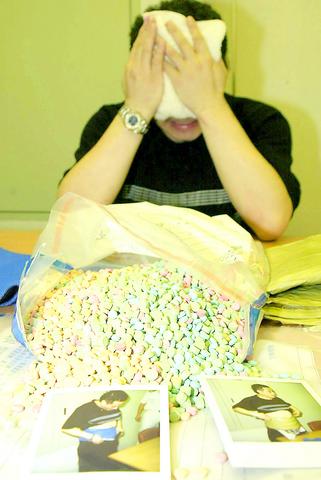
TAIPEI TIMES FILE PHOTOS
The detentions of both Jonas and So are a result of a national drug policy that focuses mainly on drug users over dealers, manufacturers or smugglers. Last year enforcement agencies sent more than 22,000 users, including Jonas, for 15 to 30-day stays at correction centers all over Taiwan. Over the last two years, the policy has specially targeted ecstasy, and sweeps looking for the drug's users have led to increased use of certain enforcement tactics, including mass screenings of suspected drug users for both drug use and HIV, that some feel are in violation of civil rights.
To pick out users, police have resorted to screening suspected drug users through urine tests and, at least in parts of Taipei, blood tests that look for both drugs and HIV. While the legality of urine tests is debatable, the police's authority to screen for HIV could only be described by John Chang (張進豐), chief prosecutor of Taoyuan County, as an "administrative decision that is something separate from the law."
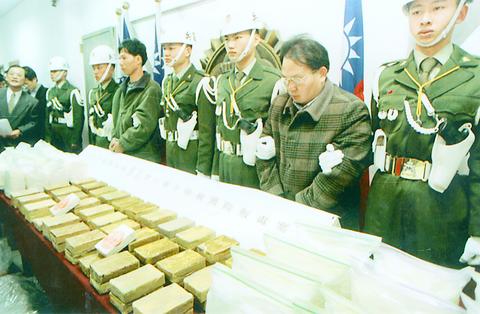
TAIPEI TIMES FILE PHOTO
"Do you want to protect human rights or protect health? This is the problem under consideration," said Ou Nai-ming (歐乃銘), head of an AIDS section at the national Center for Disease Control (CDC). In April and May of this year, his section worked with the National Police Administration and Taipei City's Bureau of Health to come up with a plan that has resulted in HIV screening of suspected drug users throughout the summer. Generally, the suspects are picked up in raids on nightclubs where drugs are discovered, and the CDC uses the data to formulate recommendations on AIDS prevention policy.
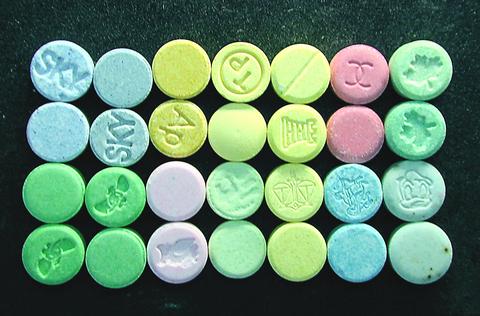
PHOTO COURTESY OF NBCD
However according to Li Jih-heng (李志恆), director-general of the National Bureau of Controlled Drugs (NBCD), the blood tests are not strictly legal. He says that Taiwan's Statute on AIDS Prevention and Treatment (愛茲病防治條例) says that "it must be completely determined that the person is a drug user" before he or she can be made to test for HIV. But what the police are doing now is testing suspects. "Legally, this doesn't really stand up. It would be better to first determine whether a person uses drugs, then do it [test for HIV]. ... If the [urine] test is positive [for drugs], then you can do a blood test," he said.
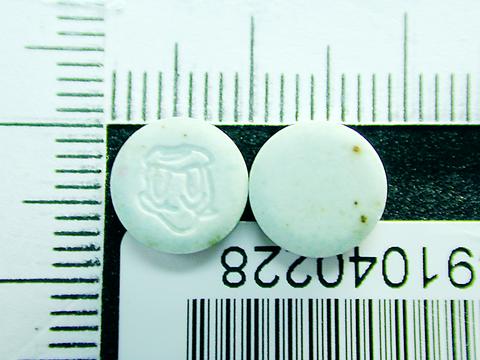
Urine tests have been more common. In June, police throughout Taiwan collected 4,705 urine samples from suspected drug users, of which 558 came back positive for MDMA. Such testing is supported in certain situations by law. The Statute for Narcotics Hazard Control, Taiwan's major law addressing illegal drugs, states that those found to be drug users can be made to provide urine samples, while other laws allow that urine tests can be demanded when there is sufficient evidence to create suspicion.
"The law is not clear in this area [of `suspicion'], but I think that if the police do not find drugs or evidence of drugs on a person or in his belongings, the person can refuse the test," Chang said.
In recent months, many enforcement authorities have adopted interpretations similar to Chang's, but not all. "Different judges might make different rulings on this," said Chang. "It's on a case-by-case basis."
In Jonas' case, possession of drug paraphernalia gave police enough suspicion to demand a urine test. It resulted in his being processed into the Tucheng Corrections Center, where he was first stripped and searched, then given a second urine test and put into a large cell with more than a dozen other new arrivals.
"There were no beds, you just sleep on the floor. In the daytime, you aren't allowed to lie down, but you can't move around very much because it's too crowded in there. If you want anything, like a blanket, you have to buy it," he said.
"After a week, they transferred me, and because my family paid an extra [NT$] five thousand, they put me in a `VIP' room on the third floor. There you had a lot more chances to buy things from the guards, like a Walkman or an electric fan, but it was expensive. One guy had a small TV, and we even had one cigarette lighter for our cell. Lighters or matches weren't allowed in most other cells, so they had this way of lighting cigarettes with [regular lead-acid] batteries."
"It was a weird experience to lose your freedom, and it was also strange because they would never tell you how long you were going to stay. Occasionally I would meet with some doctors, and they had the power to decide how long you stayed, but you'd only meet with them for a few minutes, and they'd ask really normal questions, like `How's your family situation?' or `Do you have a girlfriend?' Some people were really worried that they weren't going to get out. Other guys had been there for more than two months."
According to Taiwan's law, a drug user is considered a criminal. But to give users a chance to rehabilitate before being branded as full-fledged felons, the corrections center program was introduced in May of 1998. It uses a "three strikes" program which sends users for 15 to 30-day stays in corrections centers after their first two offences, though center officials admit that some inmates stay longer. On the third offence, a user will be indicted for drug abuse and, if found guilty, sentenced to prison.
Historically, the program fits into a drug intervention policy that has predominantly focused on drug users. According to Wang Chih-chao, a detective with the Criminal Investigations Bureau, the general practice is to "start with the user, asking them where they got their drugs. From there we trace the network up."
In 2001, Taiwan's courts handed back 13,511 guilty verdicts for drug crimes. Of the total, 11,399 were for "pure abuse," a crime that involves using illegal drugs only, and 7,209 were for "abuse" of class 2 drugs, a category including amphetamines, MDMA and marijuana. The 2,112 convictions in 2001 that weren't for abuse, included possession, sales and transport of illegal drugs.
From a prosecutor's perspective, Chang says the kinds of drug cases coming through the courts have been changing. "It used to be amphetamines, now it's MDMA, ketamine and some marijuana," he said.
At the NBCD, Li has also observed the trend, noting how marijuana has picked up slightly in recent years, and how MDMA seizures by police have grown from around 3kg in all of 2000 to 40.3kg in the first half of this year. "Ecstasy is a relatively new drug. It has only been in Taiwan three or four years and is growing rapidly, and what's worrisome is that it's attracting a new kind of user, especially students," he said.
A recent study by the Taipei City Psychiatric Center, which researches patterns of drug use and tests many of the urine samples collected by Taipei City Police, describes how ecstasy is attracting new groups of users. The study found that more women and more students are using ecstasy, each group accounting for approximately one-third of the sample. The study also showed that ecstasy users were almost exclusively unmarried and averaged 22 years of age, with a wider spread of users ranging between 16 and 37 years of age.
Moreover, "there is not much connection between groups of MDMA users and the more established amphetamines and heroin users. They tend to use daily and don't hang around in nightclubs. For example, people who smoke methamphetamines [also known as crystal meth, or ice] need a glass pipe, and you can't do that in a disco," Li said.
Police and politicians have reacted to this new, younger and more diverse crowd of drug users through raids on a massive scale. On one Saturday night in June, 6,263 police officers were mobilized to seek out ecstasy in more than 2,500 night spots throughout Taiwan.
Yet quantitatively, the amounts of MDMA turned up have been relatively small. The June raid turned up only 480 users and 354 pills, and the 40.3kg hauled in nationally between January and June of this year is still less than one-tenth the 422kg of amphetamines and one-eighth the 331kg of heroin collected by police in the same period.
Yet Li reiterates that "the problem with MDMA is that so many young people are using it, and that is worrying to a lot of parents." And Jonas, who has a 23-year-old little sister that recently finished college, agrees.
"In schools, if you're in some social groups, you have to use it, or you'll be excluded," he says. "And you can get it in every school, because there are always the gangsters there selling it. So I think it's good that they are cracking down, but I don't think they should be sending those kids into the Corrections Center. That's for real criminals."
His own stay there lasted 28 days, and though he continues to smoke marijuana, he has no intention of going back.
Taiwan's Top Drugs (based on police seizures from January through June 2002):
1. Amphetamines: 422,661g
2. Heroin: 331,681g
3. MDMA: 40,361g
4. Ketamine: 8,162g
5. Cannabis: 2,515g
History of police seizures of MDMA:
1998: 70g
1999: 3,250g
2000: 4,927g
2001: 44,650g
January-June 2002: 40,361g
History of police seizures of ketamine:
2000: -
2001: 9,540g
2002 (first six months): 8,162g
Results of urine tests given to suspected drug users from June 2002:
Total tests: 4,705
Positive for opiates: 929
Positive for amphetamines: 692
Positive for MDMA: 558
Types of drug cases in 2000:
Total cases: 49,797
Abuse only (ie, using drugs only): 40,700
Possession: 4,330
Sale: 3,524
Possession with intent to sell: 560
Importation or transportation: 129
Manufacture or cultivation: 27
Prison terms handed out for drug crimes in 2001:
Total guilty verdicts: 13,511
Less than 6 months: 41.87%
Less than 3 years: 93.1%
7 years or more: 4.1%
Death penalties for drug crimes from 1993 through 2001: 12 (1 in 2001)
Taiwan's Drug Laws
The Statute for Narcotics Hazard Control, last amended Jan. 23 of ths year by the Legislative Yuan, stands as Taiwan's major law dealing with drug related crimes. It divides narcotics into three schedules:
Schedule 1 lists nine drugs, including cocaine, morphine, heroin, opium and other opiates.
Schedule 2 lists 167 drugs, including various forms of marijuana, MDMA or ecstasy, amphetamines, methamphetamines, LSD, psylosibin mushrooms and others.
Schedule 3 lists 19 drugs, mostly prescription pain killers and muscle relaxers, including barbiturates, codeine and ketamine.
Penalties for selected drug crimes are as follows:
Manufacture, transport or sale:
Class 1 - Death or life imprisonment
Class 2 - 7 years to life
Class 3 - Minimum 5 years
Possession with intent to sell*:
Class 1 - 10 years to life
Class 2 - Minimum 5 years
Class 3 - 3 to 10 years
Possession*:
Class 1 - Maximum 3 years
Class 2 - Maximum 2 years
Class 3 - N/A
Cultivation of cannabis:
Class 1 - N/A
Class 2 - Minimum 5 years
Class 3 - N/A
Use**:
Class 1 - 6 months to 5 years
Class 2 - Maximum 3 years
Class 3 - N/A
Manufacture, transport or sale of drug paraphernalia:
Class 1 - 1-7 years
Class 2 - 1-7 years
Class 3 - 1-7 years
*According to authorities, the difference between possession and possession with intent to sell is not determined by the amount of a drug in the offender's possession, as in many other countries, but by "intent." "Intent" is proven in court by the testimony of witnesses and evidence such as packaging materials, large amounts of cash and recorded conversations.
**According to current policy, first and second-offense users are not prosecuted. Instead, they are sent to a type of jail called a Corrections Center (觀察勒戒所), where they are held for 15 to 30 days. At the end of 30 days, if they are found to be addicts, they can be detained for up to one year.
Urine Tests: Urine collected from suspected drug users is always tested for amphetamines (including MDMA) and usually for opiates. Tests are made for other drugs in certain situations. The Statute for Narcotics Hazard Control (NHC) states that if there is a factual basis for suspicion of drug use, a urine sample can be taken from a suspect within 24 hours. If the suspect does not cooperate, he or she can be forcibly compelled to provide a sample. Recently, there has been some debate as to the legality of forcing suspects to provide urine samples. Some have argued that the NHC provision is unconstitutional or conflicts with laws protecting civil rights. Officers at Taipei's Ta-an precinct recently told the Taipei Times that their current practice is to only test suspects found within one or two meters of drugs. Other precincts, like Sungshan, have continued to administer wholesale urine testing of club-goers.
Blood tests: Testing blood samples of suspected drug users for HIV is a common practice by the police, though many believe it to be illegal. As with urine tests, implementation varies from precinct to precinct.
The Statute for Narcotics Hazard Control can be found in its original Chinese on the Internet at: http://www.nbcd.gov.tw/law/law_01.asp
Foreign nationals' brushes with the law
South African male resident of Taipei was arrested on July 17 for cultivating marijuana. Police claimed that they discovered the crime by happenstance as the man was growing the plants on the balcony of his Neihu apartment. Accompanied by television cameras and a search warrant, police stormed the man's apartment, collecting two mature plants and 4.2g of dried marijuana. The man is now awaiting trial.
An American male living in Pingtung County was arrested on July 25 for cultivating marijuana after police found 18 young plants outside the man's home. Police recorded the raid with a video camera and later provided the footage to a national cable network. The man is currently awaiting trial.
Since mid-July, Taitung police have harassed a number of foreign English teachers living locally, accusing them of drug use and trafficking. A South African male targeted by the inquiries has had his residence searched and was requested by police to provide a urine sample. As the police had no evidence to suspect him of drug use, he refused. He has, however, been charged with forging a college diploma in order to work as an English teacher and currently awaits trial on NT$30,000 bond. Those familiar with the case allege that a jealous lover provided false information that led to the police investigation.
An American male English teacher fled the country on Dec. 24, 2001, one day after being tested for drugs in a police raid on a Taipei nightclub. "He told me he took like four pills [of ecstasy], so he didn't even wait for the results to come back, he just split," said a friend of the man.
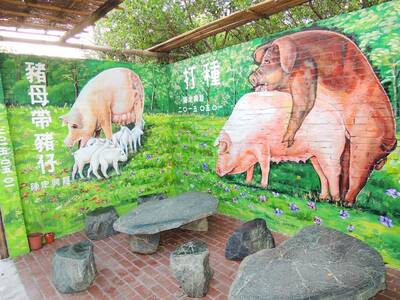
May 6 to May 12 Those who follow the Chinese-language news may have noticed the usage of the term zhuge (豬哥, literally ‘pig brother,’ a male pig raised for breeding purposes) in reports concerning the ongoing #Metoo scandal in the entertainment industry. The term’s modern connotations can range from womanizer or lecher to sexual predator, but it once referred to an important rural trade. Until the 1970s, it was a common sight to see a breeder herding a single “zhuge” down a rustic path with a bamboo whip, often traveling large distances over rugged terrain to service local families. Not only
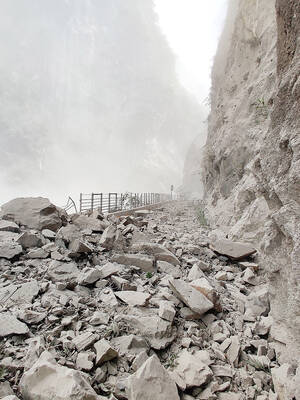
Moritz Mieg, 22, lay face down in the rubble, the ground shaking violently beneath him. Boulders crashed down around him, some stones hitting his back. “I just hoped that it would be one big hit and over, because I did not want to be hit nearly to death and then have to slowly die,” the student from Germany tells Taipei Times. MORNING WALK Early on April 3, Mieg set out on a scenic hike through Taroko Gorge in Hualien County (花蓮). It was a fine day for it. Little did he know that the complex intersection of tectonic plates Taiwan sits
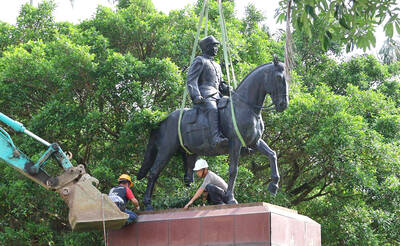
The last time Mrs Hsieh came to Cihu Park in Taoyuan was almost 50 years ago, on a school trip to the grave of Taiwan’s recently deceased dictator. Busloads of children were brought in to pay their respects to Chiang Kai-shek (蔣中正), known as Generalissimo, who had died at 87, after decades ruling Taiwan under brutal martial law. “There were a lot of buses, and there was a long queue,” Hsieh recalled. “It was a school rule. We had to bow, and then we went home.” Chiang’s body is still there, under guard in a mausoleum at the end of a path

Last week the Directorate-General of Budget, Accounting and Statistics (DGBAS) released a set of very strange numbers on Taiwan’s wealth distribution. Duly quoted in the Taipei Times, the report said that “The Gini coefficient for Taiwanese households… was 0.606 at the end of 2021, lower than Australia’s 0.611, the UK’s 0.620, Japan’s 0.678, France’s 0.676 and Germany’s 0.727, the agency said in a report.” The Gini coefficient is a measure of relative inequality, usually of wealth or income, though it can be used to evaluate other forms of inequality. However, for most nations it is a number from .25 to .50


 RSS
RSS