


When opposition lawmakers meet with members of China's Association for Relations Across the Taiwan Strait (ARATS,
Citing unfair treatment at the hands of Taiwanese skippers and unsanitary living conditions, Beijing officially banned its nationals from working on Taiwanese-owned fishing boats in February.
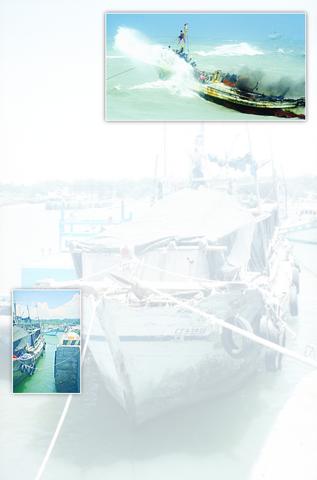
PHOTO: CHEN CHENG-CHANG AND GAVIN PHIPPS, TAIPEI TIMES
And while several thousand Chinese fishermen ignore their government's edict and continue to work on Taiwanese boats, the ban has resulted in upwards of 5,000 Taiwanese fishing boats without crews lying idle in their homeports.
"Chinese fishermen have become a very important factor in the future of our fishing industry," explained James Sha (
According to Hsieh Fan-tung (謝藩東), general manager of the Keelung Fisherman's Association (基隆區漁會), there are at present 20,000 local fishermen and 30,000 Chinese fishermen plying their trade on Taiwan-registered fishing boats.
"Over the past decade, the number of Taiwanese fishermen has declined rapidly. Taiwan's young people don't want to live such a hard life and earn such low wages," Hsieh said. "On a boat with a crew of eight, say, at least six will now be Chinese. It's gotten to the stage now where [Chinese] are the crux of our fishing industry." Although Beijing's ban has led to demands for Taipei to call Beijing's bluff by employing more Vietnamese fishermen, industry officials remain insistent that the continuing use of Chinese fishermen is the industry's most efficient path.
"They speak the same language, eat the same food and are of the same race as us, which makes life easier for all concerned," said Wu Chun-an (
"I guess compared to Taiwanese people we earn nothing. But we are here because there's little work opportunity in Fujian," said one Fujianese fisherman who is at present residing on the Jie-an No. 1 (捷安一號), a 10m fishing vessel which houses over 100 Chinese fishermen that is currently moored at Keelung's Badoutz fishing harbor (基隆八斗子漁港).
Employment of Chinese fishermen by local fishing companies is by no means a new phenomenon. Until the late 1980s, however, Vietnamese and Philippine nationals were the backbone of Taiwan's fishing fleets.
An increase in the illegal employment of Chinese fishermen towards the end of the 1980s saw the numbers of Chinese nationals working on Taiwanese boats reach such proportions that the government was forced to legitimize the use of the workforce in 1990.
The process remained unregulated, however, and calls for stricter government control soon echoed throughout the Executive Yuan. Legislators argued that such unrestricted use of Chinese nationals jeopardized national security.
"It was totally unorganized before 1990. Boats would simply pick up Chinese nationals in international waters, which was pretty dangerous and at the time a flagrant violation of Taiwan's maritime laws," Hsieh said.
By 1998, the number of Chinese fishermen hired to outfit local boats had surpassed that of other nationalities and the government began monitoring the thousands of Chinese fishermen working for Taiwanese fishing companies.
Many Chinese fishermen had taken up residence on old Taiwan-registered fishing boats converted to floating dormitories moored between 5km and 20km offshore. It would be another two years before they would be permitted to enter ports, and only then during inclement weather, when winds exceed 50kph. For the most part, the fishermen ate and slept at sea, only stepping ashore when they returned to Chinese ports.
"There was quite a bit of apprehension when the boats were first allowed to enter ports, but most of this was based on misconceptions and overblown ideas of Chinese spies and soldiers infiltrating the groups," Hsieh said. "It's without foundation, though. You have to bare in mind that all of the fishermen who live on the boats know each other."
All of the fishermen currently living aboard the 1,000 Taiwanese-owned "floating hotels," as the boats are referred to, comes with a reference from at least one Taiwanese skipper with whom he has previously worked.
"We don't advertise for fishermen and not anyone can live on the boats. We only accept those who have worked for Taiwanese companies and who can be vouched for by a local boat owner or captain," Wu explained.
While the "floating hotels" are now allowed to moor at certain specially designated sections of some the nation's larger fishing ports, no Chinese fisherman is permitted to leave his vessel unescorted by either the boat's captain or a member of Taiwan's coast guard.
Even stepping foot ashore in order to purchase a soft drink or ice cream from one of the many street venders who frequent the harbors can lead to incarceration and deportation.
"About eight years ago, we had one guy who made the stupid mistake of getting off his boat to walk the 50 or so meters to another boat. It was a costly mistake, as he was picked up, taken to a holding cell and finally deported back to China," said He Wen-an (
"It's something that no one does. Sure, the individual would be put in prison, but that would only be the beginning of his problems. Can you imagine what would happen to the rest of us?" said a 40-year-old nine-year guest of Taiwan's "floating hotels." "We'd all fall under suspicion and end up losing our jobs. Because it only takes one stupid incident like that to jeopardize all our futures we'd never let the person get off if we caught wind of such an intention."
This is not to say that Chinese fishermen never come ashore. Although still technically in breach of national security laws, Chinese crews have long been moved from their boats to fishing association dorms located within the domain of the port authorities during typhoons.
"We've been housing them in our association's dorms for years and nobody has ever questioned this. I'm sure that before the recent incident on one of the boats [in which a Taiwan search and rescue team plucked 134 fisherman from the Yuanshen No. 2 (元勝二號), which was caught in the path of Typhoon Nakri], very few people were aware that Chinese fishermen set foot in Taiwan," Wu said. "In a way it was bad publicity, but in another way, the evacuation and subsequent clamor has helped the Chinese fishermen gain support for a semi-official status that would enable them to live in specially built dorms within the port area." Shortly before Beijing's ban, Taiwan's fisheries administration was already making plans to remove the fishermen from their rickety old boats and house them in dormitories built adjacent to harbor patrol headquarters.
At a cost of NT$3 billion, the Fisheries Administration, along with regional fishing associations, began building four dormitories at the beginning of the year in Keelung, Taichung, Suao and Hsinchu. One of the first to be completed is situated in Hsinchu's Nanliao harbor.
Located adjacent to the offices of the harbor patrol, the NT$10 million two-story structure is able to accommodate all of the 120 Chinese fishermen presently housed on the port's pair of "floating hotels."
Although still awaiting inspection by representatives of the central government [due to take place on the 23rd of this month], when opened, the building will be a vast improvement to the fishermen's current living conditions.
"We've given them a great place to live. There's everything they need here; storage space and a kitchen that will be staffed by local cooks so as they don't have to cook for themselves," Wu said. "We've even put doors on the toilets for them, which is more than they have at home." While the dorm offers the Chinese fishermen a comfortable home away from home, it is certainly not a hotel.
Even if Beijing agrees to grant special licenses to its fishermen who work for Taiwanese fishing companies -- the proposed requisite for allowing the fishermen to reside on Taiwan soil -- the facilities' future guests will still be considered nationals of a country that threatens Taiwan's national security, which is why there are a half-dozen close-circuit television cameras suspended from the ceiling throughout the building.
"It makes it much easier for us to monitor their whereabouts. Safety and security are both paramount and the new dorm offers both," said the lieutenant commander based at the Nanliao facility. "Of course, they still won't be allowed to come and go from the dorm without supervision, and the close circuit television will be monitored at all times."
Not scheduled to be completed until mid-October, one of the larger dorms is that under construction at Badoutz -- a port currently home to four floating hotels and roughly 300 Chinese fishermen. While the complex is being touted by port authorities as the fishermen's new home, not everyone is equally optimistic about the project.
Many future residents of the dorm at Badoutz, who have watched the edifice grow since construction began in March, are not holding their breath.
"Sure it will be a vast improvement. But I don't expect it tohappen," said a 30-year-old Fujianese fisherman. "I've been on this boat for two years, and to be honest I don't expect to be moved anytime soon."

And so, in the wake of US President Donald Trump’s trip to the People’s Republic of China (PRC), all the experts on the Strait of Hormuz suddenly became experts on US-China-Taiwan relations. The Internet has certainly expanded human knowledge. Lots of these sudden experts made noise this week about Trump’s words after the meeting with PRC dictator Xi Jin-ping (習近平). Trump is going to sell out Taiwan! Longtime Taiwan commentator J. Michael Cole summed the situation up neatly in the Guardian: “We need to keep in mind that he has a tendency to say many things — sometimes contradicting himself within

There is considerable frustration and confusion among many, both in Taiwan and abroad — including in Washington — as to why the Chinese Nationalist Party (KMT) seems so dead set on using their legislative leverage to slash defense spending and disrupt the ability of the ruling Democratic Progressive Party (DPP) administration to function. Are they pawns of the Chinese Communist Party (CCP)? Are they traitors? In reality, there are multiple reasons. In the first column in this series on this subject, “Donovan’s Deep Dives: How and why the TPP and KMT help Beijing” (Sat May 16, page 12), we examined three

It took 12 years and months of standing in the same mountain location for director Liang Chieh-te (梁皆得) to capture a few seconds of footage: Taiwan’s largest resident raptor locking talons with its mate and spinning through the air in a courtship ritual. With only about 1,000 left in the wild and very short flight windows, the mountain hawk-eagle remains among Taiwan’s most elusive birds. The species generally produces only one offspring per year. Using forest cameras, the film crew and research teams document the arduous process the monogamous pairs go through for the chick to hatch and grow up, weathering

May 25 to May 31 Few believed that apples could be cultivated on a commercial scale in Taiwan’s high mountains. When horticulturalist Cheng Chao-hsiung (程兆熊) first proposed the idea in 1955, both American and Taiwanese colleagues dismissed it as implausible, arguing that temperate fruit could not be reliably grown on a subtropical island, especially on rugged terrain. However, it was this terrain in the Central Mountain Range where many Chinese Civil War veterans were resettled in the late 1950s. With limited job prospects and no family in Taiwan, they were placed on cooperative farms aimed toward self-sufficiency. Some say the conditions


 RSS
RSS