


Although the first black tuna was caught about one month ago, the black tuna season has its official commencement today. The Black Tuna Festival (
Last year, the event focused almost exclusively on tours for which the highpoint was feasting upon flesh of the black tuna, which is one of the great delicacies for those who fancy raw fish. Although this continues to be the main draw for the event, the tourism bureau has responded to public demand this year to broaden the activities associated with the event.
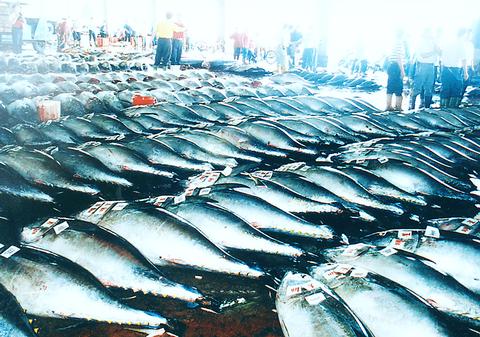
PHOTO: PINGTUNG COUNTY GOVERNMENT
The most important difference from last year is that the one and two-day tours will not be restricted to the weekends, and many events will be open to tourists traveling outside the tours. Black tuna is known to many in Taiwan as "black gold" for the top quality belly meat off a good specimen is virtually worth its weight in gold.
In a Japanese sushi bar, the meat goes by the name of "toro" and can sell for as much as NT$5000 to NT$600 for a single piece.
Many local restaurants are joining in the project with special deals and the customers can be assured of getting the best quality as, over this period, both the Tourism Bureau and the Pingtung County Government are providing certifications to those that provide outstanding service and quality.
For those not on an organized tour, a special bus has been organized to help people get around. In an effort to broaden the overall appeal to tourists and increase the total value of Pingtung tourism, a number of combination tours have also been arranged, combining the attractions of fine dining with other tourism resources such as its golf facilities, paragliding at nearby Saijia, tours focusing on Aboriginal beads and on Hsiao Liuchiu, a still largely unexplored sight.
The black tuna festival follows in the wake of the Kenting Wind-Bell Festival, another effort by the government to build up tourism in one of Taiwan's most attractive and rural areas. Catering to the love of food and drink, the Black Tuna Festival proved much more successful last year than the wind-bell festival and the government hopes that the county's other festivals will also receive a boost.
Bookings for the variety of tours on offer can be made at http://www.eztravel.com.tw or by calling Eztravel at (02) 8770-7480. More information can also be obtained from the Pingtung County Government at (08) 738-5401.

“Taiwan’s Opposition Leader Comes to US With a Message Straight Out of Beijing” read a May 31 headline in the Wall Street Journal. Top US administration officials and members of Congress almost certainly read the WSJ, and if there was a bullet point takeaway that people in Washington should absorb ahead of Chinese Nationalist Party (KMT) Chair Cheng Li-wun’s (鄭麗文) arrival in DC on June 9, that headline is it. The last few columns have discussed this very topic, and the timing is not coincidental. While those top officials likely do not read the Taipei Times, judging by the number

With weighty, anxiety-inducing geopolitical topics dominating the headlines, checking in on the wild and weird state of local politics can take some of the edge off. This November’s elections will determine who will be in charge of fixing potholes in your neighborhood, not the potholes in Taiwan’s complicated geopolitical space. Recently, after an online interview with a Taipei-based journalist, I commented that Taipei journalists never go further than the MRT can take them. He laughed and agreed. Naturally, the Taipei mayoral race is eating up much of the press attention. TAIPEI CITY Democratic Progressive Party (DPP) candidate Puma Shen (沈伯洋) has
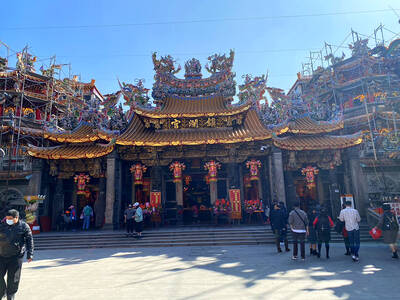
In December of 2008 Lee E-tin (李乙廷), a Miaoli county legislative hopeful, was convicted of vote-buying. Rather than buy votes retail, voter by voter, in the usual manner, Lee had done it wholesale, in a commendably efficient manner: he had visited local temples and made donations to gain their support. Because he did not normally make donations to temples, the court ruled he was attempting to improperly influence voter behavior. The case indicates how important temples are in influencing political life. Both judge and politician appeared to see them in the same way. Beijing sees them that way as well. Democratic Progressive
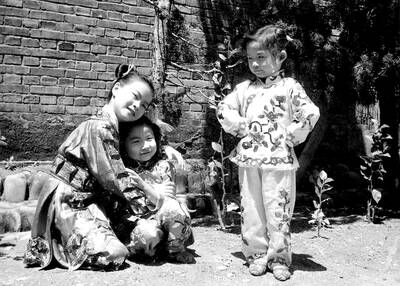
Audiences in Leicester, Cardiff, London and Sheffield will this month gather to watch a series of black-and-white Taiwanese-language films made more than 70 years ago. On the surface, these screenings commemorate the seventieth anniversary of taiyupian (台語片) — Taiwanese-language cinema. Yet the significance of these events extends far beyond nostalgia or film history. They represent a remarkable chapter in Taiwan’s ongoing effort to recover, preserve and reinterpret a cultural heritage that was once thought to have largely disappeared. The centerpiece of the program is the Ho Chi-ming (何基明) directed Xue Pinggui and Wang Baochuan (薛平貴與王寶釧), a film produced in 1955 and


 RSS
RSS