


While art in the Western world has long been seen as a mechanism to challenge, belittle and castigate political institutions, government policies and society at large, popular recognition of such art in Taiwan is a mere 15 years young. Even in this short period of time, however, heavily politicized art has lost much of its originality and bite and has become yuppie-esque and fashionable. Thankfully, long before such art became chic, the radical styles and concepts that sprung up immediately following the lifting of martial law laid waste to the old conservative ideas of art and the thoughts it should provoke.
When martial law was lifted in 1987, the art community was no longer forced to whitewash over Taiwan's many cracks. Portraying the nation's political and social conditions in alluring oil colors and captivating pastels was no longer the norm from which artists drew inspiration. Local artists such as Chen Long-shing and (陳隆興) Hong Ken-shen (洪根深) wasted no time in exploiting their new freedom.
Their works began to express their dissatisfaction with both their nation and society in ways many found shocking and some found offensive.
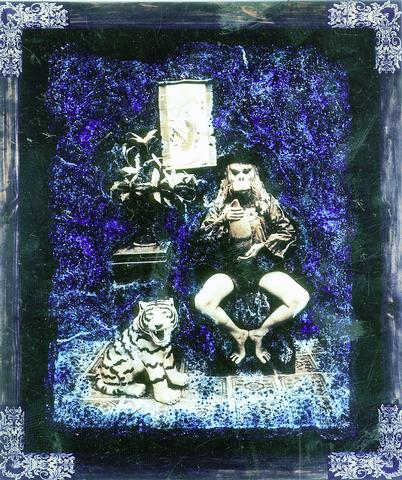
PHOTO COURTESY OF KMFA
"In 1987, artists who went against the grain were considered outcasts. Their works were thought of as vulgar, crude and non-artistic," explained Tsai Hsin-ling (蔡辛伶), curator at the Kaohsiung Museum of Fine Arts (高雄市立美術館). "Few outside of the art community realized that the avenues artists such as Chen Long-shing were exploring were not aimed at offending, but were simply asking viewers to open their minds to concepts and ideas that were once considered taboo."
According to Tsai, the extremes taken by artists in the initial post-martial law years led to a radical change in the way people viewed art in Taiwan. Whereas art lovers would once be searching for the obvious, after 1987 they were suddenly swamped by a multitude of works whose meanings weren't quite as instantly interpretable.
"It was a milestone that shook up art audiences across the nation. Gone were the fancy, joyous and colorful works, all of a sudden we were swamped by a mass of dark, opposing, jagged edges that could not be instantly understood," said Tsai.
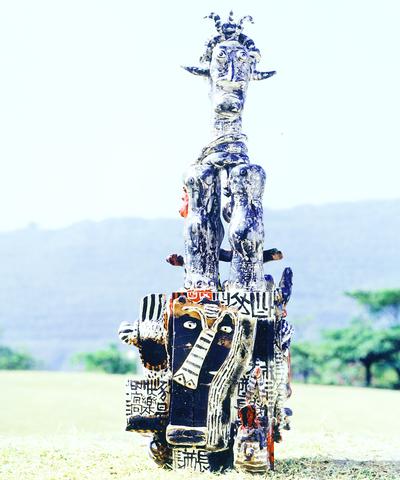
PHOTO COURTESY OF KMFA
Entitled Art in Kaohsiung After the Lifting of Martial Law (後解嚴時代的高雄美術), the exhibition at the Kaohsiung Museum of Fine Arts sets out to put the art spawned by the lifting of martial law into a historical retrospective.
Dating from the period immediately following the lifting martial to the present day, the exhibition fuses together over 50 works by 20 Kaohsiung-based artists into three categories.
Although Topical Liberation, (議題解放), Marginal Consciousness (邊陲意識) and Local Focus (本土關懷) all contain works of a similar questioning and refractory nature, there was, according to Lee Jiun-shyan (李俊賢), associate professor at the Kaoyuan Institute of Technology (高苑技術學院), a need to divide them in order to capture the academic significance of the differing styles utilized by the artists.
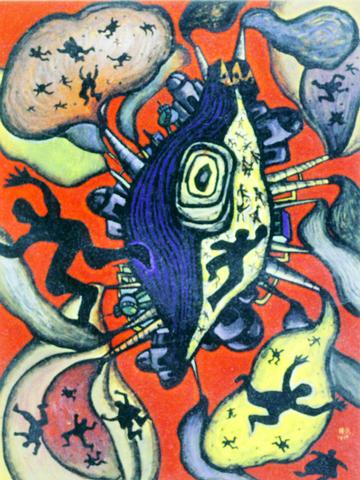
PHOTO COURTESY OF KMFA
Topical Liberation concerns itself with political and social themes. "Marginal Consciousness" explores the feminine and social consciences in modern Taiwan. And Local Focus sets out to give audiences a glimpse of how the many ethnic groups of Southern Taiwan saw the transition from totalitarian state to democracy with works such as Juang Min-chi's (莊明旗) multi-medium totem entitled Tribal Chief (酋長), a work that tackles the issue of Aborigines' rights.
Regardless of the topics tackled and mediums used by the artists, all of the works on display rely to a certain degree on sarcasm in order to get their messages across.
Lee Jiun-shyan's (李俊賢) Girl Selling Betel Nut (北灰西施) fuses a Buddha and a topless betel nut girl in order to depict the artist's conception of the way in which he feels modern society has become blind to true divinity.
While Yang Shun-fa's (楊順發) Lin Tsu Kung (林祖公), a work which in an amalgamation of random and unrelated images with a Gothic twist, provides viewers with a less in-your-face and more thought-provoking glimpse of post-martial law Taiwan.
Not that all the works belittle the social system. Works such as Chen's 1989 Escaping from the Polluted Island (逃出污染島), is a piece that condemns the nonchalant and uncaring manner in which the nation industrialized without sparing a thought for the environment.
Ironically the once dark ominous tones, stark realism and sarcasm that once shocked the art world have since become trendy. Whereas the aesthetic rebellion of artists in the time immediately following the lifting of martial law was born of political oppression, such art has found itself commanding a very different place in modern Taiwan.
"I guess it's a natural progression. What was once considered radical and shocking is no longer conceived of as such," said the exhibition's curator. "It's quite surprising how quickly social comment has become socially fashionable. Works that depict anger and idealism are now fashion items rather than social commentary."
What: "Art in Kaohsiung After the Lifting of Martial Law" (後解嚴時代的高雄美術)
Where: Kaohsiung Museum of Fine Arts (高雄市立美術館)
20 Meishukuan Rd., Kaohsiung (高雄市美術館路20號)
When: Through March 10


Taiwan’s English education system is being pulled apart by three opposing forces. Bilingual Nation 2030 pulls students toward English and global communication. Artificial Intelligence (AI) readiness pulls them toward digital judgment, verification and AI-mediated work. But Taiwan’s old exam culture pulls them back toward memorization, grammar drills, timed reading and correct answers. If the education system keeps using old exams to define success, it risks producing graduates who are neither genuinely bilingual nor genuinely AI-ready, but trained for tasks machines can already perform. The first force is Bilingual Nation 2030. Launched in 2018, the policy aimed to “help Taiwan’s workforce connect

“Taiwan’s Opposition Leader Comes to US With a Message Straight Out of Beijing” read a May 31 headline in the Wall Street Journal. Top US administration officials and members of Congress almost certainly read the WSJ, and if there was a bullet point takeaway that people in Washington should absorb ahead of Chinese Nationalist Party (KMT) Chair Cheng Li-wun’s (鄭麗文) arrival in DC on June 9, that headline is it. The last few columns have discussed this very topic, and the timing is not coincidental. While those top officials likely do not read the Taipei Times, judging by the number
With weighty, anxiety-inducing geopolitical topics dominating the headlines, checking in on the wild and weird state of local politics can take some of the edge off. This November’s elections will determine who will be in charge of fixing potholes in your neighborhood, not the potholes in Taiwan’s complicated geopolitical space. Recently, after an online interview with a Taipei-based journalist, I commented that Taipei journalists never go further than the MRT can take them. He laughed and agreed. Naturally, the Taipei mayoral race is eating up much of the press attention. TAIPEI CITY Democratic Progressive Party (DPP) candidate Puma Shen (沈伯洋) has
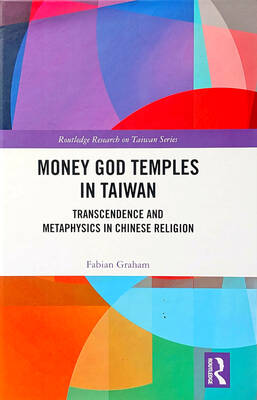
As someone who normally steers clear of books with “transcendence” or “metaphysics” in their subtitles, this reviewer — a casual observer of local belief systems since the 1990s — found Fabian Graham’s Money God Temples in Taiwan a challenging read. Those who’ve only dipped their toes into temple culture will likely need to parse several sections with special care if they’re to keep up with the author, a British ethnographic researcher whose previous books have investigated religious practices among ethnic Chinese in Southeast Asia. This scholarly volume examines a facet of Taiwan’s religious landscape that didn’t exist a century ago, and


 RSS
RSS