


Cycling in Taipei is often regarded as foolhardy at best, and fighting the city's chaotic traffic provides ample justification for this assessment. Nonetheless, in recent years, considerable effort has been made toward establishing bicycle paths to promote non-polluting transport, though within the city itself, the project has met with limited success.
On the city's riverbank, long stretches of trail have been created. Some sections of this network have suffered periodic neglect, but in the well-maintained stretches these riverside trails provide a haven for the cyclist who doesn't have the time to get out of town.
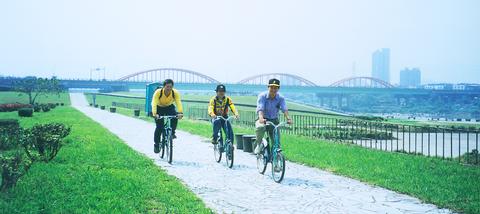
PHOTO COURTESY OF CYCLAND FOUNDATION
Much of Taipei is hemmed in by a giant "U" made up of the Keelung River (
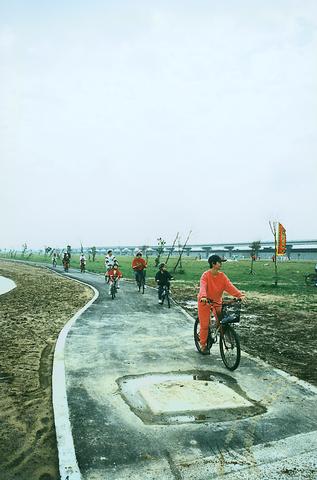
PHOTO COURTESY OF CYCLAND FOUNDATION
Starting from the northeastern arm of the U, the trail runs from near the Nanhu Bridge (
The western-most road entrance to this section is a small floodgate located opposite 180 Sungho Rd. (
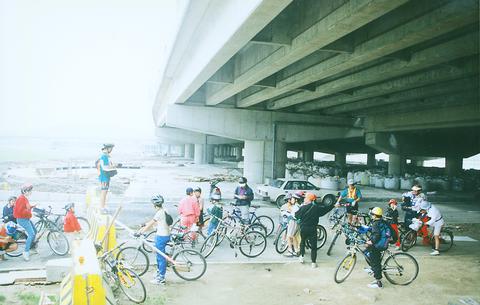
PHOTO COURTESY OF CYCLAND FOUNDATION
Heading in the other direction from the Sungho Road entrance, it is just under a kilometer to the No. 5 Floodgate (
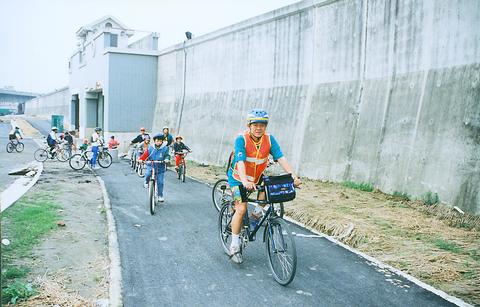
PHOTO COURTESY OF CYCLAND FOUNDATION
well-stocked on weekends with food, drink and entertainment options for kids. On weekdays, the park is virtually deserted. Bridge construction currently cuts this trail just after the No. 7 Floodgate, requiring a detour onto Pinjiang Road (
The section between Kuanshan Riverside Park and Tachia Riverside Park is probably the most heavily used section of the riverside cycle trail, and while the environment is pleasant, it suffers from overcrowding on weekends and is far from being the best that Taipei's river trails have to offer.
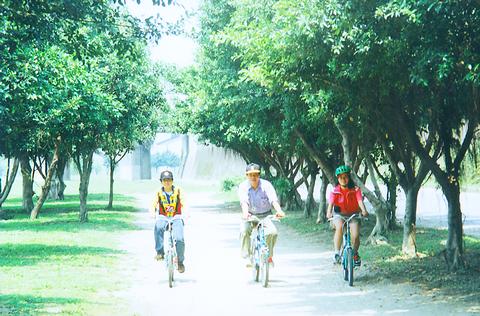
PHOTO COURTESY OF CYCLAND FOUNDATION
The Tachia section can be exited from the No. 10 Floodgate, where the culturally inclined can stop off at the Lin An Tai Old House (
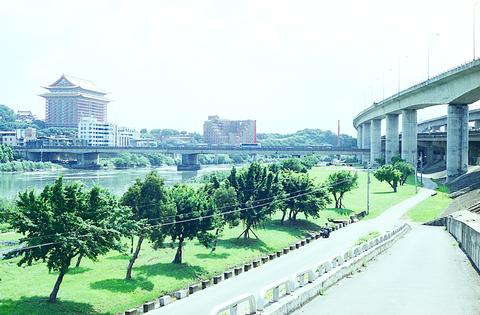
PHOTO: IAN BARTHOLOMEW, TAIPEI TIMES
Starting under the Chungshan Bridge (
Some areas along the trail have also been converted into sports areas where groups often play baseball, soccer and even croquet. Other sections are less well-maintained and grass alongside the trail sometimes reaches waist-high. Initially, the river is at some distance from the trail, but a couple of kilometers on, the trail mounts the dike, and you ride on the 2m-wide tarmac surface, looking across mud flats and shimmering water. For a short section, it is necessary to ride on the road, which is lined with small factories, but there is little traffic, and for the most part, the dike offers uninterrupted vistas, culminating with a view across to Kuantu (
More river scenes can be found on the southern leg, with the addition of a couple of small riverside communities, most centered around small temples. While there are few fish to be had this far downstream, many people still enjoy living life by the water, even if it is just sitting in an easy chair sipping tea and chatting with friends.
Currently, this long, uninterrupted stretch is broken just before the floodgate opposite Kueiteh Street (
One kilometer out of Huachung Riverside Park is the Machangting memorial park, which is outside the dike opposite Youth Park (
From here, there is about another 3.5km of somewhat barren riverside landscape before the trail comes to an abrupt halt at Yungfu Bridge (
From this point on, the riverside trail becomes somewhat broken up. A pleasant stretch from under Yungfu Bridge is often closed off due to work carried out by the water processing plant there, but it is possible to circumvent this by following the road to Fuho Bridge (
While there are good sections of trails after this along the Chingmei River (景美溪), especially near the National Chengchi University (國立政治大學), the overall experience deteriorates with the repeated necessity of cycling for longer or shorter sections on busy roads.
Given the ease of access, it is remarkable the level of insulation from the city that these trails can offer. Because most of the crowds will be in areas of the trail accessible by car, the relatively long linking sections are virtually deserted of traffic, even on weekends.

“Taiwan’s Opposition Leader Comes to US With a Message Straight Out of Beijing” read a May 31 headline in the Wall Street Journal. Top US administration officials and members of Congress almost certainly read the WSJ, and if there was a bullet point takeaway that people in Washington should absorb ahead of Chinese Nationalist Party (KMT) Chair Cheng Li-wun’s (鄭麗文) arrival in DC on June 9, that headline is it. The last few columns have discussed this very topic, and the timing is not coincidental. While those top officials likely do not read the Taipei Times, judging by the number
With weighty, anxiety-inducing geopolitical topics dominating the headlines, checking in on the wild and weird state of local politics can take some of the edge off. This November’s elections will determine who will be in charge of fixing potholes in your neighborhood, not the potholes in Taiwan’s complicated geopolitical space. Recently, after an online interview with a Taipei-based journalist, I commented that Taipei journalists never go further than the MRT can take them. He laughed and agreed. Naturally, the Taipei mayoral race is eating up much of the press attention. TAIPEI CITY Democratic Progressive Party (DPP) candidate Puma Shen (沈伯洋) has
In December of 2008 Lee E-tin (李乙廷), a Miaoli county legislative hopeful, was convicted of vote-buying. Rather than buy votes retail, voter by voter, in the usual manner, Lee had done it wholesale, in a commendably efficient manner: he had visited local temples and made donations to gain their support. Because he did not normally make donations to temples, the court ruled he was attempting to improperly influence voter behavior. The case indicates how important temples are in influencing political life. Both judge and politician appeared to see them in the same way. Beijing sees them that way as well. Democratic Progressive
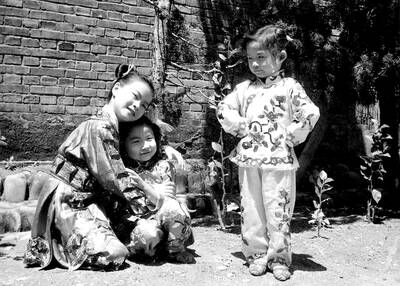
Audiences in Leicester, Cardiff, London and Sheffield will this month gather to watch a series of black-and-white Taiwanese-language films made more than 70 years ago. On the surface, these screenings commemorate the seventieth anniversary of taiyupian (台語片) — Taiwanese-language cinema. Yet the significance of these events extends far beyond nostalgia or film history. They represent a remarkable chapter in Taiwan’s ongoing effort to recover, preserve and reinterpret a cultural heritage that was once thought to have largely disappeared. The centerpiece of the program is the Ho Chi-ming (何基明) directed Xue Pinggui and Wang Baochuan (薛平貴與王寶釧), a film produced in 1955 and


 RSS
RSS