


cristina Becker has her work cut out for her.
An English teacher at the Chung An branch of Hess Education Organization, the 23-year-old American tries to convey the nuances of language by playing a game of "Snakes and Ladders" with her kindergarten class.
During the day's three-hour lesson, the 20 boys and girls will learn how to spell "apple," "boy" and "cat," and describe how they feel. Becker, who has been teaching at Hess for 10 months, cares deeply about the success of her students. "I am establishing their foundation for a foreign language that will really be important to them someday," Becker says. "Not only am I teaching them English, but I'm teaching them about another culture and how to be open-minded and accept people who are different from them."
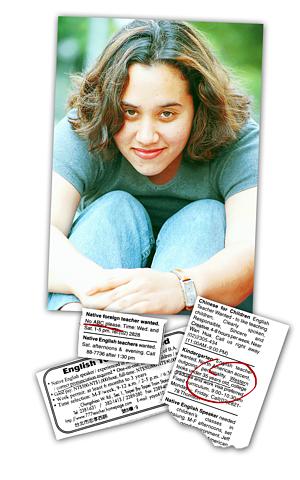
These are lessons she wishes more people in Taiwan -- parents and school administrators especially -- could have learned. For months after her arrival, Becker found that in the lucrative English-teaching business, a preference for Caucasian teachers exists.
Classified advertisements for private English tutors and cram school instructors in Taipei's English-language dailies routinely call for "Western-looking applicants," "no ABCs [American Born Chinese] please" and "native foreigners only."
Those who don't fit the descriptions will sometimes be offered positions -- but for lower wages. And many schools are unapologetic about their practices, saying a white face is needed to placate parents' demands.
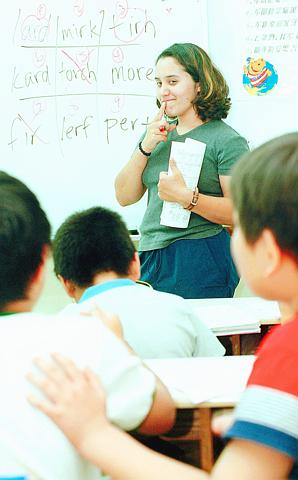
PHOTO: CHIANG YING-YING, TAIPEI TIMES
The Giraffe English Language School recently placed an ad discouraging ABCs from applying. "We need real foreigners," says Stella Young, a Taiwanese teacher at Giraffe. "Parents have that requirement."
Foreign experience
Becker, who was born in Spain but raised in the US since the age of three, has Malaysian, Thai, English, Polish and German ancestries. Since she began teaching last August, several parents of her students have complained that their child was not receiving the "full, foreign experience" because Becker did not look white, she says.
"Their perspective is that if someone is white, they're American," Becker says. "If they're not white, they're not American. I understand that it's just ignorance, but it's really hard for me to swallow."
Despite reassurances from her school director and kindergarten manager that the biases stem from the parents' problems and not her teaching, Becker can't help but consider the effects the negative attitudes have on her relationship with students. "If the parents have a negative impression of me, how will that impact their children's views of me?"
The parents' stereotypes also influence schools and their hiring policies. Parents, who often pay as much as NT$8,000 for three-month lessons, have the financial power of placing pressure on private cram schools to satisfy their requirements, however whimsical.
"Parents who don't understand English will believe the myth that white teachers can teach their kids better English," says Melanie Lin, the chief of the teaching department at Kid Castle American School. "From a marketing standpoint, it's understandable why schools would want to hire more white teachers," she says, adding that Kid Castle doesn't discriminate.
Faith Liao, a Taiwanese English teacher who owns Victory English School, agrees that discrimination in hiring practices stems mostly from parental ignorance.
"Most Taiwanese parents don't care much about a teacher's educational background, as long as they're white and American," Liao says. "But it's more important for me to hire someone with experience. I would never judge job applicants by their color, but I know that the situation is very different outside of my school."
Connie Liu found that to be the case during her job search last December. An American of Chinese descent who's lived most recently in South Korea, Liu says her background worked against her in finding a teaching position. Having taught English for six years in Korea, she came to Taiwan to study Chinese and to earn money.
"Nobody really said anything direct but there was always an uncomfortable pause after I tell them that I'm Chinese American," Liu says of her phone interviews. "It's like `Oh, you're not really American.' It's unsettling that my background oftentimes cuts out my credibility."
Before landing her current job at Joy American School, where she makes NT$510 per hour, Liu applied to three other private cram schools which all offered her jobs -- but with lower pay than what she felt she deserved with her teaching experience.
At one branch of the Sesame Street School, a manager offered to pay her NT$450 per hour, whereas a "foreign" teacher would receive NT$500.
Color vs qualification
The Sesame Street School maintains that it does not discriminate by color, according to staff member Anita Hsu. The minimum wage they offer, according to Hsu, is NT$450, depending on experience.
"My personal experiences interviewing are one thing, but just to see ads in the papers asking for `native foreign speakers' infuriates me. I mean, what do they mean by `native'? I'm native, but I know that someone like me is not who they're looking for," Liu says.
All Virtues Kindergarten, a private school advertising for "Western-looking" teachers, ran the ad to attract more foreign applicants, says Lila Tang, manager of the school. "But we won't turn others away if they're qualified," Tang says.Some parents say they prefer white teachers simply because they think that will give their child greater access to Western culture. Tina Wang, a mother of two teenagers who she's been sending to English cram schools for the last eight years, says she likes her children to study with Caucasians to expose them to people who look different from them. "This will make them more at ease with foreigners and not just stare and stutter in front of them," she says. "They learn about a new culture authentically. And their accents are more natural."
Parents should try to understand that it's not what the teachers look like but their teaching style, methods and rapport with the students that matter, Liu emphasizes.
Ambiguous laws
Many countries have strict laws prohibiting discrimination based on ethnicity, age and sex in the work place, but Taiwan laws are vague, and classified ads routinely specify age and sex preferences of particular jobs.
Though the 1992 Employment Services Act guarantees equal job opportunities and employment discrimination evaluation committees were established in larger Taiwan cities in 1998, most of the emphasis has been placed on monitoring manual labor.
Foreign English teachers are protected by just their employment contracts negotiated between them and their employer, according to the Council of Labor Affairs.
No specific laws exist to address racial discrimination when it comes to hiring foreign English teachers, says Ling Tzu-huei of the Department of Social Education. As long as the teachers are being paid the national minimum wage of NT$15,840 a month, the law has little else to say about their rights.
Caucasian policy
English teachers at Hess have been told by company representatives that when Hess opened in 1983, the organization originally had a policy to only hire Caucasians with North American accents. "I was told that the policy didn't reflect the company as much as it reflected the nature of the market at that time," says Wilda Lin, a Chinese American currently teaching for Hess. A company representative denied such a policy ever officially existed.
In any case, as Hess rapidly expanded -- it is now the largest English teaching corporation in Taiwan with more than 100 branches -- it has had to cast a wide net to meet its need for teachers. Of the more than 200 foreign English teachers currently employed by Hess, about 15 percent are of Chinese descent, says Eleanor Chong, a recruiter for Hess. The only requirement is that applicants hold a passport from an English speaking country. Two-thirds of the foreign teachers are from Canada or the US; the remaining third hail from Great Britain, Australia, South Africa and New Zealand.
"We don't discriminate at all," Chong says. "The parents may want white teachers, but we still hire ABCs and colored people and see it as our job to educate the parents."
Problems are regional
Cecilia Wan, born in England to Chinese parents, says the preference for white English teachers extends beyond Taiwan to other Asian cities and countries. While living in Hong Kong two summers ago, she applied for a job that required a "native English speaker" and was quickly dismissed. "They blatantly told me `You're Chinese, not Caucasian. You can't teach our kids,'" Wan says.
Wan now teaches for Hess, but thinks that as recently as three years ago, it would have been difficult for her to get the job. "Back then, before there were so many branches, if you were an American born, British born or Canadian born Chinese, forget about landing a position," she says.
Parents of her students are often surprised to learn that she is the English teacher, but most of them soon move beyond the initial shock. One mother, however, demanded copies of every piece of teaching material to monitor the way Wan taught her child.
Despite such reactions, Wan thinks that looking Chinese gives her an advantage with the children. "I know about the culture, and the kids open up to me a bit more quickly."
Back in the classroom with "Teacher Tina," the children eagerly volunteer to spell out words on the board and carefully trace the letter "T" in their workbooks with colorful markers. The girls, who just beat the boys in the game of "Snakes and Ladders," join hands and do a victory dance.
"The kids are happy and they're learning," Becker says. "That's all that should matter. But unfortunately, that isn't the case."

In late October of 1873 the government of Japan decided against sending a military expedition to Korea to force that nation to open trade relations. Across the government supporters of the expedition resigned immediately. The spectacle of revolt by disaffected samurai began to loom over Japanese politics. In January of 1874 disaffected samurai attacked a senior minister in Tokyo. A month later, a group of pro-Korea expedition and anti-foreign elements from Saga prefecture in Kyushu revolted, driven in part by high food prices stemming from poor harvests. Their leader, according to Edward Drea’s classic Japan’s Imperial Army, was a samurai

The following three paragraphs are just some of what the local Chinese-language press is reporting on breathlessly and following every twist and turn with the eagerness of a soap opera fan. For many English-language readers, it probably comes across as incomprehensibly opaque, so bear with me briefly dear reader: To the surprise of many, former pop singer and Democratic Progressive Party (DPP) ex-lawmaker Yu Tien (余天) of the Taiwan Normal Country Promotion Association (TNCPA) at the last minute dropped out of the running for committee chair of the DPP’s New Taipei City chapter, paving the way for DPP legislator Su

It’s hard to know where to begin with Mark Tovell’s Taiwan: Roads Above the Clouds. Having published a travelogue myself, as well as having contributed to several guidebooks, at first glance Tovell’s book appears to inhabit a middle ground — the kind of hard-to-sell nowheresville publishers detest. Leaf through the pages and you’ll find them suffuse with the purple prose best associated with travel literature: “When the sun is low on a warm, clear morning, and with the heat already rising, we stand at the riverside bike path leading south from Sanxia’s old cobble streets.” Hardly the stuff of your

Located down a sideroad in old Wanhua District (萬華區), Waley Art (水谷藝術) has an established reputation for curating some of the more provocative indie art exhibitions in Taipei. And this month is no exception. Beyond the innocuous facade of a shophouse, the full three stories of the gallery space (including the basement) have been taken over by photographs, installation videos and abstract images courtesy of two creatives who hail from the opposite ends of the earth, Taiwan’s Hsu Yi-ting (許懿婷) and Germany’s Benjamin Janzen. “In 2019, I had an art residency in Europe,” Hsu says. “I met Benjamin in the lobby


 RSS
RSS