


According to the most recent tally, the Washington Post, the New York Times, and the Wall Street Journal publish a combined total of 1,000 stories every day. Although the report did not say how many people read all of them, it is safe to assume that nobody managed to do so.
Each of us probably overlooks tens of thousands of important news stories every year, but the biggest one that people missed this year happened on Oct.10 in a conference hall in Lyon, France, where a gathering of government officials, business leaders and philanthropists pledged US$14 billion to an organization called the Global Fund.
Not many people know what the Global Fund is until they hear its full name: the Global Fund to Fight AIDS, Tuberculosis and Malaria.
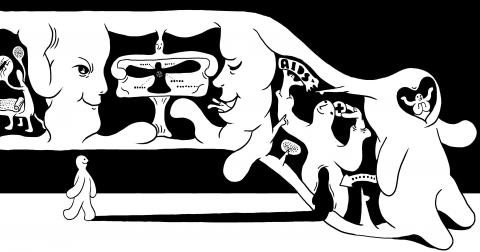
Illustration: Mountain People
The fund was established shortly after the turn of the millennium, when hundreds of thousands of children were dying from preventable diseases. The AIDS crisis was at its height, with news outlets describing the virus as a “malevolent scythe” cutting across sub-Saharan Africa. Its unstoppable spread, some predicted, would lead to the collapse of entire countries.
This was an international crisis that required an international response.
Then-UN secretary-general Kofi Annan rallied the world around the Millennium Development Goals — a set of specific targets related to poverty and disease reduction — and launched the Global Fund to achieve them.
The fund was designed to be a new kind of multilateral venture, not just a coalition of governments. It also brought in partners from the business and philanthropic sectors, including the newly formed Bill & Melinda Gates Foundation.
This inclusive approach enabled the initiative to draw on a wider range of expertise.
Over the past two decades, the Global Fund has transformed the way people fight AIDS, tuberculosis and malaria — the three biggest killers in poor countries.
By pooling resources, the fund created economies of scale for life-saving products such as anti-malarial bed nets and antiretroviral drugs. Then, by working with almost 100 countries, the fund built a massive supply chain to deliver the goods.
In the process, deaths from AIDS have fallen by 50 percent from their peak and malaria deaths have decreased by about 50 percent since the turn of the millennium.
Now, the fund has US$14 billion in new funding to continue this work.
The replenishment is vitally important news, first and foremost because of the sheer number of lives it will help to save. The US$14 billion, the fund says, is expected be enough to cut the three diseases’ death rates by almost 50 percent again by 2023.
That translates into 16 million lives saved.
However, what happened on Oct. 10 in Lyon is critical for another reason: It illustrates how the world is at a pivotal point in history, from which it might move in one direction or another.
On one hand, the successful recent fundraising effort was a testament to the way the world went about solving humanitarian crises in the early years of this century. Multilateralism, it turns out, worked — and worked extremely well.
That same period also gave rise to organizations such as Gavi, the Vaccine Alliance — a global alliance of public and private-sector stakeholders that aims to get vaccines to some of the world’s poorest children.
Gavi has helped to immunize more than 760 million children to date, and the coverage rate of the diphtheria-tetanus-pertussis vaccine in Gavi-supported countries increased from 59 percent in 2000 to 81 percent last year — only four percentage points below the global average.
Gavi, too, needs to raise new funding over the next year.
On the other hand, the fact that no similar multilateral organization has been established since the early 2000s — at least not on such a scale — should give everyone pause.
The fund managed to raise the US$14 billion at a time of rising isolationism. Today, many governments seem to prefer to go it alone rather than engage in the expansive problem-solving that worked so well over the past 20 years.
Brexit is one example of this. Others include US President Donald Trump’s decision to withdraw the US from the Paris Agreement on climate change, and his administration’s call for deep cuts to US foreign aid — which, thanks to the US Congress, have yet to be made.
What would have happened had the AIDS crisis emerged 20 years later than it did? Would people be able to create the Global Fund today?
The answer, I think, is no. It would be very difficult to build support for that kind of initiative in this environment.
Last month’s news from Lyon, then, is part of an ongoing story. Will the world realize that multilateral coalitions work and reverse course? Or is the era of multilateralism at an end?
The Global Fund’s replenishment might be the best news you had not yet heard about this year, but unless everyone halts the slide toward isolationism and starts rebuilding a global community, it is the kind of news you might never hear again.
Mark Suzman is chief strategy officer and president of global policy and advocacy at the Bill & Melinda Gates Foundation.
Copyright: Project Syndicate
Chinese state-owned companies COSCO Shipping Corporation and China Merchants have a 30 percent stake in Kaohsiung Port’s Kao Ming Container Terminal (Terminal No. 6) and COSCO leases Berths 65 and 66. It is extremely dangerous to allow Chinese companies or state-owned companies to operate critical infrastructure. Deterrence theorists are familiar with the concepts of deterrence “by punishment” and “by denial.” Deterrence by punishment threatens an aggressor with prohibitive costs (like retaliation or sanctions) that outweigh the benefits of their action, while deterrence by denial aims to make an attack so difficult that it becomes pointless. Elbridge Colby, currently serving as the Under
The Ministry of the Interior on Thursday last week said it ordered Internet service providers to block access to Chinese social media platform Xiaohongshu (小紅書, also known as RedNote in English) for a year, citing security risks and more than 1,700 alleged fraud cases on the platform since last year. The order took effect immediately, abruptly affecting more than 3 million users in Taiwan, and sparked discussions among politicians, online influencers and the public. The platform is often described as China’s version of Instagram or Pinterest, combining visual social media with e-commerce, and its users are predominantly young urban women,
Most Hong Kongers ignored the elections for its Legislative Council (LegCo) in 2021 and did so once again on Sunday. Unlike in 2021, moderate democrats who pledged their allegiance to Beijing were absent from the ballots this year. The electoral system overhaul is apparent revenge by Beijing for the democracy movement. On Sunday, the Hong Kong “patriots-only” election of the LegCo had a record-low turnout in the five geographical constituencies, with only 1.3 million people casting their ballots on the only seats that most Hong Kongers are eligible to vote for. Blank and invalid votes were up 50 percent from the previous
Japanese Prime Minister Sanae Takaichi lit a fuse the moment she declared that trouble for Taiwan means trouble for Japan. Beijing roared, Tokyo braced and like a plot twist nobody expected that early in the story, US President Donald Trump suddenly picked up the phone to talk to her. For a man who normally prefers to keep Asia guessing, the move itself was striking. What followed was even more intriguing. No one outside the room knows the exact phrasing, the tone or the diplomatic eyebrow raises exchanged, but the broad takeaway circulating among people familiar with the call was this: Trump did


 RSS
RSS