


On a Friday evening early last month, an off-duty Hong Kong police officer grabbed his holstered gun and warned away protesters who surrounded him.
One pulled him into a headlock and soon he was swarmed on the ground. A loud bang reverberated through the street. Hours later, photographs of a protester shot in the thigh did the rounds of social media. Public broadcaster RTHK said someone had been hit by a live bullet.
He was 14.

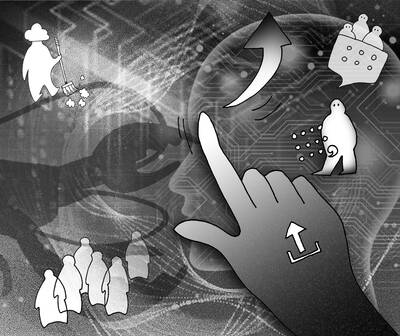
Illustration: Mountain People
While idealistic students have played key roles in social and political movements around the world, Hong Kong’s teenagers are turning into activists at an unusually young age.
As thousands have taken to Hong Kong’s streets, marching through tear gas and baton-wielding police officers, some of those demonstrating have been students just out of junior high school, or even still in it.
The death on Friday last week of a 22-year-old student Alex Chow (周梓樂) in an area near a clash between police and protesters threatened to further inflame demonstrations that have become increasingly violent.
Besides the risk of serious injury or death, the teenagers helping to fuel the protests also pose a problem for Beijing — they are to oversee the transition when the “one country, two systems” framework underpinning Hong Kong’s autonomy expires in 2047.
Interviews with three young teenagers, lawyers and social workers reveal a generation growing politically charged through ideas picked up on social media platforms such as Instagram, Facebook and Telegram.
They have grown up in the former British colony that allows free flow of information and has a lengthy history of feisty protest movements, but unlike their peers in the West, they place an added value on these freedoms because of fears they could lose them as Beijing increases its control over their home. They do not trust the government, they identify as Hong Kongers rather than Chinese, and they are prepared to keep pushing for more freedoms — putting Hong Kong at risk of more violent protest movements for years to come.
“For countries with democracy, they take it for granted,” said Agnes Chow (周庭), 22, who became a social activist as a 15-year-old student only after reading about the government’s plans to change the education curriculum to promote nationalism. “They don’t treat it as something special. While to us, it’s difficult to gain.”
Hong Kong’s protests began in June with thousands taking to the streets to oppose a proposed bill that would have allowed extraditions to the mainland. While that bill has since been withdrawn, demonstrators have since widened their demands to include an investigation into police action and election reform.
Of the 1,812 people arrested in connection with protests between June 9 and Sept. 30, police data showed that 64 — or 3.5 percent — were under 16, the age when they can be tried in adult court. Last month, 8.5 percent of the 1,189 people arrested were minors.
One 14-year-old student said that he first joined the protests in mid-June after his exams because of his concerns about the extradition bill, which would have allowed Hong Kongers to be tried in courts in China.
His classmates are not as involved, so he often goes alone and keeps abreast of events through social media.
He always keeps his parents informed, he said, only goes to peaceful protests and is home by dinner at about 8pm.
His mother, who was present, confirmed that.
The teenager envisioned no other home for himself other than the Cantonese-speaking territory.
He would stay, he said, until Hong Kong is not the territory he knows — that is until everyone speaks Mandarin, the language of the mainland.
Managing such young protesters also complicates policing.
In response to a request for comment, the Hong Kong police said that they strive to interview children only when a guardian is present. They also “consider each case on its own merits having regards to the individual circumstances” before deciding whether to apply for a care or protection order for minors, the statement said.
The 14-year-old who was shot in the thigh was arrested for taking part in rioting and assaulting a police officer, although he has since been released on bail. His name has not been made public and he could not be reached for this article.
After the incident, Hong Kong police released a statement saying that the officer had fired in self-defense.
Underage protesters can also be split up from their families.
If a court order is granted, they can be sent into foster care for weeks, said Johnny So, a barrister who has represented minors.
Foster-care institutions in Hong Kong often house teenagers with serious family or emotional issues, and some underage protesters are not used to such an environment, he said.
He recalled one of his clients who was sent to such facility for a month.
“She wasn’t happy in there and cried while we visited her. She’s from a normal family, not that type of problem child,” So said.
When the former British colony was handed over to China in 1997, close to half of those between the ages of 18 and 29 considered themselves Hong Kongers, data from the Hong Kong Public Opinion Research Institute showed. The number has now risen to 75 percent.
Meanwhile, those who view themselves as Chinese has slumped from 16.5 percent in 1997 to just 2.7 percent.
Protests have been part of Hong Kong’s collective memory for generations. During peaceful demonstrations some marchers bring their young children along.
The territory witnessed one of its largest rallies in 1989 over the Tiananmen Square Massacre in Beijing and there is a rally each year in Hong Kong to memorialize the event.
There are also regular smaller-scale demonstrations around everything from conservation to poverty alleviation.
Teenagers have grown up to play bigger roles in the territory’s political movement. Joshua Wong (黃之鋒), one of the most recognizable faces of the Hong Kong protest movement, rose to prominence in 2011 while protesting against a government plan to introduce a national education curriculum when he was just 14 years old.
Wong appeared before the US Congress in September to solicit support for US legislation backing Hong Kong’s pro-democracy protesters.
Wong said in an interview that he decided to protest against the national education curriculum because it was something that was related to him directly: The students had a stake.
He thinks the protesters are becoming younger because they see the Hong Kong government’s controls as authoritarian.
“If the government didn’t introduce the national education curriculum, I wouldn’t start protesting,” Wong said.
On a Sunday afternoon last month, two masked 14-year-olds left a rally in Central that was terminated early by the police.
They said they were out on the streets to fight for freedom, but were never at the front lines because they were weak. As they struggled to figure out transportation to leave the scene, the two said that they would continue protesting, despite the increasing danger.
“Their physical age is small, but their mental age is very mature,” said T. Wing Lo (盧鐵榮), a criminology professor at City University of Hong Kong, who has also been a social worker. “They can access a lot of information that informs them about social justice, and they see democracy, freedom and rule of law as very important.”
Additional reporting by Natalie Lung

Weeks into the craze, nobody quite knows what to make of the OpenClaw mania sweeping China, marked by viral photos of retirees lining up for installation events and users gathering in red claw hats. The queues and cosplay inspired by the “raising a lobster” trend make for irresistible China clickbait. However, the West is fixating on the least important part of the story. As a consumer craze, OpenClaw — the AI agent designed to do tasks on a user’s behalf — would likely burn out. Without some developer background, it is too glitchy and technically awkward for true mainstream adoption,
On Monday, the day before Chinese Nationalist Party (KMT) Chairwoman Cheng Li-wun (鄭麗文) departed on her visit to China, the party released a promotional video titled “Only with peace can we ‘lie flat’” to highlight its desire to have peace across the Taiwan Strait. However, its use of the expression “lie flat” (tang ping, 躺平) drew sarcastic comments, with critics saying it sounded as if the party was “bowing down” to the Chinese Communist Party (CCP). Amid the controversy over the opposition parties blocking proposed defense budgets, Cheng departed for China after receiving an invitation from the CCP, with a meeting with
Chinese Nationalist Party (KMT) Chairwoman Cheng Li-wun (鄭麗文) is leading a delegation to China through Sunday. She is expected to meet with Chinese President Xi Jinping (習近平) in Beijing tomorrow. That date coincides with the anniversary of the signing of the Taiwan Relations Act (TRA), which marked a cornerstone of Taiwan-US relations. Staging their meeting on this date makes it clear that the Chinese Communist Party (CCP) intends to challenge the US and demonstrate its “authority” over Taiwan. Since the US severed official diplomatic relations with Taiwan in 1979, it has relied on the TRA as a legal basis for all
A delegation of Chinese Nationalist Party (KMT) officials led by Chairwoman Cheng Li-wun (鄭麗文) is to travel to China tomorrow for a six-day visit to Jiangsu, Shanghai and Beijing, which might end with a meeting between Cheng and Chinese President Xi Jinping (習近平). The trip was announced by Xinhua news agency on Monday last week, which cited China’s Taiwan Affairs Office (TAO) Director Song Tao (宋濤) as saying that Cheng has repeatedly expressed willingness to visit China, and that the Chinese Communist Party (CCP) Central Committee and Xi have extended an invitation. Although some people have been speculating about a potential Xi-Cheng


 RSS
RSS