


The climate crisis is intensifying a new military buildup in the Arctic, diplomats and analysts said earlier this month, as regional powers attempt to secure northern borders that were until recently reinforced by a continental-sized division of ice.
That so-called unpaid sentry is now literally melting away, opening up shipping lanes and geo-security challenges, said delegates at the Arctic Frontiers conference, the polar circle’s biggest talking shop, who debated a series of recent escalations.
Russia is reopening and strengthening Cold War bases on the Kola Peninsula in the far northwest of the country. Norway is beefing up its military presence in the high Arctic.
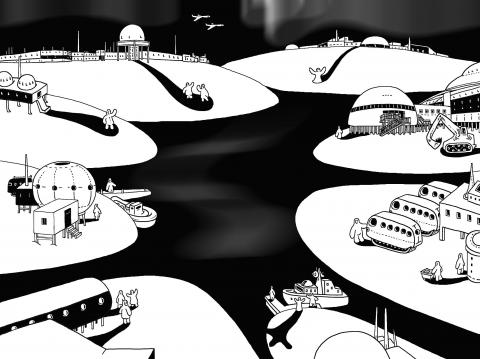
Illustration: Mountain People
In October last year, NATO staged Exercise Trident Juncture with 40,000 troops, its biggest military exercise in Norway in more than a decade.
A month earlier, the UK announced a new “Defence Arctic Strategy” and promised a 10-year deployment of 800 commandos to Norway and four Eurofighter Typhoons of the British Royal Air Force to patrol Icelandic skies.
The US is also sending hundreds more marines to the region on long-term rotations and has threatened to send naval vessels through Arctic shipping lanes for the first time.
While these strategic moves have echoes of the Cold War, the modest buildup falls far short of that era and there remains a strong spirit of cooperation in many areas.
The current tensions are a result of a world warmed by industrial emissions. The Arctic is heating up twice as fast as the rest of the planet, shrinking sea ice and exposing more water and territory to exploitation and access.
“Right now, the reasons we are seeing more military activity is that countries are worried by the specter of open water,” one of the speakers, Royal Holloway, University of London geopolitics professor Klaus Dodds, told the Guardian.
“The unique Arctic security architecture has shape and form that come from natural extremities. If the Arctic becomes just another ocean, this breaks down. It’s elemental,” he said.
The Arctic’s unique characteristics are under attack from all sides.
Below, the once-frozen ocean is now mixed with warmer, more saline Atlantic waters. In the skies above, the polar vortex is weakening, allowing intrusions of balmy air currents from the south.
Sea ice is being lost at a rate of more than 10,000 tonnes per second, University of Bergen Geophysical Institute professor Tore Furevik said.
“We’re heading for a new and uncertain Arctic with ramifications for nature and politics,” he said. “We should strive to be less suspicious, less hostile and more open-minded if we are to deal with a problem that we have so recklessly created.”
By 2035, the Arctic is forecast to be free of ice during summer, which would allow ships to sail across the north pole.
Business interest is growing. Last summer, a Maersk container ship for the first time navigated the northern sea route from Asia to Europe carrying fish and electronic goods.
Energy companies are exploring new oil and gas fields. Once-remote regions are becoming geopolitical hot spots.
Norway’s Troms, which hosted the conference, was once a tiny trading post. Today, it is a tourism hub and a gateway to the mineral-rich north.
“Now we have a historically strange situation with political and economic activity in the Arctic. So many people are knocking on our door, including business and state representatives from China, Pakistan, Singapore and Morocco,” Troms Mayor Kristin Roymo told the Guardian. “There is also a very obvious increased naval presence.”
This concerns many conference participants, who highlight the peaceful history of cross-border cooperation in the far north. Even during the Cold War, there were agreements on fishing, scientific research and reindeer herding that continue today.
Norwegian politicians were at pains to downplay the significance of the military buildup.
“There is no direct link between climate change and conflict,” former Norwegian minister of defense Espen Barth Eide said. “It’s not because there is an immediate threat, it’s that, as an area becomes more important, it’s natural to have a heightened military presence.”
He compared the situation to the South China Sea, where China, the US and other nations compete, not by firing weapons, but by demonstrating capacity and presence.
“To some extent that is happening now in the Arctic,” he said, but added that there were no territorial disputes to inflame passions.
The buildup is portrayed almost as a form of climate adaptation — strengthening the military presence along with infrastructure affected by melting permafrost.
However, there are tensions.
In a keynote speech, Norwegian Minister of Foreign Affairs Ine Marie Eriksen Soreide complained about communications interference by Russia in the far north.
She plans to arrange a meeting with Russian Deputy Minister of Foreign Affairs Sergei Ryabkov to discuss the allegation.
“[The] most important [thing] is to open political dialogue and talk, not just about what we agree on, but what we do not agree on,” she said.
Norway is also contributing to the climate problem and the strategic tensions. It has just approved a raft of new oil exploration licenses in the Barents Sea and one of its citizens has been caught allegedly spying in Russia.
Russia is uneasy about NATO exercises that have pushed deep into the north, Russian Ambassador to Norway Teimuraz Ramishvili said.
He told the Guardian that the military modernization on the Russian side was overdue after 20 years of neglect and its significance should not be overstated.
“In Europe, you have military installations that are used for peaceful purposes. Why it that okay in Europe, but not in Russia?” he asked.
Moscow put a high priority on the northern region, where the potential was so great that some talk enthusiastically of an “Arctic age,” he said.
“For us, this is a matter of sustainable development of Russian territory. This is not open water, it is Russian territory,” Ramishvili said. “The Arctic isn’t a nature resort. It’s a place where Russians have lived for a long time.”
Cargo companies that use the northern shipping lanes need to pay Russia. However, this would change as the sea ice recedes and Arctic routes open up in international waters.
China, which has declared itself a “near-Arctic nation,” is among the countries exploring this area.
Last year, it launched the Snow Dragon 2 icebreaker and released an Arctic white paper that explored the potential for infrastructure investments in a “Polar Silk Road.”
By comparison, the US is lagging behind. Although its nuclear submarines have operated under the ice for decades, its surface navy is ill-equipped for the Arctic.
“Everyone’s up there, but us,” US Secretary of the Navy Richard Spencer said last month. “The threat is back on. This is an area we need to focus on.”
Spencer has called for a strategic Arctic port in Alaska and US naval vessels to conduct navigation operations later this year in northern shipping lanes so they have the capacity to conduct emergency operations if necessary.
“Can you imagine a Carnival line cruise ship having a problem and the Russians do the search and do the extraction?” he said.
The prospect of a US warship sailing near Russia’s vast northern border would certainly amplify unease, as well as highlighting the geopolitical challenges caused by global heating.
US Senator Lisa Murkowski did not expect the US Navy to enter Russian waters, but, considering everything else that is going on, she said that any freedom of navigation mission in the region would raise sensitivity.
“It’s important for the US to project military strength, but there should be no intention to be unduly provocative,” she told the conference.
The problem was that the White House had not updated its strategy to deal with a fast-changing region, she said.
“Under this administration, we are not assigning a significant priority to our role as an Arctic nation. There is a void,” she said.
Environmentalists at the conference highlighted the dual role of oil in worsening the tension: both as a driver of climate change and of the push for more resource extraction from the still largely pristine Arctic.
Norway came under fire for approving 83 new exploration licenses earlier this month, more than a dozen of which were in the Barents Sea.
“The false narrative of this conference is that Arctic countries are doing sustainable development,” WWF Arctic Program head of conservation Martin Sommerkorn said. “You can’t say that just days after you grant 83 new licenses. That’s completely wrong.”

KMT Chairwoman Cheng Li-wun’s (鄭麗文) recent visit to Beijing and her upcoming visit to Washington will serve as a high-level test of her diplomatic mettle. In Beijing, Cheng was received with symbolic gestures, a warm reception, and high-level access. In Washington, she will receive far less pomp and far sharper questions about the KMT’s vision for the future of Taiwan. Her challenge will be to persuade Washington that the KMT’s engagement with China can coexist with strong deterrence. Cheng’s April 7-12 visit to mainland China coincided with an intense period of conflict in Iran. Despite the strategic significance of Cheng’s trip,

The closure of the Strait of Hormuz has sent the vast Asian chemicals industry into a tailspin. Deprived of the likes of Qatari natural gas and Saudi Arabian oil, the region’s fertilizer and plastics plants are slowing production or even shutting down. Everywhere except China, that is. In petrochemicals, China is unique. As well as a traditional industry that uses oil and gas as feedstock, it has parallel output that relies on its abundant domestic coal. Unsurprisingly, India and other regional powers want to copy and paste the Chinese method. This would not be easy — or climate friendly. The
US President Donald Trump recently repeated his claim that “Taiwan stole America’s chip industry,” reigniting public debate on the issue. As a former Taiwanese minister of economic affairs and an entrepreneur deeply involved in semiconductor supply chain development, I feel a responsibility to clarify this misunderstanding. From the perspective of global industrial evolution and the economic principle of comparative advantage, such a statement appears overly simplistic and risks obscuring the essence of the issue. The rise of Taiwan’s semiconductor industry was not built on “replacing America,” but rather emerged as a result of countries pursuing different development paths within the
Indonesian President Prabowo Subianto says he knows how to fix the problems facing Indonesia. Yet his economic mismanagement and authoritarian tendencies are steering the nation toward a familiar mix of currency instability and political chaos. The world’s fourth-most populous nation risks reversing the hard-won democratic and business reforms that came after the Asian Financial Crisis in 1997. At that time, the rupiah collapsed and the political upheaval that followed forced former president Haji Mohamed Suharto from power. Prabowo’s administration is ignoring similar warning signs. That disconnect was apparent in a national address on Wednesday, when Prabowo projected the swagger that has


 RSS
RSS