


When Hong Kong property tycoon Cecil Chao (趙世曾) offered US$65 million to any man who could win over his lesbian daughter and make her straight, he inadvertently laid the ground for her to become one of Asia’s most prominent gay rights campaigners.
The bizarre reward in 2012 grabbed international headlines and his daughter, Gigi Chao (趙式芝), was bombarded with thousands of marriage proposals from across the world — from war veterans to a body double of George Clooney in a sports movie.
It was the first time the issue of acceptance of the lesbian, gay, bisexual and transgender (LGBT) community had played out in such high-profile way in Hong Kong — a territory modern in many ways, but where social attitudes remain conservative.
“I am glad it happened,” Gigi Chao said at the office of her property firm is housed in Hong Kong’s third-tallest skyscraper overlooking the territory’s harbor.
“It has been able to put a comic spin on a topic that is often marred by a lot of tragedies and taboos,” the 38-year-old said, wearing a sparkly rainbow-colored jacket.
The elder Chao — whose property empire invests in Hong Kong, China and Malaysia — put the US$65 million “marriage bounty” on his daughter’s head after she entered into a civil partnership with her girlfriend in France in early 2012.
After failing to find any suitors, the 81-year-old billionaire doubled the offer to HK$1 billion (US$127 million) in 2014.
This prompted Chao to pen an open letter published in Hong Kong newspapers, which said: “Dear daddy, you must accept I’m a lesbian” and urged him to treat her partner like a “normal, dignified human being.”
Such a public feud in a well-known family would have been remarkable anywhere, but was particularly unusual in Asia, when no country in the region at that time recognized same-sex marriage.
It was only last year that Taiwan’s Council of Grand Justices paved the way for the nation to become the first place in Asia with gay marriage after it ruled in favor of same-sex unions.
Today Chao is not only the heir to her father’s property business and one of Hong Kong’s richest women, she is also the most recognizable face campaigning for LGBT rights in the territory.
Homosexuality has been decriminalized since 1991 in Hong Kong, a former British colony which returned to Chinese rule in 1997. The territory has an annual pride parade and lively gay scene.
However, despite the territory enjoying freedom of speech and assembly, it does not recognize same-sex marriage and campaigners say LGBT people still face widespread discrimination and often come under family pressure to marry and have children.
Transgender people are recognized if they have undergone sex reassignment surgery, but activists have been lobbying to remove this requirement.
A proposal to outlaw discrimination based on sexual orientation has been under discussion in the territory’s legislature, the Legislative Council (LegCo), but there is no clear indication whether it will be adopted.
“It is disappointing in that LegCo doesn’t have the forward vision or the courage to put something forward like this in fear of offending the traditional groups,” Chao said.
However, where the government has failed, is where Chao believes businesses can step in to take the lead.
The businesswoman has been using her influence in high society to forge a coalition of allies to mobilize support.
“What we found to be most effective is to engage top executives and allow them to see how inclusion, diversity and equality is something they should, and they shall, stand for and let it cascade down the organization,” she said. “There are a lot of notable organizations which have been doing that. Engaging the government is more difficult.”
There have been other signs of growing acceptance.
Hong Kong is set to become the host of the 2022 Gay Games, a sports and cultural event dubbed the “Gay Olympics,” after fighting off bids from cities in the US and Mexico.
In a rare victory, a Hong Kong court last year ruled that a British lesbian whose partner worked in the territory should receive a spousal visa.
The charity Big Love Alliance — of which Chao is a founding member — organizes an annual Pink Dot gathering to campaign for LGBT rights and it has attracted sponsorship from embassies and investment banks.
Chao also works with the UN on LGBT rights and became the first Asian to be named as the top LGBT executive on an annual OUTstanding list compiled by the Financial Times which ranks LGBT role models in business.
A qualified helicopter pilot, Chao said the marriage bounty episode did not tarnish her ties with her father — who like her also shares a passion for flying.
“You build a much stronger bond in these relationships after you have been able to live your full self, be a full person and live as an honest person in front of your mom and dad,” she said. “It is an important process to go through, although in the short term it does jolt them into a bit of shock.”
However, in a signal that there is still a long way to go for same-sex marriage in Hong Kong, Chao said she and her partner have had to temporarily put aside the idea of having children.
“Even for people like me — who many perceive as having all the resources in the world to do whatever I want in some ways — it is very difficult,” she said. “It is not easy because you can’t do it in Hong Kong or anywhere else in Asia.”
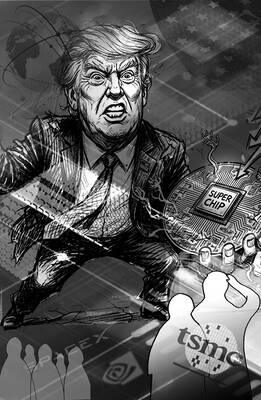
The White House’s decision to take a 9.9 percent stake in Intel Corp is looking like very shrewd business indeed. Since the government bought in at US$20.47 a share last August, the US chipmaker’s surging stock price has delivered the US a US$43 billion return. One of the reasons the investment has so far proved so sound is that the White House has made sure of it. According to The Wall Street Journal, Howard personally pushed deals on Intel’s behalf with some of the most lucrative clients imaginable. They include Nvidia Corp, the company at the heart of the AI
The Ministry of the Interior, working with the navy and coast guard, is organizing Taiwan’s first joint exercise simulating escort tankers carrying liquefied natural gas (LNG) and oil through a Chinese blockade. The drills simulate fuel transport along three maritime corridors leading toward Japan, the Philippines and the US. Deputy Minister of the Interior Sawyer Mars (馬士元) said that a blockade of the Taiwan Strait would amount to “almost a 100 percent blockade of the regional energy supply.” Minister of National Defense Wellington Koo said planning to counter a blockade is standard practice in Taipei. While the exercise is limited in
A single photograph can cut through a lot of noise, but it can also be used to misrepresent the truth. At the very least, it can concentrate the mind on something that requires further investigation. On Monday last week, Ma Ying-jeou Foundation CEO Tai Hsia-ling (戴遐齡) and former National Security Council secretary-general King Pu-tsung (金溥聰) held a news conference in which they showed a photograph of former foundation CEO Hsiao Hsu-tsen (蕭旭岑), now Chinese Nationalist Party (KMT) deputy chairman. In the image Hsiao is seated next to Xiamen Taiwan Businessmen Association chairman Han Ying-huan (韓螢煥). The two men were holding
I first met Professor Ray Jiing (井迎瑞) as a film and documentary student at Shih Hsin University’s (SHU) Department of Radio Television and Film in 1988. The following year, he went on to become the director of the Chinese Taipei Film Archive — forerunner of the Taiwan Film and Audiovisual Institute (TFAI). Over his eight-year tenure, Jiing rescued and restored over 200 classic Taiwanese films. In 1997, he established the Graduate Institute of Studies in Documentary and Film Archiving at Tainan National University of the Arts (TNNUA), and I joined the program in his third cohort of students. Beyond a


 RSS
RSS