


The US is engaged in a national debate about school security after a mass shooting at Marjory Stoneman Douglas High School in Parkland, Florida. To US President Donald Trump and some gun supporters, the solution is to put more guns in the hands of trained school staff — including teachers — to “play defense” against a rampaging shooter.
The rest of the world has varying strategies to deal with violence around schools, but the US appears to be the only place in the world where some want to arm teachers to the degree that Trump has suggested. Rather, emergency drills, armed guards patrolling school campuses and intruder drills appear to be the norm.
ISRAEL
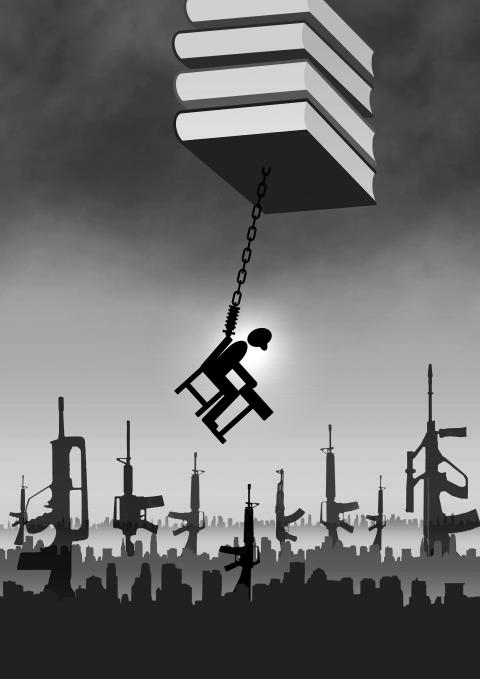
Illustration: Yusha
“The vast majority of schools have armed security guards,” Israeli Ministry of Education spokesman Amos Shavit said, adding that schools that do not are supposed to have heavy locks and security systems.
Visitors to a school are questioned by the guard, who checks their bags and sometimes uses a hand-held metal detector, and entry is strictly forbidden to anyone without authorization, Shavit said.
That is augmented by municipal security units that work in conjunction with police.
“If there is an incident at a school, they will be there in a minute or less,” Shavit said.
The small number of teachers who have a legal gun license and usually carry a weapon can do so in school, but it is not policy or encouraged, he said.
“Teachers here aren’t supposed to be carrying weapons in classrooms, teachers are supposed to teach,” he said.
RUSSIA
Violent incidents have been rare in Russian schools over the past years, but two attacks last month attracted nationwide attention and drew comparisons to school violence in the US.
In one, a teenager armed with an axe attacked fellow students at a school in southern Siberia, wounding five children and a teacher. In another attack in the Ural city of Perm, two teenagers stabbed children and their teacher with knives, wounding 15 people. They then attempted to kill each other, but were detained.
The incidents highlighted lax security in schools, triggering calls for stronger protection. Now, there are security guards at Russian schools.
? FRANCE
In the wake of deadly terrorist attacks in Paris and Nice, France introduced new security guidelines at schools when children went back to class in September 2016.
The measures, which remain in place, include a tighter screening of people entering schools, which can include bag checks, and improved coordination with police.
Police officers patrol in school areas, while parents and students are requested to avoid gathering near schools and to report any suspicious behavior or object.
French schools also hold three security drills each year, including one in which an alleged assailant enters their premises. Students are taught how to hide or to escape.
All students aged 13 and 14, as well as class representatives, get basic training on life-saving measures. In preschool and kindergarten, for toddlers aged two to six, children are taught to hide and keep quiet through games.
JAPAN
Attacks on schools are rare in Japan, which has seen a handful of knifings, but guns are practically non-existent. Security measures at Japanese schools became compulsory only after a June 2001 attack at an Osaka elementary school, where eight children were stabbed to death and 15 were injured by an intruder who was later sentenced to death and executed.
Japanese schools generally do not allow outsiders to freely walk in without getting permission at the gate, which is usually closed during school hours. Parents or other visitors must wear a pass to go in. Schools are also required to have an emergency manual on responses in case of crime or accident at school or while children are walking to and from school.
Some schools have set up security cameras and teachers sometimes take turns patrolling during breaks or lunchtime. Parents or neighborhood volunteers usually stand along designated commuting routes or intersections to watch kids as they walk to and from school.
Children usually carry handheld alarms attached to their school bags that they can use in an emergency while they are on the road. Schools, parent-teacher associations and students set up commuting routes and draw safety maps.
ITALY
Rome has been spared any terrorism-related attacks, but international schools in Italy’s capital have been identified as “soft targets” for several years and receive extra security. Several have army jeeps with machine-gun-toting soldiers standing guard.
The measures are similar for embassies, as well as popular outdoor gathering spots, such as the Campo dei Fiori market in Rome’s historic center. The increased security is more a response to fears of Muslim militants than of mentally unstable people getting hold of weapons. There have been no visible signs of increased security at public schools.
“In my country, teachers teach. They don’t open fire,” League Party leader Matteo Salvini said in response to questions about his views on the Trump administration.
SWEDEN
The Swedish National Agency for Education has issued a pamphlet for schools with general advice about what to do in case of an armed attack, including locking doors or barricading oneself, evacuating the premises and seeking shelter.
The brochure says that the guidelines are general because school buildings can vary.
There were no changes in security ordered after a 2015 attack on a school in the industrial town of Trollhattan, in which three people were killed by a masked sword-wielding man who was eventually shot and killed by police.
An investigation found that the attack was racially motivated: The school was located in a neighborhood with a large immigrant population.
POLAND
There is no armed security in Polish schools, which have not experienced any mass attacks. In most schools, visitors need to ring in to be admitted. Janitors at the doors are supposed to ask what brings them to the school. The main concerns are drug dealers and truancy.
Kindergartens are locked, mainly to prevent kids from wandering into the street or someone other than the parent picking up a child without written permission.
MEXICO
Mexico’s ongoing drug war has driven schools in Baja California, Monterrey, Ciudad Juarez and other cities to hold emergency drills, to instruct teachers and students on what to do in case of gunfire, which sometimes breaks out near schools during drug cartel shootouts.
Students are usually advised to drop to the floor, seek cover behind walls, remain calm and crawl to safety.
NIGERIA
Nigerian President Muhammadu Buhari has ordered security forces to defend all schools in “liberated areas” of the country’s northeast to avoid further mass abductions from schools by Boko Haram Muslim militants.
The order follows last month’s kidnapping of 110 girls at a school in the town of Dapchi, and requires leaders of police and civil defense forces to coordinate with the military and the governors of Borno, Yobe and Adamawa states.
Shettima Kullima, executive chairman of the Universal Basic Education Board in northern Nigeria’s Borno state, ruled out guns even in schools where soldiers serve as teachers and said that students should be trained to be aware of security threats.
Students would find armed teachers “highly distractive and disorienting” and could associate teachers with fear, said Yusuf Tom, a teacher in Maiduguri.
Better to have private security guards frisking people at the entrances of schools, in addition to metal detectors, he said.
According to data from UNICEF and the Borno state government, about 1,397 schools have been destroyed in the state by Boko Haram militants and 2,295 teachers have been killed since 2009.
In Yobe State, where the latest mass abduction occurred, the government has said it is deploying armed security personnel to schools in remote locations.
Ian Deitch in Israel, Vladimir Isachenkov in Russia, Samuel Petrequin in France, Mari Yamaguchi in Japan, Nicole Winfield in Italy, Jan Olsen in Sweden, Fernando Gonzalez in Mexico, Monika Scislowska in Poland, Sam Olukoya and Haruna Umar in Nigeria and Maria Danilova in Washington contributed to this report.
Minister of Labor Hung Sun-han (洪申翰) on April 9 said that the first group of Indian workers could arrive as early as this year as part of a memorandum of understanding (MOU) between the Taipei Economic and Cultural Center in India and the India Taipei Association. Signed in February 2024, the MOU stipulates that Taipei would decide the number of migrant workers and which industries would employ them, while New Delhi would manage recruitment and training. Employment would be governed by the laws of both countries. Months after its signing, the two sides agreed that 1,000 migrant workers from India would
In recent weeks, Taiwan has witnessed a surge of public anxiety over the possible introduction of Indian migrant workers. What began as a policy signal from the Ministry of Labor quickly escalated into a broader controversy. Petitions gathered thousands of signatures within days, political figures issued strong warnings, and social media became saturated with concerns about public safety and social stability. At first glance, this appears to be a straightforward policy question: Should Taiwan introduce Indian migrant workers or not? However, this framing is misleading. The current debate is not fundamentally about India. It is about Taiwan’s labor system, its
On March 31, the South Korean Ministry of Foreign Affairs released declassified diplomatic records from 1995 that drew wide domestic media attention. One revelation stood out: North Korea had once raised the possibility of diplomatic relations with Taiwan. In a meeting with visiting Chinese officials in May 1995, as then-Chinese president Jiang Zemin (江澤民) prepared for a visit to South Korea, North Korean officials objected to Beijing’s growing ties with Seoul and raised Taiwan directly. According to the newly released records, North Korean officials asked why Pyongyang should refrain from developing relations with Taiwan while China and South Korea were expanding high-level
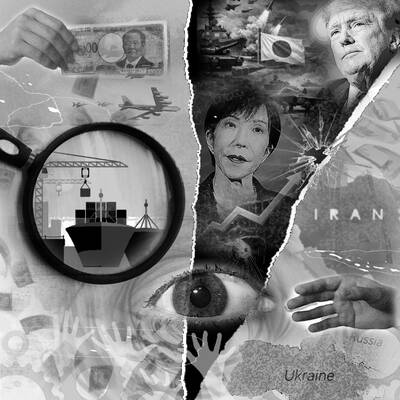
Japan’s imminent easing of arms export rules has sparked strong interest from Warsaw to Manila, Reuters reporting found, as US President Donald Trump wavers on security commitments to allies, and the wars in Iran and Ukraine strain US weapons supplies. Japanese Prime Minister Sanae Takaichi’s ruling party approved the changes this week as she tries to invigorate the pacifist country’s military industrial base. Her government would formally adopt the new rules as soon as this month, three Japanese government officials told Reuters. Despite largely isolating itself from global arms markets since World War II, Japan spends enough on its own


 RSS
RSS