

Taiwan and China in January 2015 consulted over the M503 flight route, which runs northeast to southwest about 8 nautical miles (14.8km) west of the median line of the Taiwan Strait.
At the time, China said that overland civil aviation routes from Shanghai to Guangzhou had become so congested that it needed to open a new air artery over the Strait.
Taiwan countered that air routes over the Strait were too congested for such a move, so the two sides compromised on a southbound-only opening and agreed that China would not seek additional northbound routes without prior consultation.
The median line has been a useful concept for air traffic over the Strait for more than six decades. US Air Force general Benjamin Davis demarcated the median line in 1955 for rules of engagement purposes in the strife-torn Strait.
Davis was the commander of the 13th Air Task Force in Taiwan just prior to the 1958 Taiwan Strait Crisis, during which China shelled the islands of Kinmen and Matsu off its east coast to “liberate” Taiwan from the Chinese Nationalist Party (KMT).
The median line was such a useful construct that during the 1958 crisis it became known as the “Davis Line.”
It was tacitly accepted by the Chinese air force and the KMT as the transition point from innocent passage to hostile action, and both sides tended to stay as far away from it as they were comfortable.
For close to 65 years, the “Davis Line” has been central to the Taiwan-China maritime and civil aviation “status quo” in the Strait.
Since the 1958 crisis, the Strait has become one of the busiest international air corridors in the world, if not the busiest, with 29,494 departures last year on the 935km route.
Thanks to Taiwanese and Hong Kong civil aviation negotiators, as well as the air traffic controllers of Hong Kong and Taipei Flight Information Region (FIR), the route is also one of the safest and best-managed in the world.
The Taipei FIR covers 466,198km2 and provides services for nearly 1.53 million controlled flights carrying 58 million travelers annually.
The instrumentation and equipment that air traffic controllers use, the procedures they adhere to and the safety checklists that pilots, air traffic controllers, ground safety teams, coast guard and military personnel must adopt as common standards all require constant interaction and communication with the International Civil Aviation Organization (ICAO).
However, because Taiwan has been excluded from the ICAO since 1971, Taiwanese civil aviation offices have had to rely primarily on the generosity of the US Department of Transportation to keep them informed and up-to-date on ICAO rules and standards.
China, on the other hand, demands that Taiwan place itself in Chinese jurisdiction in exchange for allowing Taiwan’s civil aviation officials anywhere near the ICAO.
China invited Taiwan to participate in some ICAO activities and to observe the triennial ICAO assembly in 2013, but at the cost of Taiwan acquiescing to Chinese jurisdiction.
However, China frowned upon Taiwan’s participation in the 2016 ICAO assembly, claiming that President Tsai Ing-wen (蔡英文) was insufficiently servile to China’s superior status.
And of course it does not help that ICAO’s new secretary-general, Liu Fang (柳芳), is Chinese.
China on Jan. 4 unilaterally decided to open northbound flights on the M503 route without so much as a hi-dee-ho in Taiwan’s direction.
In addition, China mapped three feeder routes into the Strait, intersecting with M503 8 nautical miles short of the “Davis Line.”
Never mind that Beijing is required by ICAO procedures to coordinate with “affected parties” before launching new routes.
Under Item 4.2.6 of the ICAO’s Air Traffic Services Planning Manual, changes to any route should be made only after it has been coordinated with all parties concerned.
American Institute in Taiwan (AIT) spokeswoman Sonia Urbom reiterated the US government’s position that it opposes any unilateral actions by either side of the Strait to alter the cross-strait “status quo.”
“We encourage authorities in Beijing and Taipei to engage in constructive dialogue, on the basis of dignity and respect,” she added.
However, Washington should be more alarmed by the sudden erosion of nearly seven decades of the precious “status quo” in the Strait.
We therefore recommend that the US administration dispatch US Secretary of Transportation Elaine Chao (趙小蘭) to Taiwan to oversee US-Taiwan civil aviation cooperation, especially in areas where Taiwan and the US need to coordinate on ICAO standards and routinize information exchanges.
Perhaps the US Department of Transportation could attach an officer to the AIT in Taipei as a civil aviation attache.
However, if the shipping and aviation “status quo” in the Strait is to be shorn up, both Taipei and Washington must act now.
Peter Chen is president of the Washington-based Formosan Association for Public Affairs.
Taiwan’s democracy and high-tech economy play a crucial role in global affairs and are central to the world’s embrace of a raft of next-generation technologies, including AI. It is underpinned by a security relationship with the United States that’s existed in several iterations since 1949 and the Chinese Nationalist Party’s (KMT) retreat from China. A central pillar of that security relationship is the American willingness to sell arms to Taiwan. Indeed, since 1979 it has been embedded in US law, with the Taiwan Relations Act (TRA) charging the US with helping to improve the island’s ability to deter an attack from
Academia Historica director Chen Tsui-lien (陳翠蓮), speaking at the handover ceremony for her new role on Monday, said that when she accepted the position, she knew that her peaceful life as a history professor was a thing of the past, and that from now on she would have to “wear a helmet.” A specialist in Taiwan’s post-World War II history and the 228 Incident, she has been accused of being politically divisive. A phrase she used in her acceptance speech set headlines alight this week, putting her in the sights of editorials in blue-leaning media. She said opposition figures calling for
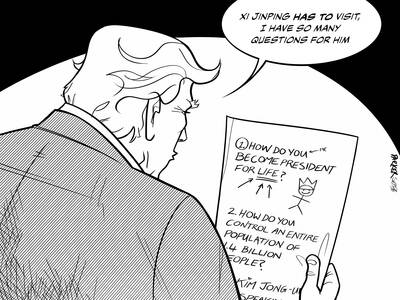
EDITORIAL CARTOON
Taiwanese-Americans, lawmakers and civic groups marched through Manhattan on Saturday last week in support of Taiwan’s participation in the UN. Marshall Islands Permanent Representative to the UN John Silk joined the demonstration, saying he hoped Taiwan would one day be able to participate in UN meetings as a member, and Democratic Progressive Party Legislator Wang Yi-chuan (王義川) took part while visiting New York City with a delegation. Taiwanese communities in Vancouver held a “UN for Taiwan” event. The campaign comes as the 81st UN General Assembly gets under way. In Taipei, President William Lai (賴清德) said China was deliberately misinterpreting UN


 RSS
RSS