


Alarmed by the rise of unpredictable strongmen around the world, German Chancellor Angela Merkel feels she must do more to defend the Western order on which Germany depends.
It has been a transformation for Merkel. Last year, she dismissed as “absurd” the idea that she should head a Western alliance shaken by US President Donald Trump’s election victory.
Weakened by Europe’s migrant crisis, Merkel even wondered if she should run for re-election.
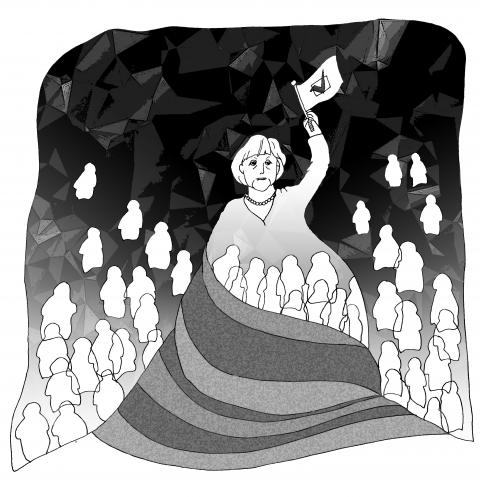
Illustration: Tania Chou
“She asked herself: ‘Can I do this? Am I ready for this?’” one close aide said.
Yet now, with the migrant issue under control in Germany, the 63-year-old is ready. Visibly happier, she is campaigning for next month’s election with renewed conviction: a resolve to secure a world order threatened by leaders like Trump, Russian President Vladimir Putin and North Korean leader Kim Jong-un.
On the campaign trail, she likes to invoke the “uncertain situation in the world.”
The message is clear, the aide said: “Things have changed; this means Germany must take on more responsibility.”
German foreign policy has been constrained by the legacy of the last World War. However, Merkel is pushing Berlin’s interests beyond its traditional European sphere.
With North Korea, she says Germany is ready to offer diplomatic and political muscle if required, a senior government source said.
Germany is one of the few Western countries with an embassy in Pyongyang and is willing to do what it can to use this channel to help bring about talks.
At the same time, Merkel is using the trade-based relationship she has nurtured with China to press Beijing to help defuse the dispute.
“We must use our good relations with the Chinese to encourage them to come up with constructive proposals on what can be done,” German Bundestag Coordinator of Transatlantic Cooperation Juergen Hardt said.
GUARDIAN ANGELA
In April last year, Merkel described how she realized that trouble on the EU’s doorstep meant Germany must play a bigger role beyond its borders.
Looking at a map showing the Shengen Area — Europe’s passport-free area — in one color and neighboring countries in another, she saw clearly how close Syria and Ukraine were.
“This is Europe’s neighborhood,” she said.
Reacting to crises in this neighborhood, Merkel first strongarmed Turkish President Tayyip Erdogan into a deal to stem the migrant flow from Syria in exchange for EU economic aid.
Now, she wants to slow the tide of refugees from Africa with a new “Marshall Plan” to bring investment and business growth that should persuade people to stay at home.
In Ukraine, Merkel is pursuing with France a joint diplomatic response to Russian meddling, though this has yet to produce peace.
“All of a sudden, German policymakers realize they need to be much bigger stakeholders in this global order on which they depend, but into which they have not invested as much as they should,” said Jan Techau of the American Academy in Berlin.
Merkel is starting to take diplomatic positions out of conviction — a departure from her consensus-based style during the eurozone and migrant crises.
This shift began after Trump’s election, when she set out how she would deal with him: a readiness to work closely on the basis of the values of democracy, freedom, respect for the law and for the dignity of people.
CLIMATE CHANGE
For Merkel, climate policy belongs to this value set. She sees it as crucial to managing globalization, and it has been her principal point of disagreement with Trump.
“We Europeans must really take our fate into our own hands,” she said.
When Trump announced he was quitting the Paris climate change agreement, she sought to isolate him.
Merkel wanted the six members of the G7 other than the US to issue a statement backing the accord, sources close to her said.
In the end, Germany, France and Italy signed. Britain, Canada and Japan — all with close ties to the US — did not.
Merkel stayed on the case. In the run-up to a summit last month of G20 leaders, which she chaired, she made a point of courting a list of countries hoping to profit from trade with Germany.
The upshot was isolation for Trump at the G20 meeting, where 19 members agreed that the Paris accord was “irreversible.”
At the same time, the communique included a text all G20 countries could sign, a compromise achieved with German help.
“In terms of global leadership, it’s not hugely ambitious,” one G20 diplomat said. “On the other hand, the success could be seen as getting Trump into the process: Take a step back to get him in, and later move forward with him.”
COMPROMISE
Despite her growing diplomatic assertiveness, it is this instinct to compromise that handicaps Merkel’s quest for a place in history alongside former West German chancellor Konrad Adenauer, who led the country’s rebirth after World War Two, and former German chancellor Helmut Kohl, who reunified the country.
Restricting Merkel’s room for maneuvering is the fact that many Germans are turned off by foreign policy, with one survey showing that just 30 percent of voters think it is a top priority for Germany to do more to promote its interests abroad
“The big problem is that this is not anything that sells at home,” Techau said. “You can’t win votes with this.”
Merkel is also hampered by Germany’s Nazi past, which has left it without the military might needed to project power.
Yet Kohl, Merkel’s mentor, took chances, first with reunification and then by defying public opinion to bring in the euro.
CAUTION
Merkel is altogether more cautious. In 2015, “merkeln” — a verb that means being unable to make decisions — was named Germany’s Youth Word of the Year.
German Member of European Parliament David McAllister, a close ally within the Merkel’s Christian Democratic Union party, said: “She looks at the different approaches to solve the problem and has a debate with her advisers about what’s best: A, B, C, or D. Then we go with the best option.”
This methodical approach, honed during her training as a physicist, can leave her upstaged by more dynamic leaders.
Trump and Putin did just that at the G20 summit, when they walked out of a session on climate change to hold a bilateral meeting that stole headlines and highlighted the ‘hard power’ they wield and Merkel does not.
Merkel still welcomed their meeting. As a committed Atlanticist, she does not want to alienate a US president. However, the episode showed the limits of what she can achieve on the world stage.
“Germans have learned that they will only do well if they are ready to compromise,” one senior party official said. “We don’t want to be the ones that people look at and feel they must tremble or admire.”
Additional reporting by Andreas Rinke and Roberta Rampton

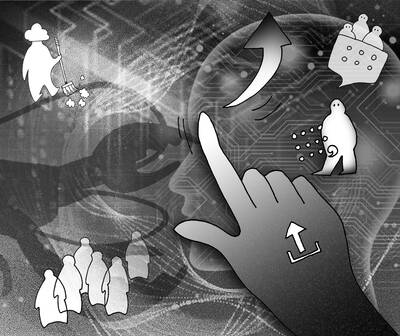
Weeks into the craze, nobody quite knows what to make of the OpenClaw mania sweeping China, marked by viral photos of retirees lining up for installation events and users gathering in red claw hats. The queues and cosplay inspired by the “raising a lobster” trend make for irresistible China clickbait. However, the West is fixating on the least important part of the story. As a consumer craze, OpenClaw — the AI agent designed to do tasks on a user’s behalf — would likely burn out. Without some developer background, it is too glitchy and technically awkward for true mainstream adoption,
On Monday, the day before Chinese Nationalist Party (KMT) Chairwoman Cheng Li-wun (鄭麗文) departed on her visit to China, the party released a promotional video titled “Only with peace can we ‘lie flat’” to highlight its desire to have peace across the Taiwan Strait. However, its use of the expression “lie flat” (tang ping, 躺平) drew sarcastic comments, with critics saying it sounded as if the party was “bowing down” to the Chinese Communist Party (CCP). Amid the controversy over the opposition parties blocking proposed defense budgets, Cheng departed for China after receiving an invitation from the CCP, with a meeting with
Chinese Nationalist Party (KMT) Chairwoman Cheng Li-wun (鄭麗文) is leading a delegation to China through Sunday. She is expected to meet with Chinese President Xi Jinping (習近平) in Beijing tomorrow. That date coincides with the anniversary of the signing of the Taiwan Relations Act (TRA), which marked a cornerstone of Taiwan-US relations. Staging their meeting on this date makes it clear that the Chinese Communist Party (CCP) intends to challenge the US and demonstrate its “authority” over Taiwan. Since the US severed official diplomatic relations with Taiwan in 1979, it has relied on the TRA as a legal basis for all
A delegation of Chinese Nationalist Party (KMT) officials led by Chairwoman Cheng Li-wun (鄭麗文) is to travel to China tomorrow for a six-day visit to Jiangsu, Shanghai and Beijing, which might end with a meeting between Cheng and Chinese President Xi Jinping (習近平). The trip was announced by Xinhua news agency on Monday last week, which cited China’s Taiwan Affairs Office (TAO) Director Song Tao (宋濤) as saying that Cheng has repeatedly expressed willingness to visit China, and that the Chinese Communist Party (CCP) Central Committee and Xi have extended an invitation. Although some people have been speculating about a potential Xi-Cheng


 RSS
RSS