


Following Donald Trump’s election as the 45th president of the US, Taiwanese observers have begun to fear that Trump — ever the businessman — would use Taiwan as a bargaining chip in exchanges with China to further US interests.
Michael Szonyi, director of the Fairbank Center at Harvard University, believes that under a Trump presidency, US policy toward Taiwan will become ambiguous and unpredictable, to the detriment of Taiwan.
According to an analysis by former National Security Bureau director Tsai Der-sheng (蔡得勝), “Trump is a businessman who cares primarily about his own interests” and that given the current political climate, Taiwan should be on the lookout for a possible “abandonment” of Taiwan by Washington. Given that China’s military power is on the rise and the economic benefits to the US’ access to the Chinese market, Tsai said that US think tanks and security advisers have for some time been advocating a policy of “abandonment.”
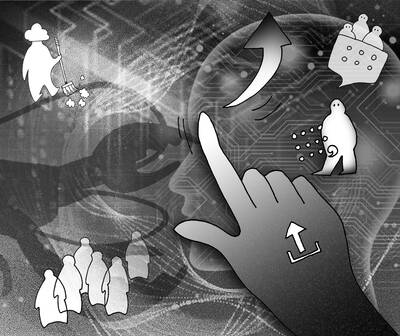
China outspends Taiwan’s military by about a factor of 20, while the US is not willing to sell Taiwan advanced military equipment. At a time when military power between Taiwan and China is extremely unbalanced and public opinion in the US is increasingly opposed to war, the only way for Taiwan to ensure its survival is to proactively pursue the development of non-military defense using non-violent civil defense techniques to bolster the nation’s conventional defensive capabilities.
This means resisting through comprehensive non-cooperation and civil disobedience without surrendering until invading forces are repelled. Non-violent civil disobedience entails political non-cooperation, a refusal to abide by the laws and orders enacted by the invader. Economic non-cooperation measures would include labor strikes, boycott of classes, not paying taxes, a shopkeepers’ strike, boycott of goods, occupations or any actions that would cause paralysis to the system of government and would mean that the invader is unable to reap economic benefits. In the cultural sphere, the public would resist brainwashing, refuse to watch or listen to any of the occupier’s broadcasts or propaganda and boycott all its activities. The invading force’s cost of occupation would increase dozens of times compared with its military cost, and be unable to assume control, it would be forced to retreat.
History is full of examples of successful civil resistance. Mahatma Gandhi led India’s peaceful independence movement; the three small Baltic states, Lithuania, Latvia and Estonia resisted the Soviet Union and successfully gained their independence; and Serbians overthrew former Serbian president Slobodan Milosevic.
Civil resistance does not imply weakening or diminishing the existing national defense structure or displacing military defenses. Rather, it provides strong support complementarity to national defense.
The Ministry of the Interior should establish a civil defensive system that runs parallel to Taiwan’s established national defense structures. If China were to carry out a military attack on Taiwan, the public would need a well-trained military force to defend the nation and strike back.
The onslaught of war would unite Taiwanese in resistance and a concerned international community would condemn China’s invasion. As the nation’s defenses wear down and the Chinese People’s Liberation Army makes landfall, Taiwan’s non-military civic defense would swing into action to put up a comprehensive resistance against the Chinese army.
Faced with unarmed civilians, authorizing a massacre would be foolhardy and doing so would placed China under extreme moral pressure and make it the target of international condemnation, while at the same time voices within China would start to question the necessity of using military force due to fears that it could cause internal instability within China.
Without a legitimate mandate to use military force against unarmed Taiwanese civilians, Beijing would realize that governing Taiwan would be impossible. Taiwanese would be able to win over the sympathy and support of the international community so that China’s occupying forces would eventually be forced to retreat and Taiwan would be able to restore its democratic freedoms.
The threat of a nonviolent civil defense would be sufficient to deter China from acting rashly. With the nation’s leaders receiving the full support of Taiwanese, the nation would be on a more even footing with China and could argue for Beijing to respect the wishes of Taiwanese and stand up for its democratic values.
Taiwan’s civil defense is tasked with supporting the nation’s conventional military defense and it has not been assigned an independent defensive role. The government should amend the Civilian Defense Act (民防法) as soon as possible and add a special non-military defense clause to allow for the establishment of a research center for the study of strategic and tactical non-military civil defense.
The government should establish a department to take charge of civil defense, and produce teaching materials and provide training for civic groups and organizations. It should also actively develop the nation’s non-military defense capabilities to supplement conventional defense forces and safeguard the security of Taiwan.
Chien Hsi-chieh is executive director of the Peacetime Foundation of Taiwan.
Translated by Edward Jones

Weeks into the craze, nobody quite knows what to make of the OpenClaw mania sweeping China, marked by viral photos of retirees lining up for installation events and users gathering in red claw hats. The queues and cosplay inspired by the “raising a lobster” trend make for irresistible China clickbait. However, the West is fixating on the least important part of the story. As a consumer craze, OpenClaw — the AI agent designed to do tasks on a user’s behalf — would likely burn out. Without some developer background, it is too glitchy and technically awkward for true mainstream adoption,
On Monday, the day before Chinese Nationalist Party (KMT) Chairwoman Cheng Li-wun (鄭麗文) departed on her visit to China, the party released a promotional video titled “Only with peace can we ‘lie flat’” to highlight its desire to have peace across the Taiwan Strait. However, its use of the expression “lie flat” (tang ping, 躺平) drew sarcastic comments, with critics saying it sounded as if the party was “bowing down” to the Chinese Communist Party (CCP). Amid the controversy over the opposition parties blocking proposed defense budgets, Cheng departed for China after receiving an invitation from the CCP, with a meeting with
Chinese Nationalist Party (KMT) Chairwoman Cheng Li-wun (鄭麗文) is leading a delegation to China through Sunday. She is expected to meet with Chinese President Xi Jinping (習近平) in Beijing tomorrow. That date coincides with the anniversary of the signing of the Taiwan Relations Act (TRA), which marked a cornerstone of Taiwan-US relations. Staging their meeting on this date makes it clear that the Chinese Communist Party (CCP) intends to challenge the US and demonstrate its “authority” over Taiwan. Since the US severed official diplomatic relations with Taiwan in 1979, it has relied on the TRA as a legal basis for all
A delegation of Chinese Nationalist Party (KMT) officials led by Chairwoman Cheng Li-wun (鄭麗文) is to travel to China tomorrow for a six-day visit to Jiangsu, Shanghai and Beijing, which might end with a meeting between Cheng and Chinese President Xi Jinping (習近平). The trip was announced by Xinhua news agency on Monday last week, which cited China’s Taiwan Affairs Office (TAO) Director Song Tao (宋濤) as saying that Cheng has repeatedly expressed willingness to visit China, and that the Chinese Communist Party (CCP) Central Committee and Xi have extended an invitation. Although some people have been speculating about a potential Xi-Cheng


 RSS
RSS