


Let us be clear: Installing Donald Trump in the White House is an epic mistake. In the long run, its consequences might well be apocalyptic, if only because we have probably lost our last, best chance to rein in runaway climate change.
However, will the extent of the disaster become apparent right away? It is natural and, one must admit, tempting to predict a quick comeuppance — and I myself gave in to that temptation, briefly, on that horrible election night, suggesting that a global recession was imminent. However, I quickly retracted that call. Trumpism will have dire effects, but they will take time to become manifest.
In fact, do not be surprised if economic growth actually accelerates for a couple of years.
Why am I, on reflection, relatively sanguine about the short-term effects of putting such a terrible man, with such a terrible team, in power? The answer is a mix of general principles and the specifics of our current economic situation.
First, the general principles: There is always a disconnect between what is good for society, or even the economy, in the long run and what is good for economic performance over the next few quarters. Failure to take action on climate might doom civilization, but it is not clear why it should depress next year’s consumer spending.
Or take the signature Trump issue of trade policy. A return to protectionism and trade wars would make the world economy poorer over time, and would in particular cripple poorer nations that desperately need open markets for their products.
However, predictions that Trumpist tariffs would cause a recession never made sense: Yes, the US will export less, but it will also import less and the overall effect on jobs will be more or less a wash.
The US already had a sort of dress rehearsal for this disconnect in the case of Brexit, Britain’s vote to leave the EU. Brexit will make Britain poorer in the long run, but widespread predictions that it would cause a recession were, as some pointed out at the time, not really based on careful economic thinking. And sure enough, the Brexit recession does not seem to be happening.
Beyond these general principles, the specifics of the US’ economic situation mean that for a time, at least, a Trump administration might actually end up doing the right thing for the wrong reasons.
Eight years ago, as the world was plunging into financial crisis, I argued that the US had entered an economic realm in which “virtue is vice, caution is risky and prudence is folly.” Specifically, the US had stumbled into a situation in which bigger deficits and higher inflation were good things, not bad. And the US is still in that situation — not as strongly as it was, but the US could still very much use more deficit spending.
Many economists have known this all along, but they have been ignored, partly because much of the political establishment has been obsessed with the evils of debt, partly because US Republicans have been against anything the administration of US President Barack Obama proposes.
However, power has now fallen into the hands of a man who definitely does not suffer from an excess of either virtue or prudence. Trump is not proposing huge, budget-busting tax cuts for the wealthy and corporations because he understands macroeconomics. However, those tax cuts would add US$4.5 trillion to US debt over the next decade — about five times as much as the stimulus of the early Obama years.
True, handing out windfalls to rich people and companies that will probably sit on a lot of the money is a bad, low-bang-for-the-buck way to boost the economy, and I have my doubts about whether the promised surge in infrastructure spending will really happen. However, an accidental, badly designed stimulus would still, in the short run, be better than no stimulus at all.
In short, do not expect an immediate Trump slump.
In the longer run Trumpism will be a very bad thing for the US economy, in a couple of ways.
For one thing, even if the US does not face a recession right now, stuff happens, and a lot depends on the effectiveness of the policy response. Yet we are about to see a major degradation in both the quality and the independence of public servants. If the US faces a new economic crisis — perhaps as a result of the dismantling of financial reform — it is hard to think of people less prepared to deal with it.
And Trumpist policies will, in particular, hurt, not help, the US’ working class. Eventually, promises to bring back the good old days — yes, to make America great again — will be revealed as the cruel joke they are.
However, all of this will probably take time; the consequences of the new regime’s awfulness will not be apparent right away. Opponents of that regime need to be prepared for the real possibility that good things will happen to bad people, at least for a while.

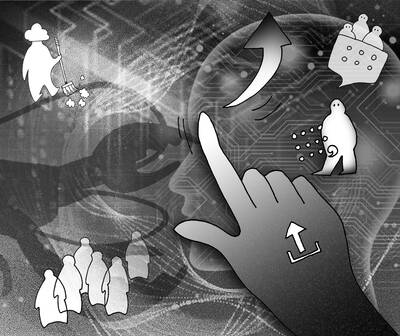
Weeks into the craze, nobody quite knows what to make of the OpenClaw mania sweeping China, marked by viral photos of retirees lining up for installation events and users gathering in red claw hats. The queues and cosplay inspired by the “raising a lobster” trend make for irresistible China clickbait. However, the West is fixating on the least important part of the story. As a consumer craze, OpenClaw — the AI agent designed to do tasks on a user’s behalf — would likely burn out. Without some developer background, it is too glitchy and technically awkward for true mainstream adoption,
On Monday, the day before Chinese Nationalist Party (KMT) Chairwoman Cheng Li-wun (鄭麗文) departed on her visit to China, the party released a promotional video titled “Only with peace can we ‘lie flat’” to highlight its desire to have peace across the Taiwan Strait. However, its use of the expression “lie flat” (tang ping, 躺平) drew sarcastic comments, with critics saying it sounded as if the party was “bowing down” to the Chinese Communist Party (CCP). Amid the controversy over the opposition parties blocking proposed defense budgets, Cheng departed for China after receiving an invitation from the CCP, with a meeting with
Chinese Nationalist Party (KMT) Chairwoman Cheng Li-wun (鄭麗文) is leading a delegation to China through Sunday. She is expected to meet with Chinese President Xi Jinping (習近平) in Beijing tomorrow. That date coincides with the anniversary of the signing of the Taiwan Relations Act (TRA), which marked a cornerstone of Taiwan-US relations. Staging their meeting on this date makes it clear that the Chinese Communist Party (CCP) intends to challenge the US and demonstrate its “authority” over Taiwan. Since the US severed official diplomatic relations with Taiwan in 1979, it has relied on the TRA as a legal basis for all
A delegation of Chinese Nationalist Party (KMT) officials led by Chairwoman Cheng Li-wun (鄭麗文) is to travel to China tomorrow for a six-day visit to Jiangsu, Shanghai and Beijing, which might end with a meeting between Cheng and Chinese President Xi Jinping (習近平). The trip was announced by Xinhua news agency on Monday last week, which cited China’s Taiwan Affairs Office (TAO) Director Song Tao (宋濤) as saying that Cheng has repeatedly expressed willingness to visit China, and that the Chinese Communist Party (CCP) Central Committee and Xi have extended an invitation. Although some people have been speculating about a potential Xi-Cheng


 RSS
RSS