


As Taiwanese continue to grow in the exercise and appreciation of their hard-won democracy, they are now recognizing how they have also outgrown the immaturity found in those who follow and adhere to a cult of personality.
A natural contributor to this growth is, of course, the scrutiny of a free press, which Taiwan has. Take for example, President Tsai Ing-wen (蔡英文): She has not yet reached that somewhat arbitrary judgement day when her performance will be evaluated, ie, that of her first 100 days in office. However, she is already feeling the heat of scrutiny of her actions and her Cabinet appointments.
This scrutiny is the same that is put on any official in a democracy. Chosen by the will of the people, elected officials quickly learn and accept that their actions will have to pass the test of constant public scrutiny. So even if Tsai hoped for a cult of personality, which she does not, she knows that performance and not personality will be the key to her success. The media are always watching.
Such careful observation is not new to Tsai. Her experience in Taiwan’s democracy has certainly made her conscious of this scrutiny. She weathered many storms and criticisms both in getting to be chairperson of the Democratic Progressive Party (DPP) and in losing public elections. After winning the party’s presidential nomination last year, she eventually went on to become president of the nation. Throughout all, she has had to rely on her performance.
A free press, of course, does not take place in a vacuum; it is essential that it be exercised in a multi-party democracy where no one person or party has control over the mass media, or any state means of propaganda.
On the opposite side of the scale of a democracy stands the one-party-state dictatorship, the natural breeding ground for a cult of personality.
In Asia, for example, the foremost leader who can be said to enjoy a cult of personality would be North Korean leader Kim Jong-un. This stands in contrast to Taiwan, where the cult of personality has died with good riddance.
An additional contributor to the decline of the cult of personality in Taiwan and the modern world is the constantly developing easy access to information and communication on the Internet and mobile phones that people have. Information moves swiftly, not only across a nation, but around the world. Events and actions, good and bad, that happen in one place or area are almost instantaneously announced and made known everywhere. Even a firewall in a one-party state only serves to slow this down.
Taiwanese, of course, have an additional advantage from their history. They had a definite spate with the cult of personality as they emerged from their own one-party-state days under the Chinese Nationalist Party (KMT). This reality is something that they must regularly reflect on.
Taiwanese first experienced a cult of personality in Chiang Kai-shek (蔣介石), who fled to Taiwan with the remnants of his army and followers after losing the Chinese Civil War. His government imposed martial law and the resulting White Terror era, while at the same time trying to build a cult around Chiang.
After Chiang’s death, the KMT strove to perpetuate that cult by constructing the Chiang Kai-shek memorial, a monument that might have been well received in the one-party-state days, but is now regarded by many as a monument to a dead dictator. It is seen as a constant reminder of that past and the brainwashing the people received at that time.
Chiang’s son, former president Chiang Ching-kuo (蔣經國) also had his moments flirting with a cult of personality. Many remember his heavy-handed side as director of the secret police and an assassination attempt was made on his life. However, the people also acknowledge that the one-party state was dismantled under his presidency.
Former president Lee Teng-hui (李登輝), who served as vice president under Chiang Ching-kuo and met with him daily, put it this way: When asked whether Chiang Ching-kuo fostered democracy due to his personal beliefs or because he felt a growing public pressure, Lee answered enigmatically and/or diplomatically: “Because of both.”
In today’s world, former president Ma Ying-jeou (馬英九) stood as the KMT’s last chance to develop a cult of personality and the best example of how a free press and democracy militate against such.
Ma’s fall from grace stands as a classic example of the unreliability of pre-hyped personality. He was elected with the highest percentage of the vote of any Republic of China president, but his performance soon faltered. Shortly into the start of his second term, he was already known as the “bumbler” and his [approval] ratings dipped at one point to 9 percent.
In Taiwan, the cult of personality can be said to have clearly died with Ma.
Historically, democracies find it difficult to sustain a cult of personality. In the UK, former prime minister Winston Churchill was hailed as the man who led the nation throughout World War II, but he was not elected as a leader for the peacetime that followed.
In the US, presidents also know that even if they are elected for one term, any popularity that comes from that does not mean they will be re-elected.
With this knowledge, Taiwanese can compare their nation and its history of cults of personality with that of the one-party state on the other side of the Taiwan Strait. It is true that China’s leaders do feel the pressure to perform well, even though they keep the press from being too critical.
However, while a developing democracy in Russia has come to terms with Joseph Stalin, and a democratic Germany has come to terms with Adolf Hitler, China still has not been able to come to terms with Mao Zedong (毛澤東) and all the deaths that happened under him. The lack of a free press and the lack of democracy will always prove to be a stumbling block there.
One might be tempted to suggest that China could learn from Taiwan and how it outgrew its immature reliance on any cult of its leaders, but that is an admission that most Chinese would find difficult, if not impossible, to swallow.
Jerome Keating is a writer based in Taipei.

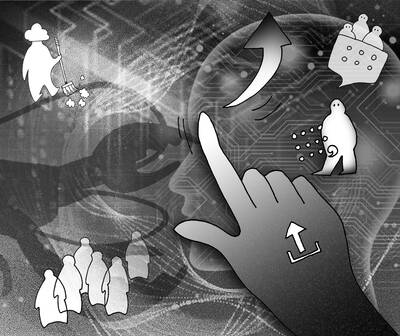
Weeks into the craze, nobody quite knows what to make of the OpenClaw mania sweeping China, marked by viral photos of retirees lining up for installation events and users gathering in red claw hats. The queues and cosplay inspired by the “raising a lobster” trend make for irresistible China clickbait. However, the West is fixating on the least important part of the story. As a consumer craze, OpenClaw — the AI agent designed to do tasks on a user’s behalf — would likely burn out. Without some developer background, it is too glitchy and technically awkward for true mainstream adoption,
On Monday, the day before Chinese Nationalist Party (KMT) Chairwoman Cheng Li-wun (鄭麗文) departed on her visit to China, the party released a promotional video titled “Only with peace can we ‘lie flat’” to highlight its desire to have peace across the Taiwan Strait. However, its use of the expression “lie flat” (tang ping, 躺平) drew sarcastic comments, with critics saying it sounded as if the party was “bowing down” to the Chinese Communist Party (CCP). Amid the controversy over the opposition parties blocking proposed defense budgets, Cheng departed for China after receiving an invitation from the CCP, with a meeting with
Chinese Nationalist Party (KMT) Chairwoman Cheng Li-wun (鄭麗文) is leading a delegation to China through Sunday. She is expected to meet with Chinese President Xi Jinping (習近平) in Beijing tomorrow. That date coincides with the anniversary of the signing of the Taiwan Relations Act (TRA), which marked a cornerstone of Taiwan-US relations. Staging their meeting on this date makes it clear that the Chinese Communist Party (CCP) intends to challenge the US and demonstrate its “authority” over Taiwan. Since the US severed official diplomatic relations with Taiwan in 1979, it has relied on the TRA as a legal basis for all
A delegation of Chinese Nationalist Party (KMT) officials led by Chairwoman Cheng Li-wun (鄭麗文) is to travel to China tomorrow for a six-day visit to Jiangsu, Shanghai and Beijing, which might end with a meeting between Cheng and Chinese President Xi Jinping (習近平). The trip was announced by Xinhua news agency on Monday last week, which cited China’s Taiwan Affairs Office (TAO) Director Song Tao (宋濤) as saying that Cheng has repeatedly expressed willingness to visit China, and that the Chinese Communist Party (CCP) Central Committee and Xi have extended an invitation. Although some people have been speculating about a potential Xi-Cheng


 RSS
RSS