


Akira, 37, lives in the heart of Tokyo, a metropolis that lights up like a fluorescent fairground at night. She shares the city with 13.35 million other residents, but had no one to turn to when she was suffering from anorexia and bulimia.
It is an issue she has faced since she was 11.
“Bulimia is very common, but in Japan people don’t really care about mental health issues,” she said. “People just avoid talking about them.”
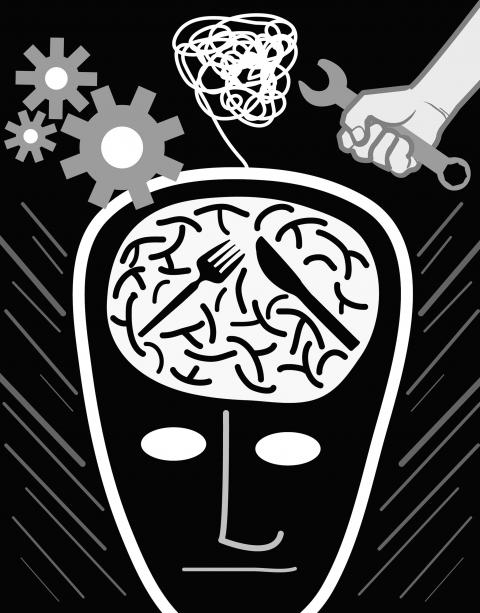
illustration: Lance Liu
She could not open up to friends and family members and so ended up joining Overeaters Anonymous, a program that tackles a variety of food-related issues from starving to using food as a reward.
She also started going to an English-language help center for counseling, but the service is expensive and ineffective.
“None of the help offered has been of any use,” she said. “I can talk for about five minutes in Overeaters Anonymous and that’s about it. In my experience, no one really understands having an eating disorder, so there’s basically no one who can help.”
Japanese doctors warned recently that their health system is failing hundreds of thousands of people like Akira — many of them teenage girls.
The BBC spoke to Japan Society for Eating Disorders president Toshio Ishikwa, who said: “It’s often too late by the time the patient is seen in a hospital. Their condition is very severe. Sometimes they are even close to death.”
This needs to change — and fast, as eating disorders have been on the rise since the 1980s, according to a 2009 study. Another study last year, which was based on questionnaires sent to schools in seven prefectures in Japan, found that the prevalence of anorexia nervosa among adolescents is similar to that found in Europe and the US. It particularly affects girls: The number of boys affected was one-third that of girls in some prefectures.
Few hospitals in Japan deal specifically with eating disorders and most sufferers, like Akira, must go to independent clinics where staff are not trained to assess the psychological causes of the illness. The government partly funds a handful of community support groups, which can help spot the early signs of illness.
However, change might be on the way. In 2000, the Japanese Ministry of Health, Labor and Welfare drew up plans to research the issue and established specialized medical centers throughout Japan. Last year, it created a policy to fund five acute treatment centers for eating disorders in hospitals around the country, as well as putting money toward a national center.
The biggest independent support organization at the moment is the Nippon Anorexia and Bulimia Association, a self-help group comprised of 200 chronic sufferers of anorexia and bulimia. It is where Kaiyo, 42, who has suffered from bulimia, went when she was 17.
“Their format was similar to Anorexics Anonymous, where you talk about and accept your problems with others, but it wasn’t effective enough,” she said.
Doctors have agreed that support groups on their own are not sufficient.
Part of the reason for the lack of treatment is cultural, according to Hanu, 23, who said there is a stigma around eating disorders and mental health concerns in Japan.
Hanu has been binging and purging since she was in high school, but has never been diagnosed, despite seeing a psychiatrist for years.
Hanu said that her eating disorder is not about body image.
“When it all started, eating was, for me, the only sensually satisfying experience. Japanese people never hug or kiss or cuddle and, even as a kid, you don’t get many of these from your parents or siblings. I think that’s why I resorted to comfort from eating at an early age,” she said.
Eri, 45, agrees. She started binge eating to help deal with life’s pressures, but then found eating itself became a stress.
Both she and Hanu also talk about the shame and guilt associated with wasting food.
“This is particularly true in Japan,” she said. “Maybe it came from the first world war — when we were forced to provide food for the imperial soldiers while the citizens were starving. My mother couldn’t throw away food; when I opened the freezer, the frozen foods fell off the shelves on my head. I remember I was pressured into eating every last grain of rice otherwise I would have to feel sorry and sinful. At school those kids with lactose intolerance were commonly seen puking up milk,” she said.
“My parents never taught me to listen to my own feelings and body, and stop eating when I was full. I was just told to eat what you’re given,” she adds.
However, it is no secret that there is pressure to be slim in Japan. With its small portions of low-calorie foods such as vegetables and oily fish, the country has one of the lowest obesity rates in the world.
This pressure is compounded by the 2008 “Metabo law,” which requires those aged 40 to 75 to keep within certain waist measurements. This rule was promoted all over the Japan with posters and signs.
Akira said she feels she has to live up to an ideal body image — the women shown in the media are often very thin.
“In every combini [convenience store] there’s a big magazine rack with anime porn and actual porn, all of it featuring degrading images of women — half naked, boobs busting out of tiny bikinis, their T-shirts stretching to contain their ample boobs, their knees drawn up to show a tiny triangle of panty,” she said. “This is total objectification. There are no men being shown this way, only girls and women, in every combini, and that’s just for starters.”
Kaiyo said it is “normal” to be thin in Japan, and failing to fit in to the stereotype can lead to a lack of acceptance from friends and wider society.
International relations expert Nancy Snow, from the US, has lived in Tokyo for the past four years.
“There is an obsession here with food because it is so high-quality. Every picture I put up [on social media] of food gets more likes than anything else, we talk about food constantly,” she said.
Snow’s analysis of the larger cultural landscape has led her to think the issue could be down to a lack of female empowerment, with women looking for a way to reclaim some control.
Snow said that she can understand why people in the country are so reluctant to talk about their issues.
“This is not a place where you are going to admit to any weakness. It’s also a disease that it not connected to Japanese culture, and is seen as an import, something that has come from somewhere else,” she said.
However, Japan seems to be waking up to the damaging implications of strict ideals of the perfect body, with a plus-size magazine launching recently. Despite this, far more needs to be done to address eating disorders and the stigma around mental health issues in general.
As Hanu puts it: “Japanese people are not so sensitive, but if you are a sensitive person born into that culture then you get problems. I thought my life was hell when I was a really small kid because of pressure from my parents to work hard after school, and I wanted to kill myself. When someone commits suicide, parents say there was nothing wrong, he was happy and fine; he was good at school,” she said. “They never notice anything is wrong until someone dies.”
Some names have been changed
KMT Chairwoman Cheng Li-wun’s (鄭麗文) recent visit to Beijing and her upcoming visit to Washington will serve as a high-level test of her diplomatic mettle. In Beijing, Cheng was received with symbolic gestures, a warm reception, and high-level access. In Washington, she will receive far less pomp and far sharper questions about the KMT’s vision for the future of Taiwan. Her challenge will be to persuade Washington that the KMT’s engagement with China can coexist with strong deterrence. Cheng’s April 7-12 visit to mainland China coincided with an intense period of conflict in Iran. Despite the strategic significance of Cheng’s trip,
The closure of the Strait of Hormuz has sent the vast Asian chemicals industry into a tailspin. Deprived of the likes of Qatari natural gas and Saudi Arabian oil, the region’s fertilizer and plastics plants are slowing production or even shutting down. Everywhere except China, that is. In petrochemicals, China is unique. As well as a traditional industry that uses oil and gas as feedstock, it has parallel output that relies on its abundant domestic coal. Unsurprisingly, India and other regional powers want to copy and paste the Chinese method. This would not be easy — or climate friendly. The
US President Donald Trump recently repeated his claim that “Taiwan stole America’s chip industry,” reigniting public debate on the issue. As a former Taiwanese minister of economic affairs and an entrepreneur deeply involved in semiconductor supply chain development, I feel a responsibility to clarify this misunderstanding. From the perspective of global industrial evolution and the economic principle of comparative advantage, such a statement appears overly simplistic and risks obscuring the essence of the issue. The rise of Taiwan’s semiconductor industry was not built on “replacing America,” but rather emerged as a result of countries pursuing different development paths within the
The Presidential Office on Saturday reiterated that Taiwan is a sovereign, independent nation after US President Donald Trump said that Taiwan should not “go independent.” “We’re not looking to have somebody say: ‘Let’s go independence because the United States is backing us,’” Trump said in an interview with Fox News aired on Friday. President William Lai (賴清德) on Monday said that the Republic of China (ROC) — Taiwan’s official name — and the People’s Republic of China (PRC) are not subordinate to each other. Speaking at an event marking the 40th anniversary of the establishment of the Democratic Progressive Party (DPP), Lai said


 RSS
RSS