


During China’s traditional festival for honoring the dead — Qingming or Tomb Sweeping Day — Zheng Zhisheng (鄭志勝) usually visits a vine-draped cemetery where pillars declare the dead’s eternal loyalty to Mao Zedong (毛澤東). He walks among the mass graves, sharing memories and sometimes tears, with mourners who greet him as their “corpse commander.”
They are veterans of the Cultural Revolution and their kin, who at the Qingming Festival each year gather at the graves of family and friends killed in the convulsive movement that Mao unleashed upon China. Cities and regions became battle zones between rival Red Guards — militant student groups that attacked intellectuals, officials and others — and up to 1.5 million people died nationwide, according to one recent estimate.
Yet this cemetery in Chongqing, an industrial city on the Yangtze River, is the only sizable one left solely for those killed then. Zheng, 73, is one of the aging custodians of their harrowing stories. He buried many of the 400 to 500 bodies here, on the edge of a park in the Shapingba District.
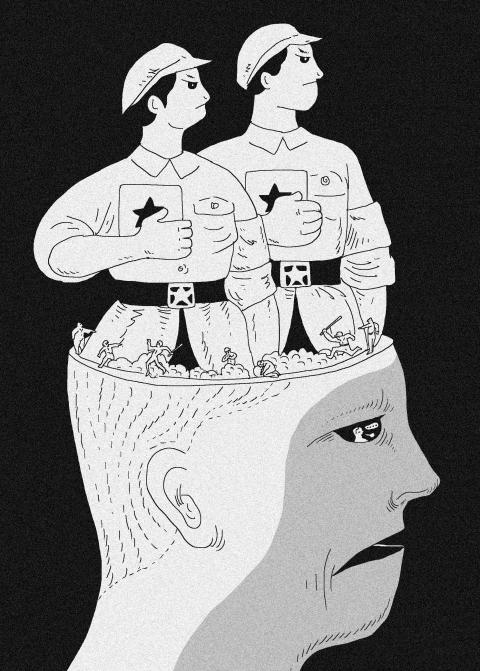
Illustration: Mountain People
“I think about their memories and the lessons we should absorb and I try to comfort the relatives,” he said in an interview. “It would be impossible to erase that time from our hearts.”
Fifty years after the start of the Cultural Revolution, the cemetery embodies China’s evasive reckoning with its legacy. Here the tension between official silence and grassroots remembrance is palpable.
The cemetery is usually locked, but on Tomb Sweeping Day, a door opens for families and friends of the dead to hold vigils, light incense and leave wreaths and other offerings at the graves.
This year, officials took special precautions, attaching coils of barbed wire along the top of the wall around the cemetery. They mounted surveillance cameras at the entrance, as well as a sign in Chinese and English that read: “Historical preservation, no photographing.”
On Tomb Sweeping Day, which this year was on Monday, clusters of older people registered at a booth to enter the cemetery, some joined by couples with children. Dozens of guards hustled onlookers and journalists away, telling them they could not even take photographs of the exterior.
“There’s nothing to see,” one said. “Go away.”
About 1,700 people were put to death across Chongqing during the worst clashes, which receded in 1968, according to an official estimate by He Shu, the city’s unofficial chronicler of that time.
The total killed was probably higher.
As the bodies piled up, rotting in the heat, faction leaders conscripted Zheng, an engineering student, to dispose of them.
In a cool air-raid shelter, he learned to inject them with formaldehyde and he chose the park site to bury them, using prisoners from the rival faction as helpers.
Some of the dead were photographed in Red Guard uniforms — military-style clothes, belts and caps, and badges — while their comrades and family stood proudly beside them.
“I personally laid to rest more than 280 people,” Zheng said. “I bathed and injected them with formaldehyde, I dressed them, I put them in graves, so my nickname was the corpse commander. We were all sacrificial objects in a political struggle.”
Across Chongqing, about 20 Cultural Revolution cemeteries were razed as the movement waned and Mao died. This one survived in part because of its out-of-the-way location and a tolerant city party secretary in the 1980s, said Everett Yuehong Zhang (張躍宏), an anthropologist from Chongqing at Princeton University.
However, the past it contains has become a delicate topic with the coming of the 50th anniversary of the Cultural Revolution. Focusing on that time offends Chinese President Xi Jinping’s (習近平) drive against dwelling on mistakes by Mao and the party. Although his own family suffered grievously during the Cultural Revolution, he would rather focus on past glories.
No official memorial events have been announced to acknowledge the milestone; none of the reports about Qingming by the state news media mentioned the Cultural Revolution dead.
Mao started the “Great Proletarian Cultural Revolution” in 1966 to purge China of “revisionist” compromises that he said imperiled his revolution. He gave his blessing to militant students to enforce his will, but the movement took a chaotic turn and vicious rivalries broke out between Red Guard factions competing to represent Mao’s vision.
In Chongqing, the schisms erupted into war in the summer of 1967, when militants seized weapons from armament plants. Most people buried in the Shapingba cemetery supported the “August 15” faction that battled the “rebel to the end” faction.
“We had eight big weapons factories, making tanks and guns and other arms, and many of the workers were ex-soldiers who knew how to fight,” said Wu Qi (吳琪), a businessman from Chongqing who watched the fighting as a teenager. “It was like a real military battle.”
The victims who have most haunted Zheng did not end up in his cemetery.
In August 1967, after his August 15 faction had been under ferocious attack, in a fit of fury he handed two prisoners to a crowd that stomped them senseless. A day or two later, he let two Red Guards beat them to death. Their bodies were thrown into a ditch on a university campus.
“This was the greatest regret of my life,” Zheng said.


Weeks into the craze, nobody quite knows what to make of the OpenClaw mania sweeping China, marked by viral photos of retirees lining up for installation events and users gathering in red claw hats. The queues and cosplay inspired by the “raising a lobster” trend make for irresistible China clickbait. However, the West is fixating on the least important part of the story. As a consumer craze, OpenClaw — the AI agent designed to do tasks on a user’s behalf — would likely burn out. Without some developer background, it is too glitchy and technically awkward for true mainstream adoption,
On Monday, the day before Chinese Nationalist Party (KMT) Chairwoman Cheng Li-wun (鄭麗文) departed on her visit to China, the party released a promotional video titled “Only with peace can we ‘lie flat’” to highlight its desire to have peace across the Taiwan Strait. However, its use of the expression “lie flat” (tang ping, 躺平) drew sarcastic comments, with critics saying it sounded as if the party was “bowing down” to the Chinese Communist Party (CCP). Amid the controversy over the opposition parties blocking proposed defense budgets, Cheng departed for China after receiving an invitation from the CCP, with a meeting with
Chinese Nationalist Party (KMT) Chairwoman Cheng Li-wun (鄭麗文) is leading a delegation to China through Sunday. She is expected to meet with Chinese President Xi Jinping (習近平) in Beijing tomorrow. That date coincides with the anniversary of the signing of the Taiwan Relations Act (TRA), which marked a cornerstone of Taiwan-US relations. Staging their meeting on this date makes it clear that the Chinese Communist Party (CCP) intends to challenge the US and demonstrate its “authority” over Taiwan. Since the US severed official diplomatic relations with Taiwan in 1979, it has relied on the TRA as a legal basis for all
A delegation of Chinese Nationalist Party (KMT) officials led by Chairwoman Cheng Li-wun (鄭麗文) is to travel to China tomorrow for a six-day visit to Jiangsu, Shanghai and Beijing, which might end with a meeting between Cheng and Chinese President Xi Jinping (習近平). The trip was announced by Xinhua news agency on Monday last week, which cited China’s Taiwan Affairs Office (TAO) Director Song Tao (宋濤) as saying that Cheng has repeatedly expressed willingness to visit China, and that the Chinese Communist Party (CCP) Central Committee and Xi have extended an invitation. Although some people have been speculating about a potential Xi-Cheng


 RSS
RSS