


When Russian President Vladimir Putin announced the withdrawal of most of the nation’s military contingent from Syria there was an expectation that the Yauza, a Russian naval icebreaker and one of the mission’s main supply vessels, would return home to its Arctic Ocean port.
Instead, three days after Putin’s March 14 declaration, the Yauza, part of the “Syrian Express” — the nickname given to the ships that have kept Russian forces supplied — left the Black Sea port of Novorossiysk for Tartous, Russia’s naval facility in Syria.
Whatever it was carrying was heavy — it sat so low in the water that its load line was barely visible.
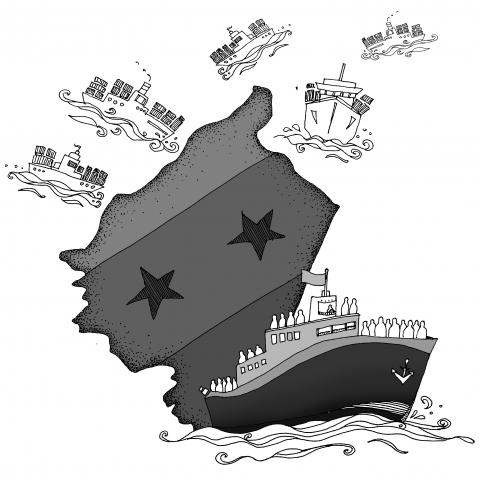
Illustration: Tania Chou
Its movements and those of other Russian ships in the two weeks since Putin’s announcement of a partial withdrawal suggest Moscow has in fact shipped more equipment and supplies to Syria than it has brought back in the same period, a Reuters analysis showed.
It is not known what the ships were carrying or how much equipment has been flown out in giant cargo planes accompanying returning war planes, but the movements — while only a partial snapshot — suggest Russia is working intensively to maintain its military infrastructure in Syria and to supply the Syrian army so that it can scale up again swiftly if need be.
Putin has not detailed what would prompt such a move, but any perceived threat to Russia’s bases in Syria or any sign that Syrian President Bashar al-Assad, Moscow’s closest ally in the Middle East, was in peril is likely to trigger a powerful return.
Russia operates an air base in Hmeymim and a naval facility in Tartous. Putin has said Russia will keep both and that they will need to be well-protected.
“Since the main part of the force de facto stayed there, there is no reason to reduce the traffic,” said Mikhail Barabanov, a senior research fellow at the Moscow-based CAST military think tank. “Supplies for the Syrian army remain significant as well.”
Moscow has not revealed the size of its force in Syria, nor has it given details of its partial withdrawal.
STRIKE FORCE
Reuters has calculated that about half of Russia’s fixed-wing strike force based in Syria flew out of the country in the days after the partial drawdown was made public. The precise number of planes Russia had was secret, but analysis suggested it had about 36 fixed-wing military jets.
On Monday, state TV showed three heavy attack helicopters being flown out of Syria, along with some support staff, but an examination of shipping data, official information, tips from maritime security sources and photographs from bloggers of Russian ships passing the Bosphorus en route from the Black Sea to the Mediterranean, showed no signs that the “Syrian Express” is being wound down.
A Reuters analysis of the same data showed Russia is also likely to have reinforced its naval force in the Mediterranean and now appears to have more warships near the Syrian coast than at the time of Putin’s declaration.
Their role is to protect cargo ships. Their presence also gives Moscow the option of firing cruise missiles from the sea.
Russia appears to have more than a dozen military vessels in the Mediterranean, including the Zeleniy Dol warship equipped with terrain-hugging Kalibr cruise missiles which are accurate to within 3m, according to Russian state media and the database of Bosphorus Naval News, a Turkish online project.
‘SYRIAN EXPRESS’
Moscow is likely to maintain that strength, Barabanov said.
“Russia doesn’t have too many ships that it can keep in the Mediterranean. The role of the force was to ensure the activity of the ‘Syrian Express’ and to demonstrate it to the West and, later, to Turkey,” he said.
The Russian Ministry of Defense did not reply to questions about what the navy was doing in the Mediterranean or whether there were plans to reduce its presence.
Russia’s military ships and most auxiliary vessels are not shown in publicly available databases, but most of its ships are seen and photographed when they pass the Bosphorus on their way from Russia to the Mediterranean or vice versa.
In most cases it is impossible to track military shipments to destination ports, though, meaning data is only partial.
Since Moscow began to scale back in Syria, Russia has sent two landing ships, which are typically used to transport troops and armor — the Caesar Kunikov and the Saratov — to the Mediterranean along with the Yauza, an auxiliary cargo vessel.
The Saratov looked loaded when it passed the Bosphorus on Thursday going south toward Syria. Its load line was visibly lower than on March 14 when it was photographed going the other way, toward Russia.
At the same time, two warships — the Alexander Otrakovsky and the Minsk — and the Dvinitsa-50, an auxiliary vessel, were photographed by Turkish bloggers passing the Bosphorus en route back to Russia.
At least two of the returning ships, the Alexander Otrakovsky and the Dvinitsa-50, looked unloaded on their way back.
Photographs show that the Otrakovsky, a large landing ship, sat higher in the water on its return to Russia compared with March 2, when it crossed the Bosphorus in the other direction. It was not clear if it carried troops or equipment.
The load line of the Dvinitsa-50 was also high above the water when it was photographed in the Bosphorus on March 20 on its way back to Russia.
It seems unlikely that Russian troops or equipment were on board any of the returning ships. None of them looked like they had heavy cargo onboard.
The Minsk has already headed back toward Syria. On Tuesday, it was photographed passing the Bosphorus. Its bow sat deep in the water; its cargo could not be discerned.
Non-military cargo traffic between Russia and Syria also shows no signs of flagging.
Four cargo ships involved in the supply operation called at Syria in the two weeks before Putin announced the drawdown.
A fifth, the Alexander Tkachenko, a Russian ferry, previously photographed with military trucks onboard, probably called there too.
Reuters shipping database showed it was approaching Syria, but then suddenly disappeared for a few days before reappearing en route back to Russia, meaning its transponders were not switched on for that period.
Five cargo ships, including an oil tanker, arrived in Syria in the two weeks following Putin’s announcement.
Additional reporting by Jonathan Saul


Weeks into the craze, nobody quite knows what to make of the OpenClaw mania sweeping China, marked by viral photos of retirees lining up for installation events and users gathering in red claw hats. The queues and cosplay inspired by the “raising a lobster” trend make for irresistible China clickbait. However, the West is fixating on the least important part of the story. As a consumer craze, OpenClaw — the AI agent designed to do tasks on a user’s behalf — would likely burn out. Without some developer background, it is too glitchy and technically awkward for true mainstream adoption,
On Monday, the day before Chinese Nationalist Party (KMT) Chairwoman Cheng Li-wun (鄭麗文) departed on her visit to China, the party released a promotional video titled “Only with peace can we ‘lie flat’” to highlight its desire to have peace across the Taiwan Strait. However, its use of the expression “lie flat” (tang ping, 躺平) drew sarcastic comments, with critics saying it sounded as if the party was “bowing down” to the Chinese Communist Party (CCP). Amid the controversy over the opposition parties blocking proposed defense budgets, Cheng departed for China after receiving an invitation from the CCP, with a meeting with
Chinese Nationalist Party (KMT) Chairwoman Cheng Li-wun (鄭麗文) is leading a delegation to China through Sunday. She is expected to meet with Chinese President Xi Jinping (習近平) in Beijing tomorrow. That date coincides with the anniversary of the signing of the Taiwan Relations Act (TRA), which marked a cornerstone of Taiwan-US relations. Staging their meeting on this date makes it clear that the Chinese Communist Party (CCP) intends to challenge the US and demonstrate its “authority” over Taiwan. Since the US severed official diplomatic relations with Taiwan in 1979, it has relied on the TRA as a legal basis for all
A delegation of Chinese Nationalist Party (KMT) officials led by Chairwoman Cheng Li-wun (鄭麗文) is to travel to China tomorrow for a six-day visit to Jiangsu, Shanghai and Beijing, which might end with a meeting between Cheng and Chinese President Xi Jinping (習近平). The trip was announced by Xinhua news agency on Monday last week, which cited China’s Taiwan Affairs Office (TAO) Director Song Tao (宋濤) as saying that Cheng has repeatedly expressed willingness to visit China, and that the Chinese Communist Party (CCP) Central Committee and Xi have extended an invitation. Although some people have been speculating about a potential Xi-Cheng


 RSS
RSS