


Had it not been for Taiwan, the Republic of China (ROC) would have perished on Oct. 1, 1949, when it was ousted by the People’s Republic of China (PRC). Despite that, the Chinese Nationalist Party (KMT), the fragments of a past China, hijacked Taiwan and continues to talk about its “glorious restitution” of the nation, words spoken to justify and consolidate its colonial rule. However, it was only able to take over and then occupy Taiwan thanks to the Allied Powers, and after that it continued to benefit from the Cold War era.
This means that for the KMT, Taiwan and the ROC belong to the party. The so-called “party-state” has become a colonial doctrine, and fundamentalism has become a kind of cultural doctrine that it has fed to KMT members and others who the party has brainwashed. In the past, dissidents were charged with colluding with the Chinese Communist Party, and now they are accused of pushing for Taiwanese independence. Everyone understands that the party-state is a parasite and that its existence is dependent on Taiwan’s lack of independence.
Under these circumstances, the KMT sees a transfer of government power as the termination of both party and state, even if it is still called the ROC. During past KMT rule, no Taiwanese could be its presidential candidate, because Taiwanese were seen as “loyal subjects” of the Japanese emperor and they could therefore not be national leaders according to the party-state ideology. However, the democratic movement and the 1996 direct presidential election reversed the party’s principle that “a gentleman (the ROC) and a thief (the PRC) cannot coexist.” Since then, the KMT claims to love Taiwan when it gains power and turns to China for comfort when it loses power, treating the thief as its father. Chiang Kai-shek (蔣介石) and former president Chiang Ching-kuo (蔣經國) must be turning in their graves; but they are dead and cannot interfere with the living.
In the KMT’s colonial party-state ideology, high-school history and civic education are tools for brainwashing students instead of cultivating their knowledge and manners like in a normal country. Taiwan’s democratic development began after Chiang Ching-kuo ended the Martial Law period in 1987. Former presidents Lee Teng-hui (李登輝) and Chen Shui-bian (陳水扁) untied the colonial knot during their terms in office. The KMT saw this as attempts at “de-Sinicization” aimed at removing the fetters of the party-state, and it was worried that the absolute rule of the party-state would no longer continue to exist, as Taiwanese were awakening.
After President Ma Ying-jeou (馬英九) brought the KMT back to power in 2008, he adjusted the high-school curriculum guidelines. However, this time around, the situation deteriorated, as the guidelines were adjusted behind closed doors in a wicked attempt at adding the KMT’s doctrine in preparation for losing power for a second time. By forcing through the adjustments, which violate procedural justice, the government angered high-school students and caused them to organize, while also attracting a lot of criticism from the public. It seems the KMT is busy digging its own grave.
The KMT colonial authorities want to fetter and restrain young people, but they are in fact being fettered by their own ideology, as it restricts their thinking. The curriculum controversy is proof of this, showing that if the ROC continues to be obsessed with China and fails to promote a transition to localization, the guidelines will put a period at the end of its history.
The KMT is no longer able to control Taiwanese, as people have gradually reshaped the nation from a shared community into a republic of free people.The nation belongs to its people, not to the KMT.
Lee Min-yung is a poet.
Translated by Eddy Chang
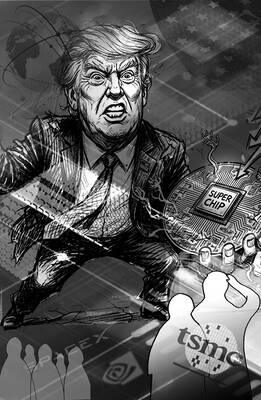
The White House’s decision to take a 9.9 percent stake in Intel Corp is looking like very shrewd business indeed. Since the government bought in at US$20.47 a share last August, the US chipmaker’s surging stock price has delivered the US a US$43 billion return. One of the reasons the investment has so far proved so sound is that the White House has made sure of it. According to The Wall Street Journal, Howard personally pushed deals on Intel’s behalf with some of the most lucrative clients imaginable. They include Nvidia Corp, the company at the heart of the AI
A single photograph can cut through a lot of noise, but it can also be used to misrepresent the truth. At the very least, it can concentrate the mind on something that requires further investigation. On Monday last week, Ma Ying-jeou Foundation CEO Tai Hsia-ling (戴遐齡) and former National Security Council secretary-general King Pu-tsung (金溥聰) held a news conference in which they showed a photograph of former foundation CEO Hsiao Hsu-tsen (蕭旭岑), now Chinese Nationalist Party (KMT) deputy chairman. In the image Hsiao is seated next to Xiamen Taiwan Businessmen Association chairman Han Ying-huan (韓螢煥). The two men were holding
I first met Professor Ray Jiing (井迎瑞) as a film and documentary student at Shih Hsin University’s (SHU) Department of Radio Television and Film in 1988. The following year, he went on to become the director of the Chinese Taipei Film Archive — forerunner of the Taiwan Film and Audiovisual Institute (TFAI). Over his eight-year tenure, Jiing rescued and restored over 200 classic Taiwanese films. In 1997, he established the Graduate Institute of Studies in Documentary and Film Archiving at Tainan National University of the Arts (TNNUA), and I joined the program in his third cohort of students. Beyond a
A recent report concerning a student who is suing his teacher posed the question in its headline: Does failing a student in two subjects constitute bullying? The college student in Chiayi County apparently sought NT$2 million (US$63,603) in state compensation, but a court dismissed the case. The first reaction of many might have been to ask: What has happened to students nowadays? Some say that teachers have lost their authority, while others say students are overindulged. Some even start reminiscing over the days when “whatever the teacher says goes.” However, the real issue might be overlooked if emotional reactions like that are the


 RSS
RSS