


During last year’s nine-in-one elections, Taiwanese taught the government a harsh lesson through the ballot box, forcing President Ma Ying-jeou (馬英九) to step down as chairman of the Chinese Nationalist Party (KMT).
There were initially high expectations on all sides that Ma, having suffered a serious setback at the hands of voters, would engage in self-reflection and adjust his government to take into account public opinion. Even if Ma is unwilling to change course, he should at least adjust his attitude and take a conciliatory approach to governance during his remaining time as president. Since Ma has generally bungled his duty as president, he should limit his actions, or even do nothing. He should avoid dabbling in things he does not understand, so that the damage inflicted upon Taiwan is kept to a minimum. However, it seems he has once again failed to live up to public expectations.
By examining Ma’s recent behavior, it becomes clear that Taiwan is facing a situation far more catastrophic than being encumbered with an incapacitated or inactive president. Two weeks ago, Ma treated public opinion with contempt and behaved like a dictator when he hastily decided that Taiwan should join the Asian Infrastructure Investment Bank (AIIB). His unilateral decision angered the public, caused a backlash within the legislature and invoked protests from student and civic groups.
Yet, far from pausing for reflection, Ma has obstinately stuck to his course, in the past few days raising the stakes further by insisting that he can accept the title of “Chinese Taipei” if the nation is accepted as an ordinary member: After China rejected Taiwan’s bid to be a founding member, Ma said that using “Chinese Taipei” was “a very good convention.”
Since China will be pulling the strings at the bank, the organization will take on political, economic, diplomatic and strategic attributes, and Taiwan’s title and its actions within the AIIB will probably create new precedents. A degree of prudence is therefore needed.
Instead, Ma has ignored national interests by rushing to cooperate with China. The public was especially angered by the way Taiwan’s letter of intent to join the bank was handed over through the Mainland Affairs Council, treating the issue as a “cross-strait” issue rather than an international matter.
Ma’s recent announcements over the AIIB have been neither logical nor wise, amounting to shooting oneself in the foot.
In international circles, using either the name “Taiwan” or the “Republic of China (ROC)” conforms to the reality of the situation and upholds the dignity of the nation. At present, Taiwan employs a multitude of titles within international organizations, leaving even Taiwanese confused and befuddled.
This all stems from China’s repressive tactics. By not standing firm on the nation’s name and upholding its dignity, this is tantamount to the president degrading national sovereignty.
Worse, Ma has in recent years accepted former Mainland Affairs Council chairman Su Chi’s (蘇起) made-up, so-called “1992 consensus,” the existence of which was denied by former Straits Exchange Foundation chairman Koo Chen-fu (辜振甫), but which Ma nevertheless continues to demand that Taiwanese accept.
Even if there were such a thing as the “1992 consensus,” aside from “one China,” most important for Taiwan is that “each side has its own interpretation” of what “China” means.
Nowadays, Ma does not even use ROC as a title, but instead accepts a name forced on the nation through Beijing’s repression. Not only has Ma revealed his hand before negotiations have started, he has also proved what a sham the “1992 consensus” really is.
Aside from the AIIB dispute, Ma also told foreign correspondents that “the situation in the Taiwan Strait has reached the most stable and peaceful circumstances in 66 years.”
This is the kind of deceptive language that takes the listener for a fool. Ma’s assumption that attracting Chinese tourists and students, signing more than 20 cross-strait bilateral agreements and institutionalizing communication channels is evidence of his assertion does not stand up to scrutiny. Hong Kong knows the pros and cons of a surge in visitors from mainland China better than any other. Last year, it accommodated 47 million total entries from the mainland, which accounted for an estimated 80 percent of all visits to the territory. This caused a reduction in local living standards and an increase in public clashes, which led to a surge in public calls for controls on Chinese visitors.
Regarding Taiwan’s agreements with China, the Economic Cooperation Framework Agreement and the cross-strait service trade agreement triggered the Sunflower movement, which led to the KMT’s losses in the nine-in-one elections in November.
Could it be that Ma is treating Taiwanese as if they have all developed amnesia? The so-called institutionalized communication channels, the Straits Exchange Foundation and China’s Association for Relations Across the Taiwan Straits (ARATS) have been around for a long time. Every time members of the Ma administration meet with Chinese officials, they automatically hide any signs of national sovereignty and talk about “mutual non-denial,” a phrase used to deceive themselves and the public.
The statement that “the situation in the Taiwan Strait has reached the most stable and peaceful circumstances in 66 years” is even more nonsensical. A statement like this shows clearly that Ma is turning a blind eye to China’s propaganda and saber-rattling, and lacks the basic qualifications to be a commander-in-chief.
China’s military preparations aimed at Taiwan remain relentless; not only has Beijing deployed as many as 2,000 missiles and flown bombers over the Bashi Channel, it has conducted pervasive espionage against Taiwan. In terms of verbal attacks, last month Chinese President Xi Jinping (習近平) threatened Taiwan by saying that “the Earth will move and mountains will shake” if Taiwan does not recognize the “1992 consensus.” This is sufficient to show that the so-called “Taiwan Strait peace” is superficial and predicated on the Ma administration’s servility toward China, and can be used by Beijing as a political bargaining chip. Once any sort of Chinese demand is rejected, Beijing could turn hostile at any time.
This could well end in disaster for Taiwan, where issues like the Apache attack helicopter security affair keep occurring because people have let their guard down because they can no longer tell whether China is the enemy.
Ma has consistently turned his back on public opinion and he is opposed to amending the Constitution. He is not in favor of lowering the voting age, nor is he willing to adjust the threshold for constitutional amendments. He has also mentioned that the US has passed only a small number of constitutional amendments over 200 years, but does not mention that times have changed since the ROC Constitution was created.
In the same way, he insists that the main beneficiaries of cross-strait trade are small and medium-sized enterprises, and says that claims that such economic ties primarily benefit big business and increase the wealth gap “demonize” cross-strait trade.
It is clear that the Sunflower movement and the nine-in-one elections have not made him change his mind, and he continues to insist on his own opinions and to oppose public opinion.
Taiwan has gone through a chaotic period in recent years, and during his election campaign, Taipei Mayor Ko Wen-je (柯文哲) made fun of the “status quo,” saying that “there are no peanuts in our peanut oil, no olives in our olive oil and no president in the Presidential Office.”
The public must prepare for an even worse challenge in the coming year, a situation worse than a Presidential Office without a president.
Translated by Edward Jones and Zane Kheir
A gap appears to be emerging between Washington’s foreign policy elites and the broader American public on how the United States should respond to China’s rise. From my vantage working at a think tank in Washington, DC, and through regular travel around the United States, I increasingly experience two distinct discussions. This divergence — between America’s elite hawkishness and public caution — may become one of the least appreciated and most consequential external factors influencing Taiwan’s security environment in the years ahead. Within the American policy community, the dominant view of China has grown unmistakably tough. Many members of Congress, as
The Hong Kong government on Monday gazetted sweeping amendments to the implementation rules of Article 43 of its National Security Law. There was no legislative debate, no public consultation and no transition period. By the time the ink dried on the gazette, the new powers were already in force. This move effectively bypassed Hong Kong’s Legislative Council. The rules were enacted by the Hong Kong chief executive, in conjunction with the Committee for Safeguarding National Security — a body shielded from judicial review and accountable only to Beijing. What is presented as “procedural refinement” is, in substance, a shift away from
The shifting geopolitical tectonic plates of this year have placed Beijing in a profound strategic dilemma. As Chinese President Xi Jinping (習近平) prepares for a high-stakes summit with US President Donald Trump, the traditional power dynamics of the China-Japan-US triangle have been destabilized by the diplomatic success of Japanese Prime Minister Sanae Takaichi in Washington. For the Chinese leadership, the anxiety is two-fold: There is a visceral fear of being encircled by a hardened security alliance, and a secondary risk of being left in a vulnerable position by a transactional deal between Washington and Tokyo that might inadvertently empower Japan
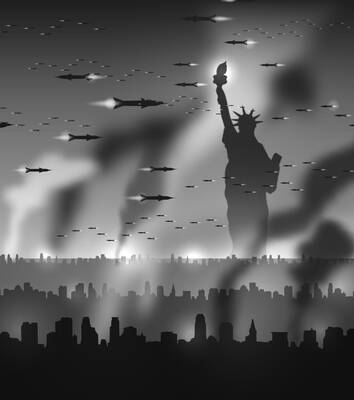
After declaring Iran’s military “gone,” US President Donald Trump appealed to the UK, France, Japan and South Korea — as well as China, Iran’s strategic partner — to send minesweepers and naval forces to reopen the Strait of Hormuz. When allies balked, the request turned into a warning: NATO would face “a very bad” future if it refused. The prevailing wisdom is that Trump faces a credibility problem: having spent years insulting allies, he finds they would not rally when he needs them. That is true, but superficial, as though a structural collapse could be caused by wounded feelings. Something


 RSS
RSS