


The Apache helicopter debacle involving showbiz personality Janet Lee (李蒨蓉) has revealed the lack of discipline within Taiwan’s military. If this is only the tip of the iceberg, could further investigation into this issue reveal facts disturbing enough to shake the nation?
So far the issue has unfurled within the remit of the military “playground.” However, if there is also an element that would fall within the realms of espionage, the implications for national security would be inconceivable.
President Ma Ying-jeou (馬英九), who is the commander-in-chief of the armed forces, only said that he was “hurt” by the incident nearly a week after it occurred. Even if Taiwan has not been sold out, with a commander-in-chief like Ma, the nation is doomed anyway.
Cases detailing slack military discipline have often made headlines in the past, leading to some behavior no longer able to capture the attention of the desensitized authorities. Taiwanese military aircraft are frequently involved in accidents, making Taiwan’s accident rate far higher than other nations, which is a reflection of the problems within the military. The authorities also do not pay attention to the many spy cases that have surfaced, as both Taiwan and China are engaged in competitive espionage.
When Chiang Kai-shek (蔣介石) retreated to Taiwan, it was only a few years before it became clear that Chiang’s grand plan to “retake the mainland” was hopeless. However, authorities at the time made sure not to expose the emperor’s new clothes, and even though high-level officials called for the overturn of Chinese Communist Pary leaders Zhu De (朱德) and Mao Zedong (毛澤東), some civilians — especially the powerful elites — made Taipei their new Beijing.
Under Ma’s adminstration, being “anti-communist” has become a sin and promises of a “peace dividend” are talked up instead. Not only are they deceiving the US, they have also completely removed the psychological defenses of the military and the public.
As the Chinese Nationalist Party (KMT) is content with ruling a small region of China, Taiwanese businesses invest in China simply to make a quick buck, and lose sight of who their enemy is. By the time they realize that they have been used by China, it will already be too late.
Although China’s economy is slowing down and is weighed down by mounting domestic debt, Taiwan’s financial industry continues to invest there, and many Taiwanese are keen on making deposits in Chinese yuan aiming to earn small profits while disregarding all the associated risks.
After they retire, civil servants are often preoccupied with making money in China when the restrictions on their contacts with China have expired. This also includes retired military officers and investigation bureau officials, as these are all groups from which China is recruiting their spies.
On the other hand, Taiwanese spies in China were all captured in one go. Retired general and former Department of General Political Warfare director Hsu Li-nung (許歷農) took the lead investing in China over 20 years ago. What other “political warfare” does the military need? The KMT and the Democratic Progressive Party are simply helpless.
Evidence of Ma’s pro-China policies can be seen when the likes of Hsia Ying-chou (夏瀛洲) say that “the Republic Of China army and the People’s Liberation Army (PLA) are all China’s army,” and when former premier Hau Pei-tsun (郝柏村) — a retired army general who was once a staunch anti-communist — visits Beijing and sings the Chinese national anthem.
Former subordinates of these men now wield significant power within the military. Are they really clear about who they are fighting for?
Their enemy is no longer the PLA, which aims thousands of missiles at Taiwan, but rather the Treaty of Mutual Cooperation and Security between the US and Japan. This has led Ma to co-star in the so-called “protect the Diaoyutais (釣魚台)” farce and turn his back on the US and Japan while directing all his efforts at bringing Taiwan into the proposed Asian Investment Bank (AIIB).
The real “dividend” envisaged by dignitaries like former vice president Lien Chan (連戰), Ma and conglomerates close to them is the opportunity to carve up the nation’s wealth. The public now faces depressed salaries, coupled with risks to national security and the eventual possibility that the nation might cease to exist.
After Hong Kong’s “smooth transition” in reuniting with China, the territory’s richest man, Li Ka-shing (李嘉誠), withdrew a significant portion of his investments from Hong Kong and waves of Hong Kongers flocked to emigrate overseas. So what will Ma’s “peace dividend” bring for Taiwan? Should Taiwanese not take the necessary action to force him to step down from office?
Chinese President Xi Jinping (習近平) has recently been trying to scare Taiwan into accepting the so-called “1992 consensus,” saying that if it does not, “the Earth will move and mountains will shake.” Where is this so-called “peace dividend” now?
Paul Lin is a political commentator.
Translated by Zane Kheir

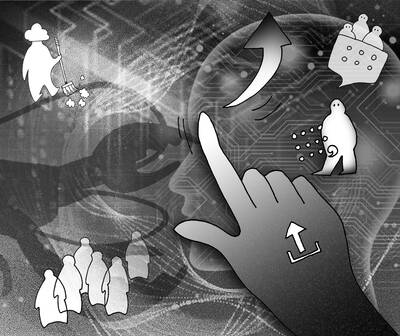
Weeks into the craze, nobody quite knows what to make of the OpenClaw mania sweeping China, marked by viral photos of retirees lining up for installation events and users gathering in red claw hats. The queues and cosplay inspired by the “raising a lobster” trend make for irresistible China clickbait. However, the West is fixating on the least important part of the story. As a consumer craze, OpenClaw — the AI agent designed to do tasks on a user’s behalf — would likely burn out. Without some developer background, it is too glitchy and technically awkward for true mainstream adoption,
On Monday, a group of bipartisan US senators arrived in Taiwan to support the nation’s special defense bill to counter Chinese threats. At the same time, Beijing announced that Chinese President Xi Jinping (習近平) had invited Chinese Nationalist Party (KMT) Chairwoman Cheng Li-wun (鄭麗文) to visit China, a move to make the KMT a pawn in its proxy warfare against Taiwan and the US. Since her inauguration as KMT chair last year, Cheng, widely seen as a pro-China figure, has made no secret of her desire to interact with the Chinese Communist Party (CCP) and meet with Xi, naming it a
A delegation of Chinese Nationalist Party (KMT) officials led by Chairwoman Cheng Li-wun (鄭麗文) is to travel to China tomorrow for a six-day visit to Jiangsu, Shanghai and Beijing, which might end with a meeting between Cheng and Chinese President Xi Jinping (習近平). The trip was announced by Xinhua news agency on Monday last week, which cited China’s Taiwan Affairs Office (TAO) Director Song Tao (宋濤) as saying that Cheng has repeatedly expressed willingness to visit China, and that the Chinese Communist Party (CCP) Central Committee and Xi have extended an invitation. Although some people have been speculating about a potential Xi-Cheng
The ongoing Iran conflict is putting Taiwan’s energy fragility on full display — the island of 23 million people, home to the world’s most advanced semiconductor manufacturing, is highly dependent on imported oil and gas, especially that from the Middle East. In 2025, 69.6 percent of Taiwan’s crude oil and 38.7 percent of liquified natural gas were sourced from the Middle East. In the same year, 62 percent of crude oil and 34 percent of LNG to Taiwan went through the Strait of Hormuz. Taiwan’s state-run oil company CPC Corp’s benchmark crude oil price (70 percent Dubai, 30 percent Brent)


 RSS
RSS