

Two US F/A-18 Hornets left Tainan yesterday afternoon, ending a two-day maintenance stop that had pundits going overboard in trying to read the portents and wire agencies trotting out the stale “sure to make Beijing angry” phrase with almost every update. So much malarkey over a blinking engine oil light.
The F/A-18s landed on the airfield that the Tainan Air Force Base shares with the civilian Tainan Airport at 1:19pm on Wednesday after one of the planes’ engine oil pressure warning lights went on and the pilots requested assistance. They left almost exactly 48 hours later after a repair crew from the US Marine Corps Air Station Iwakuni in Japan flew into Tainan on Thursday evening to fix the problem.
That the Hornets had apparently been escorting an EA-6B Prowler aircraft on what has been variously described as a trip to Singapore or a reconnaissance mission was only more cause for speculation.
US military aircraft were once a common sight at the Tainan airfield, which was used by the US Air Force until early 1979, when the US pulled its military personnel and dependents from Taiwan following Washington’s shift of diplomatic ties from Taipei to Beijing.
A US Marine Corps spokesman, Major Paul Greenberg, tried to temper speculation by saying that the pilots followed standard procedure by landing at the closest location at the time the mechanical problem arose. Other Marine Corps officials noted that the Tainan base is a US-approved divert airfield.
That did little to quell pundits’ speculation.
Some were quick to link the emergency landing to China’s People’s Liberation Army (PLA) Air Force’s training exercise that took its new H-6K bombers over the Bashi Channel on Monday, saying the US might be trying to send a message to Beijing.
Another questioned why the Hornets had not opted for Shimojishima Airport in Japan’s Ryukyu Islands, 193km east of Taiwan, which the US Marine Corps has occasionally used as a stopover point during regional exercises.
Some even wondered why the pilots did not opt for Hainan — not only ignoring Hainan’s distance from the planes’ location when one had an engine problem, but its less-than-hospitable reputation to US military aircraft. Did they forget the near miss between a PLA J-11 jet and a US Navy Poseidon P-8 patrol aircraft east of Hainan in August last year, or the April 2001 collision between a PLA J-8 and a US Navy EP-3 surveillance aircraft that left the Chinese pilot dead and forced the US aircraft to make an emergency landing on Hainan, whereupon the Chinese detained the two dozen US crewmembers for 11 days, creating a major international incident?
Meanwhile, news agencies were quick to describe China as “angry” and “strongly protesting” the Hornets’ landing in Tainan, though Chinese Ministry of Foreign Affairs spokeswoman Hua Chunying (華春瑩) simply said Beijing had made “solemn representations to the US” and “demanded that it abide by the one China policy and the three joint communiques” and deal with the issue prudently.
That is hardly an “angry reaction,” as even a quick perusal of comments from Beijing’s leaders and spokespeople over the years can attest.
An engine oil warning light blinking on an F/A-18 Hornet in flight is not like a driver seeing a similar light illuminated on a car dashboard — there is no road shoulder or nearby garage. There is also little time to react — much less have a conference call between home base and Washington on the diplomatic ramifications of the choice of nearby landing spots.
A US military plane developed an engine problem and there was an airstrip on Taiwan that it could land on — and it did so safely. The US yesterday thanked Taiwan for providing assistance.
Happy to help. Let’s leave it at that.

Taiwan’s domestic political situation is following recognizable political rhythms, while the international environment surrounding Taiwan is undergoing a major transformation. Within Taiwan, there are ongoing battles between the legislative and executive branches over the budget, and between cities and the central government over resources. Tensions between political parties dominate headlines and consume much of the attention of party leaders. Jockeying is underway for local elections this November and national elections in 2028. And the longstanding philosophical debate inside Taiwan over how best to protect Taiwan and promote the good life remains unresolved. Amidst all of this, Taiwan continues to function well. It
In an article published on Tuesday in The Atlantic, titled “Will Taiwan Just Give Up?”, journalist Simon Shuster emphasizes the unpredictability of the US as an ally under US President Donald Trump and cites diminishing faith in the US as a contributor to what he sees as waning determination to resist China. As the title suggests, Shuster views a deal between Taiwan and China as an increasingly inevitable alternative to a costly war — one that Taiwan, lacking reliable allies and military capabilities, would eventually be destined to lose. He focuses on Chinese Nationalist Party (KMT) Chairwoman Cheng Li-wun (鄭麗文) — her
With candidate registration for this year’s local elections closed on Sept. 4 and the elections less than 80 days away, Democratic Progressive Party (DPP) Legislator and Taipei mayoral candidate Puma Shen’s (沈伯洋) rapidly growing popularity has become the focus of political talk shows and online discussions over the past week, heating up the mayoral election race in Taipei. Local media headlines and political pundits have picked up his supporters’ slogan “ocean current” (洋流) — a play on the last character of Shen’s name, which literally means “ocean” (洋), and the character (流), which can mean “current,” “flow” or “trend” — to
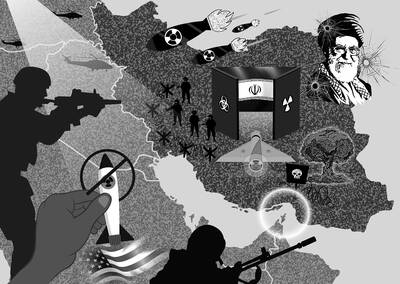
When was the last time you heard a meaningful proposal to prevent Iran from developing a nuclear arsenal? There has been nothing on the subject since the June Memorandum of Understanding between the US and Iran; the promised 60 days of talks to settle questions around Tehran’s uranium-enrichment program never began and have long since expired. When the war was launched, on Feb. 28, a resolution of the nuclear dispute was prominent among the dizzying array of US and Israeli aims to explain the attack. But as should be clear by now, the attempt was entirely reliant on achieving regime change. That


 RSS
RSS