


Former vice president Lien Chan (連戰) on Friday night apologized for using the word “bastard” when he stumped for his son Sean Lien (連勝文) — who is running for Taipei mayor — at a rally on Sunday, saying it had been too strong a word and had stirred feelings of unrest in society, for which he “felt sorry.” He added that he did not use it to describe anyone in particular, in a bid to clarify that he had not called his son’s main rival, independent candidate Ko Wen-je (柯文哲), a bastard.
As a matter of fact, Lien Chan actually did refer to Ko as a “bastard.” What he said at the rally was: “He calls himself a commoner and us the privileged few. What a bastard. Let those surnamed Ko all be taken to the cleaners.”
The remarks, which have aroused the emotions of pro-Chinese Nationalist Party (KMT) supporters, appeared to have backfired, incurring severe criticism from prominent commentators, including Jaw Shaw-kong (趙少康), a hardline pan-blue camp figure, and Shih Ming-te (施明德), whom Lien Chan once said he held in high esteem over the former Democratic Progressive Party (DPP) chairman’s failed attempts to persuade then-president Chen Shui-bian’s (陳水扁) administration to form a coalition Cabinet with the KMT after the DPP failed to secure a majority in the 2001 legislative election, which eventually led to Shih’s withdrawal from the party he had co-founded.
Lien Chan’s apology was addressed not to Ko, but rather to people disappointed in him, was designed to mitigate damage caused to Sean Lien’s election prospects and did not equate to an admission of fault in calling Ko a bastard. The apology also fell short of expressing his regret over characterizing Ko as a descendant of a man who served the Japanese colonial government, which aimed to incite ethnic tensions the way the previous KMT regime did when it took over Taiwan from Japanese colonial control in 1945.
Despite the sophistry in the apology, the move still means something in the sense that people are put forward as masters of the country when there is an election.
Sean Lien seemed to get that point when he said recently that his background did not make his election any easier and that he has been going from person to person seeking support like any other candidate. He said he did not think that running in the election was as easy as falling off a log, although some of his seniors did.
The way the KMT has waged its campaign in the election for Taipei mayor by playing on blue-versus-green tension stands in stark contrast to Ko’s main appeal of being a political novice who can break the mold of blue-green confrontation, which has paralyzed so much progress in Taiwan for a long time. As Jaw said in his criticism of Lien Chan, the KMT’s contention that the Republic of China would become “extinct” if Sean Lien loses to Ko has dominated the nation’s elections for the past two decades since Jaw ran for Taipei mayor in 1994.
Over the past few months, Ko has led Sean Lien by a stable margin in polls. In a city where pan-blue supporters have long outnumbered pan-green supporters, it is interesting to look into why Ko has become a phenomenon, even though it is widely known that he, while not affiliated with any political party, leans toward the pan-green camp in his political outlook.
The question over whether partisan politics is a temporary phenomenon or an insurmountable barrier will be answered on election day.
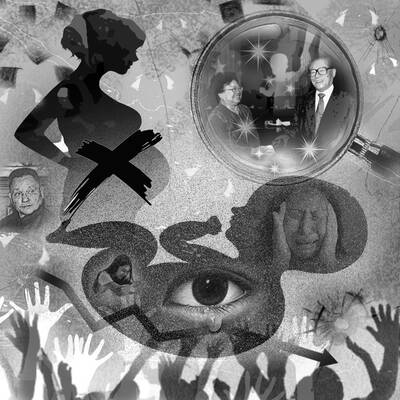
Jan. 1 marks a decade since China repealed its one-child policy. Just 10 days before, Peng Peiyun (彭珮雲), who long oversaw the often-brutal enforcement of China’s family-planning rules, died at the age of 96, having never been held accountable for her actions. Obituaries praised Peng for being “reform-minded,” even though, in practice, she only perpetuated an utterly inhumane policy, whose consequences have barely begun to materialize. It was Vice Premier Chen Muhua (陳慕華) who first proposed the one-child policy in 1979, with the endorsement of China’s then-top leaders, Chen Yun (陳雲) and Deng Xiaoping (鄧小平), as a means of avoiding the

The last foreign delegation Nicolas Maduro met before he went to bed Friday night (January 2) was led by China’s top Latin America diplomat. “I had a pleasant meeting with Qiu Xiaoqi (邱小琪), Special Envoy of President Xi Jinping (習近平),” Venezuela’s soon-to-be ex-president tweeted on Telegram, “and we reaffirmed our commitment to the strategic relationship that is progressing and strengthening in various areas for building a multipolar world of development and peace.” Judging by how minutely the Central Intelligence Agency was monitoring Maduro’s every move on Friday, President Trump himself was certainly aware of Maduro’s felicitations to his Chinese guest. Just
A recent piece of international news has drawn surprisingly little attention, yet it deserves far closer scrutiny. German industrial heavyweight Siemens Mobility has reportedly outmaneuvered long-entrenched Chinese competitors in Southeast Asian infrastructure to secure a strategic partnership with Vietnam’s largest private conglomerate, Vingroup. The agreement positions Siemens to participate in the construction of a high-speed rail link between Hanoi and Ha Long Bay. German media were blunt in their assessment: This was not merely a commercial win, but has symbolic significance in “reshaping geopolitical influence.” At first glance, this might look like a routine outcome of corporate bidding. However, placed in
China often describes itself as the natural leader of the global south: a power that respects sovereignty, rejects coercion and offers developing countries an alternative to Western pressure. For years, Venezuela was held up — implicitly and sometimes explicitly — as proof that this model worked. Today, Venezuela is exposing the limits of that claim. Beijing’s response to the latest crisis in Venezuela has been striking not only for its content, but for its tone. Chinese officials have abandoned their usual restrained diplomatic phrasing and adopted language that is unusually direct by Beijing’s standards. The Chinese Ministry of Foreign Affairs described the


 RSS
RSS