


The youngest-ever Taipei mayoral candidate has adopted “Listen and Lead” as his campaign slogan, envisioning a Taipei City Government that will shape a progressive future for the capital by gathering the public’s opinions. However, the Chinese Nationalist Party’s (KMT) Sean Lien (連勝文) has so far waged a campaign that has reflected only the party’s antediluvian political philosophy.
Whether sharpening partisan and ideological lines is an effective electoral strategy for Taipei — where voters customarily favor the pan-blue camp — remains to be seen, but the outmoded ideas Lien has associated himself with have cast doubt on his ability to run the city the way he has pledged if he is elected.
Lien has been regarded by some as a candidate who could generate new ideas for resolving old problems because of his relatively young age — 44 — and his having no prior experience in running for public office, despite the general perception that he did not have much of a choice but to throw his hat in the ring to carry on his family’s political name.
When President Ma Ying-jeou’s (馬英九) administration was criticized for its perceived affronts on constitutionalism and the rule of law in its handling of several cases, Lien was one of the few KMT figures who made admonitory remarks about the president.
For example, when commenting on the legal battle in which Ma usurped judicial tools to try to remove Legislative Speaker Wang Jin-pyng (王金平) from his post over allegations that Wang had tried to unduly influence a court case, Lien sarcastically said: “We are not living in the Ming Dynasty,” in an apparent reference to the importance of upholding the rule of law.
However, the way Lien responded to the tainted cooking oil scandal suggests he is no less inclined than Ma to place politics above the law. Lien has pandered to populist rhetoric by saying that penalties for food safety violations should be made severe enough to be “daunting” or force violators to “shut down.” He proposed implementing a 10-year ban on the sale of tainted food products in Taipei and setting a fine of up to NT$200 million (US$6.56 million) for offenders.
These proposals seem to contravene the spirit of the rule of law, as the central government legally has sole authority to order the removal of products from store shelves, not a local government, while the maximum fine a local government can impose is capped at NT$100,000. Lien looked far beyond the boundaries of local governments’ authority to address the food safety issue.
Another example of the KMT administration politicking at the expense of the rule of law is its attempt to scrap regulations governing criminal fines imposed by a court on a legal person — any public or private entity — to enable a government agency to levy an administrative penalty on that legal person immediately, subject to the prohibition against double jeopardy.
The Executive Yuan proposed an amendment to the Act Governing Food Safety and Sanitation (食品安全衛生管理法), mainly in response to the public outcry over the adulterated oil scandal in which the Ministry of Health and Welfare canceled its administrative penalty of NT$1.85 billion against Chang Chi Foodstuff Factory Co (大統長基) after a court set a NT$38 million fine.
Despite concerns voiced by the Judicial Yuan that the amendment would decriminalize legal persons and render it impossible to confiscate offenders’ assets — thereby deforming the judicial system — KMT whip Alex Fai (費鴻泰) has tried hard to push it through, regardless of the consequences. The proposed revision was simply a move to cater to public sentiments with the Nov. 29 elections in mind.
As effective as the Lien campaign’s efforts to connect to the KMT’s past may be at boosting turnout among pan-blue voters — including a visit to the mausoleums of former presidents Chiang Kai-shek (蔣介石) and Chiang Ching-kuo (蔣經國) — it is wrong to bid to go back to a time when the nation was governed by dictatorship, not the rule of law.
Taiwanese pragmatism has long been praised when it comes to addressing Chinese attempts to erase Taiwan from the international stage. “Taipei” and the even more inaccurate and degrading “Chinese Taipei,” imposed titles required to participate in international events, are loathed by Taiwanese. That is why there was huge applause in Taiwan when Japanese public broadcaster NHK referred to the Taiwanese Olympic team as “Taiwan,” instead of “Chinese Taipei” during the opening ceremony of the Tokyo Olympics. What is standard protocol for most nations — calling a national team by the name their country is commonly known by — is impossible for
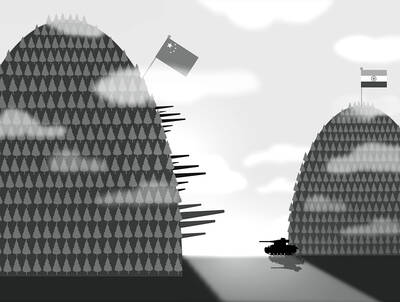
India is not China, and many of its residents fear it never will be. It is hard to imagine a future in which the subcontinent’s manufacturing dominates the world, its foreign investment shapes nations’ destinies, and the challenge of its economic system forces the West to reshape its own policies and principles. However, that is, apparently, what the US administration fears. Speaking in New Delhi last week, US Deputy Secretary of State Christopher Landau warned that “we will not make the same mistakes with India that we did with China 20 years ago.” Although he claimed the recently agreed framework
The Office of the US Trade Representative (USTR) on Wednesday last week announced it is launching investigations into 16 US trading partners, including Taiwan, under Section 301 of the Trade Act of 1974 to determine whether they have engaged in unfair trade practices, such as overproduction. A day later, the agency announced a separate Section 301 investigation into 60 economies based on the implementation of measures to prohibit the importation of goods produced with forced labor. Several of Taiwan’s main trading rivals — including China, Japan, South Korea and the EU — also made the US’ investigation list. The announcements come
Taiwan is not invited to the table. It never has been, but this year, with the Philippines holding the ASEAN chair, the question that matters is no longer who gets formally named, it is who becomes structurally indispensable. The “one China” formula continues to do its job. It sets the outer boundary of official diplomatic speech, and no one in the region has a serious interest in openly challenging it. However, beneath the surface, something is thickening. Trade corridors, digital infrastructure, artificial intelligence (AI) cooperation, supply chains, cross-border investment: The connective tissue between Taiwan and ASEAN is quietly and methodically growing


 RSS
RSS