


On Oct. 13 in the Legislative Yuan, the Mainland Affairs Council appeared to reverse its stance on whether the Dalai Lama would be able to visit Taiwan, saying that the government would consider granting permission if it was convenient for both parties.
On Oct. 23, however, Chinese Nationalist Party (KMT) Legislator Wu Yu-sheng (吳育昇), who has a close relationship with President Ma Ying-jeou (馬英九), said that “since both sides of the [Taiwan] Strait belong to China...” a visit by the Dalai Lama to Taiwan could be considered “a return to China.”
Today, when the idea that the Republic of China (ROC) could have any claim over China has become ridiculous, how is it that Wu feels he can say what others dare not?
The Dalai Lama has visited Taiwan three times: In 1997, during former president Lee Teng-hui’s (李登輝) term; in 2001, when former president Chen Shui-bian (陳水扁) was in office; and in 2009, after Ma took office.
The Dalai Lama met the then-president on his first two trips, but Ma prevaricated, and he did not meet the Tibetan spiritual leader. Their paths did not even cross.
In 2009, when Typhoon Morakot devastated the nation, Ma initially refused all international assistance from everywhere except China, eagerly anticipating help from the People’s Liberation Army (PLA), although in the end it was the US military that came to the nation’s aid.
Closely following this, not three weeks later, Ma agreed to a visit by the Dalai Lama — which China was not happy about — from Aug. 30 to Sept. 4 to offer consolation to the victims of the disaster.
Even though the invitation was originally extended by politicians affiliated with the Democratic Progressive Party (DPP), Ma approved the visit late the same night the offer was made. The speed at which he changed his mind was truly startling, and the factors at play in the background are similarly intriguing.
Then-Mainland Affairs Council minister Wang Yu-chi (王郁琦) said that he did not think this would be harmful to cross-strait relations. However, the Taiwan Affairs Office (TAO) said Beijing was very concerned about the Dalai Lama’s motivation for this particular trip, and canceled many exchanges as a result.
Clearly, there was a lot of bad feeling between the two sides. Given this, the Tibet Religious Foundation of His Holiness the Dalai Lama — the default liaison office of the Tibetan government-in-exile in Taiwan — said that Ma was able to resist this kind of interference demonstrated his spirit and courage.
Anyone familiar with the incidents surrounding the Tunghsing Building and Legislative Speaker Wang Jin-pyng (王金平) would know that the only time Ma demonstrates courage and grit is when it is in his own best interests to do so.
Why, then, would he risk sticking his neck out like that? Perhaps it was because, having revealed his intention to involve the PLA, he had to do something to atone for having caused alarm over security with Japan and the US.
However, Ma did not admit defeat over PLA involvement. Instead, he allowed China’s State Administration for Religious Affairs director Ye Xiaowen (葉小文) to come to Taiwan on Aug. 28, two days prior to the Dalai Lama’s visit. They held a press conference to much fanfare, and then went to Nantou County to take part in a special ceremony for Morakot victims.
Ma did nothing of the sort for the Dalai Lama, canceling the international press conference. He allowed him to hold a ceremony for the disaster victims, but he did not allow him to speak about Buddhist teachings, and unleashed crowds waving the Chinese flag, protesting against the Dalai Lama’s trip to Taiwan.
The reason Ma created this situation, taking the senior Chinese official to the ceremony and bringing in the hecklers, might well have been to mitigate China’s irritation.
On Sept. 29 this year, Ma indicated that his support was leaning toward China. On Oct. 10 — National Day — he, rather provocatively, urged China to move toward liberal democracy, for which the TAO, on Oct. 15, issued a stern rebuke.
In a single week, Ma called three national security meetings, ostensibly to address the ongoing food safety issue, something that is quite unprecedented: Clearly, something else was afoot.
There is little doubt that Wu’s statement that a visit by the Dalai Lama would be tantamount to “a return to China” was an example of Ma expressing his position to Beijing by proxy, and his position is that the constitutions in both China and Taiwan are crystal clear: That Taiwan is the exclusive property of China.
Of course, governing a country requires balancing the interests of all parties, but this also needs careful planning. Ma’s insistence on doing things his own way, of proceeding at full throttle and then dealing with problems as they arise, is going to lead to disaster for the nation and for East Asia.
HoonTing is a political commentator.
Translated by Paul Cooper
Taiwanese pragmatism has long been praised when it comes to addressing Chinese attempts to erase Taiwan from the international stage. “Taipei” and the even more inaccurate and degrading “Chinese Taipei,” imposed titles required to participate in international events, are loathed by Taiwanese. That is why there was huge applause in Taiwan when Japanese public broadcaster NHK referred to the Taiwanese Olympic team as “Taiwan,” instead of “Chinese Taipei” during the opening ceremony of the Tokyo Olympics. What is standard protocol for most nations — calling a national team by the name their country is commonly known by — is impossible for
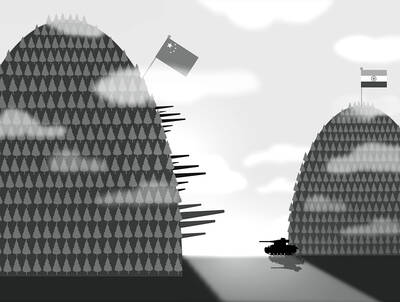
India is not China, and many of its residents fear it never will be. It is hard to imagine a future in which the subcontinent’s manufacturing dominates the world, its foreign investment shapes nations’ destinies, and the challenge of its economic system forces the West to reshape its own policies and principles. However, that is, apparently, what the US administration fears. Speaking in New Delhi last week, US Deputy Secretary of State Christopher Landau warned that “we will not make the same mistakes with India that we did with China 20 years ago.” Although he claimed the recently agreed framework
The Office of the US Trade Representative (USTR) on Wednesday last week announced it is launching investigations into 16 US trading partners, including Taiwan, under Section 301 of the Trade Act of 1974 to determine whether they have engaged in unfair trade practices, such as overproduction. A day later, the agency announced a separate Section 301 investigation into 60 economies based on the implementation of measures to prohibit the importation of goods produced with forced labor. Several of Taiwan’s main trading rivals — including China, Japan, South Korea and the EU — also made the US’ investigation list. The announcements come
Taiwan is not invited to the table. It never has been, but this year, with the Philippines holding the ASEAN chair, the question that matters is no longer who gets formally named, it is who becomes structurally indispensable. The “one China” formula continues to do its job. It sets the outer boundary of official diplomatic speech, and no one in the region has a serious interest in openly challenging it. However, beneath the surface, something is thickening. Trade corridors, digital infrastructure, artificial intelligence (AI) cooperation, supply chains, cross-border investment: The connective tissue between Taiwan and ASEAN is quietly and methodically growing


 RSS
RSS