


News of the fatal beating of a police officer by a mob outside a nightclub in Taipei’s Xinyi District (信義) on Sunday has sent shockwaves across the nation.
Three suspects have since been detained and charged with homicide, but many questions remain unanswered.
The incident is a grave matter. Taiwan prides itself on being a nation of law and order, so when a police officer — a representative of the law responsible for maintaining public order — is assaulted and killed in public view, something is not quite right, and authorities should not take the matter lightly.
Strictly speaking, the victim, Hsueh Chen-kuo (薛貞國), 38, was not at the scene in his capacity as a police officer, as he was off duty that day. He was not in uniform, nor was he equipped with the accoutrements that officers carry when he was asked to help handle a dispute at the Spark ATT bar. Police reports said that about 50 suspects attacked Hsueh with baseball bats and clubs, dragged him outside into the street and left him to die from injuries to his head and body.
Although Hsueh was off duty, according to the Xinyi District Police Precinct, he felt duty-bound to investigate what was happening when he learned of the disturbance in the area he usually patrolled. Regardless of whether the suspects knew he was a police officer, the fact that they could beat a stranger to death without fear of the law is a serious sign of deteriorating public safety.
Some have asked why Hsueh did not call the police station for backup before stepping into the club single-handedly to try to handle the disturbance. Police reports later revealed that another officer, surnamed Chuang (莊), was with Hsueh at the time of the incident. However, many have also found it puzzling why Chuang, who was on a leave of absence due to a heart problem, did not alert police in uniform to handle the case officially.
There are also rumors of dubious relations between Hsueh and gangsters, prompting some to lament how negative an impression the public has of police that even when an officer was the victim in a tragedy, his integrity is being questioned.
The incident has seemingly turned into a national guessing game, with members of the public questioning the case and the role of Hsueh and Chuang in the incident, as rumors and speculation on the complex relations between police and gangsters mount.
The incident also exposed a lack of awareness and training on the part of the Xinyi District Police Precinct, whose jurisdiction houses many “special business establishments,” such as nightclubs, KTVs and bars that, more so than other businesses, tend to be associated with criminal activity. With that in mind, one would think it is standard procedure for the precinct to increase its patrol and monitoring of the area, so that it is not left to other police officers calling the center to inform it of what is happening on its own “turf.”
One way to put to rest the mounting suspicions surrounding the role of the police in the case is for the authorities to take timely and transparent action to get to the bottom of the matter regardless of the consequences and who may be involved.
Only by exercising determination and getting to the bottom of the incident with transparency and impartiality can the authorities revive the public’s confidence in law enforcement officers, as well as erase its negative impression about police officers in general.
On March 22, 2023, at the close of their meeting in Moscow, media microphones were allowed to record Chinese Communist Party (CCP) dictator Xi Jinping (習近平) telling Russia’s dictator Vladimir Putin, “Right now there are changes — the likes of which we haven’t seen for 100 years — and we are the ones driving these changes together.” Widely read as Xi’s oath to create a China-Russia-dominated world order, it can be considered a high point for the China-Russia-Iran-North Korea (CRINK) informal alliance, which also included the dictatorships of Venezuela and Cuba. China enables and assists Russia’s war against Ukraine and North Korea’s
After thousands of Taiwanese fans poured into the Tokyo Dome to cheer for Taiwan’s national team in the World Baseball Classic’s (WBC) Pool C games, an image of food and drink waste left at the stadium said to have been left by Taiwanese fans began spreading on social media. The image sparked wide debate, only later to be revealed as an artificially generated image. The image caption claimed that “Taiwanese left trash everywhere after watching the game in Tokyo Dome,” and said that one of the “three bad habits” of Taiwanese is littering. However, a reporter from a Japanese media outlet
Taiwanese pragmatism has long been praised when it comes to addressing Chinese attempts to erase Taiwan from the international stage. “Taipei” and the even more inaccurate and degrading “Chinese Taipei,” imposed titles required to participate in international events, are loathed by Taiwanese. That is why there was huge applause in Taiwan when Japanese public broadcaster NHK referred to the Taiwanese Olympic team as “Taiwan,” instead of “Chinese Taipei” during the opening ceremony of the Tokyo Olympics. What is standard protocol for most nations — calling a national team by the name their country is commonly known by — is impossible for
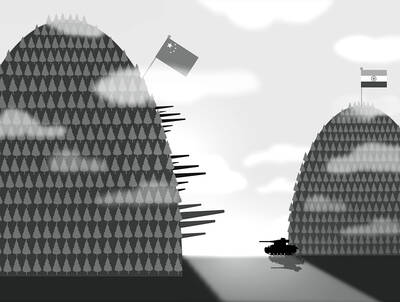
India is not China, and many of its residents fear it never will be. It is hard to imagine a future in which the subcontinent’s manufacturing dominates the world, its foreign investment shapes nations’ destinies, and the challenge of its economic system forces the West to reshape its own policies and principles. However, that is, apparently, what the US administration fears. Speaking in New Delhi last week, US Deputy Secretary of State Christopher Landau warned that “we will not make the same mistakes with India that we did with China 20 years ago.” Although he claimed the recently agreed framework


 RSS
RSS