


Former American Institute in Taiwan chairman Richard Bush was quoted on Friday last week as saying that he believes the US government will “express itself about the implications of the 2016 [Taiwanese presidential] election for US interests.” He also cited a Financial Times report in 2011 of US govenrment officials critizing then-Democratic Progressive Party (DPP) presidential candidate Tsai Ing-wen (蔡英文).
Bush’s comments have been interpreted in different ways in Taiwan, with some media outlets speculating that Washington might again come to the aid of the Chinese Nationalist Party (KMT) in the run-up to the 2016 presidential election.
The DPP disagrees with Bush, and the US Department of State has said that his views do not represent the views of Washington and that the US government will not express any opinion about who might be elected.
Although Taiwan is politically isolated, it shares a deep bond with the international community. Taiwan’s leaders affect the balance of power and peace in the region, and some countries may find ways to influence the presidential election.
Bush used the run-up to the 2012 presidential election as an example because Washington issued statements at the time that affected the election atmosphere. Beijing was more overt, with Chinese government officials mobilizing China-based Taiwanese businesspeople, arranging chartered flights to Taiwan and using pro-Chinese media outlets as mouthpieces such that the China factor percolated through the campaign.
Taiwanese politicians are keenly aware that while foreign forces do not have a vote, they can influence how some people vote. As the election atmosphere intensifies, global factors might play a large part in who wins. This is why, as the presidential election approaches, candidates will arrange visits to the US, Japan, Singapore and other countries so that foreign governments, political parties, think tanks and academics might understand their political ideas and possibly offer support. Taiwan might be the main battlefield in a presidential election, but the international community is an important secondary battlefield that must be taken into consideration.
Although there is still some time before the next presidential election, Bush’s comments have turned the spotlight on the global factor earlier than expected.
As the two sides of the Taiwan Strait engage in talks about trade in services and goods and as President Ma Ying-jeou (馬英九) approaches the end of his second and final term, the question is whether he will enter into political talks with China, either on his own initiative or as a result of Chinese pressure.
Taiwan is becoming increasingly dependent on China, and this has unsettled not only local activists, but also Japan. Even former US secretary of state Hillary Rodham Clinton had issued warnings about the situation. At a time when relations between the US, Japan and China are becoming increasingly tense because of disputes over the East China and South China seas, presidential candidates’ cross-strait policies are being scrutinized.
The presidential election is not conducted in isolation. It will affect the international community, which in turn will affect Taiwan. Presidential candidates should prepare their international credentials and their policies for dealing with cross-strait relations, as well as ties with the US and Japan. In doing so, global influences might be beneficial, or they might be a hindrance. Candidates must prepare a response for dealing with either situation.
Voters must also prepare — they must stick to their views so that their decisions are not swayed as global factors begin to make themselves felt in the run-up to the election.
On March 22, 2023, at the close of their meeting in Moscow, media microphones were allowed to record Chinese Communist Party (CCP) dictator Xi Jinping (習近平) telling Russia’s dictator Vladimir Putin, “Right now there are changes — the likes of which we haven’t seen for 100 years — and we are the ones driving these changes together.” Widely read as Xi’s oath to create a China-Russia-dominated world order, it can be considered a high point for the China-Russia-Iran-North Korea (CRINK) informal alliance, which also included the dictatorships of Venezuela and Cuba. China enables and assists Russia’s war against Ukraine and North Korea’s
After thousands of Taiwanese fans poured into the Tokyo Dome to cheer for Taiwan’s national team in the World Baseball Classic’s (WBC) Pool C games, an image of food and drink waste left at the stadium said to have been left by Taiwanese fans began spreading on social media. The image sparked wide debate, only later to be revealed as an artificially generated image. The image caption claimed that “Taiwanese left trash everywhere after watching the game in Tokyo Dome,” and said that one of the “three bad habits” of Taiwanese is littering. However, a reporter from a Japanese media outlet
Taiwanese pragmatism has long been praised when it comes to addressing Chinese attempts to erase Taiwan from the international stage. “Taipei” and the even more inaccurate and degrading “Chinese Taipei,” imposed titles required to participate in international events, are loathed by Taiwanese. That is why there was huge applause in Taiwan when Japanese public broadcaster NHK referred to the Taiwanese Olympic team as “Taiwan,” instead of “Chinese Taipei” during the opening ceremony of the Tokyo Olympics. What is standard protocol for most nations — calling a national team by the name their country is commonly known by — is impossible for
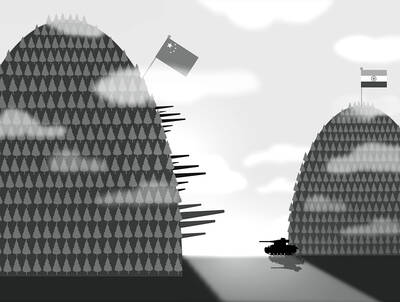
India is not China, and many of its residents fear it never will be. It is hard to imagine a future in which the subcontinent’s manufacturing dominates the world, its foreign investment shapes nations’ destinies, and the challenge of its economic system forces the West to reshape its own policies and principles. However, that is, apparently, what the US administration fears. Speaking in New Delhi last week, US Deputy Secretary of State Christopher Landau warned that “we will not make the same mistakes with India that we did with China 20 years ago.” Although he claimed the recently agreed framework


 RSS
RSS