

In the wake of Chinese President Xi Jinping’s (習近平) ascendancy since the Chinese Communist Party’s (CCP) 18th National Congress in 2012, Beijing’s stance on the Asia-Pacific region has become clearly discernible. China’s territorial claims in the South China Sea and sudden establishment of an air defense identification zone near Japan underline Xi’s ambitions to dominate Asia.
Unlike his predecessor, former Chinese president Hu Jintao (胡錦濤), who nominally presided over the CCP’s Politburo Standing Committee (PSC), but made decisions collectively with the regime’s top policymaking body, Xi commands and rules the committee. He heads and commands all organs of the party, state and military.
In addition, he has amassed powers through newly established functional bodies, including the National Security Commission, the Leading Working Group on Overall Reform, and the Leading Working Group on Cybersecurity and Information Security. By heading these functional leadership bodies, Xi exercises direct control and acquires additional power over the nation’s economy and ideology, for which his committee colleagues, Chinese Premier Li Keqiang (李克強) and Liu Yunshan (劉雲山), were formerly responsible.
Previously, the party’s leadership was noted for factional politics and wrangle. Leaders representing the interests of China’s military-industrial complex and the “oil lobby” were actively involved in the leadership consensus-building process regarding not only Beijing’s foreign and security policy, but economic and trade policy as well. Changes have taken place in the context of Xi’s rise. In the name of anti-graft, he has engineered the purge of corrupted senior officials. The campaign to take down “tigers and flies” also serves to remove political rivals as well as to enhance his grip on power.
The disgrace of Zhou Yongkang (周永康), an ex-member of the Politburo Standing Committee, and the regime’s security czar and head of the oil lobby prior to his retirement in November 2012, carries immense political implications. Zhou was placed under house arrest last year, facing charges of corruption and other serious wrongdoings from a special task force set up by the party’s anti-graft watchdog body, prior to the formal announcement of his investigation at the end of July.
In March, Chinese authorities seized assets worth more than 90 billion yuan (US$14.66 billion) from Zhou’s family members and associates, and took into custody more than 300 of Zhou’s relatives, proteges and political allies. Zhou’s associates in the oil lobby, notably Jiang Jiemin (蔣潔敏), former chairman of China’s National Petroleum Co, and other top executives in the energy sectors and state-owned enterprises were removed.
On June 30, the party hunted down a big “tiger” in the Chinese People’s Liberation Army (PLA) General Xu Caihou (徐才厚), formerly a member of the PSC and vice chairman of Central Military Commission (CMC) from 2004 to 2012, who was in charge of the PLA’s daily affairs and known to be former Chinese president Jiang Zemin’s (江澤民) confidant and spokesman.
Xu was detained for investigation on charges of violating party discipline on March 15, and expelled from the party at a PSC meeting chaired by Xi on June 30. Reports said Xu’s four principal assistants and dozens of ranking PLA officers he promoted or appointed are also under investigation.
General Guo Boxiong (郭伯雄), a PSC member and CMC vice chairman, another big “tiger,” is also under investigation. Guo and his son, another PLA officer, have been detained for questioning, but their offenses are yet to be made public. Scores of PLA officers who were appointed or promoted by Xu and Guo have been removed from their positions. Xi has seized the opportunity to reward or co-opt supporters by promoting them or appointing them to the key posts that have become vacant.
Corruption is a problem that pervades the PLA. Notwithstanding the constraints on anti-corruption enforcement and political risks involved in blackening the PLA’s image in a big campaign, Xi described corruption as a “do-or-die struggle” and warned that widespread graft in the military poses as much of a threat to China’s security as the US. Thus, he is determined to push an all-out offensive, and embark on a concerted and sustained campaign against such corruption.
In so doing, Xi has apparently enhanced his authority in the PLA and in the nation. On four separate occasions in March, April and July, scores of commanding officers in China’s seven military regions, four major departments in the PLA headquarters, air force, navy and the 2nd Artillery, have pledged their support of and loyalty to Xi and his policies.
Xi reigns supreme in the seven-member PSC — the regime’s top policymakers — much like a present-day emperor with six assistants. Some say Xi has made all the major strategic decisions virtually single-handedly and that his “China dream” poses a serious challenge to the US domination of the Asia-Pacific region.
During the past decade, the US has recognized China’s steady rise in economic and military power, as well as its growing role in international affairs, and has repeatedly urged Beijing to be a “responsible stakeholder” and cooperate with the US to manage and solve regional and global issues.
However, Chinese officials have voiced disapproval, viewing it as a ploy to impair China’s rightful place in world affairs and to strengthen the international order dominated by the US.
Xi is a staunch Marxist and a revisionist determined to challenge the Pax Americana and bring changes to the existing international order. He has called for a “new type of great powers relationship,” parity in Sino-US relations and demanded Washington respect Beijing’s core interests, including termination of the arms sales to Taiwan.
In an international meeting in Shanghai in May, Xi proposed a new Asia security concept — ideas for a new order in Asia, with China at the center and with the exclusion of the US. Xi is also taking the initiative to work with the leaders of the other BRICS (Brazil, Russia, India and South Africa) nations to set up a new international bank to help the world’s developing countries. As an alternative and challenge to the US-led IMF and the World Bank, the BRICS bank will be based in Shanghai and China will put up 40 percent of the bank’s initial capital of US$100 billion.
Xi’s dream is for China to build the world’s largest economy and strongest military. He believes that, as the US is in decline, China will eventually supplant the US as the global “champion nation.”
Can the US pivot to Asia strategy contain and check China’s expansionism? Most analysts are concerned with the stark imbalance between ends and means in the US strategy. To implement and carry out the objectives of the “pivot,” the US must have sufficient financial resources and an ability to use military means purposefully.
Parris Chang is professor emeritus of political science at the Pennsylvania State University and president of the Taiwan Institute for Political, Economic and Strategic Studies.
Taiwan’s domestic political situation is following recognizable political rhythms, while the international environment surrounding Taiwan is undergoing a major transformation. Within Taiwan, there are ongoing battles between the legislative and executive branches over the budget, and between cities and the central government over resources. Tensions between political parties dominate headlines and consume much of the attention of party leaders. Jockeying is underway for local elections this November and national elections in 2028. And the longstanding philosophical debate inside Taiwan over how best to protect Taiwan and promote the good life remains unresolved. Amidst all of this, Taiwan continues to function well. It
In an article published on Tuesday in The Atlantic, titled “Will Taiwan Just Give Up?”, journalist Simon Shuster emphasizes the unpredictability of the US as an ally under US President Donald Trump and cites diminishing faith in the US as a contributor to what he sees as waning determination to resist China. As the title suggests, Shuster views a deal between Taiwan and China as an increasingly inevitable alternative to a costly war — one that Taiwan, lacking reliable allies and military capabilities, would eventually be destined to lose. He focuses on Chinese Nationalist Party (KMT) Chairwoman Cheng Li-wun (鄭麗文) — her
With candidate registration for this year’s local elections closed on Sept. 4 and the elections less than 80 days away, Democratic Progressive Party (DPP) Legislator and Taipei mayoral candidate Puma Shen’s (沈伯洋) rapidly growing popularity has become the focus of political talk shows and online discussions over the past week, heating up the mayoral election race in Taipei. Local media headlines and political pundits have picked up his supporters’ slogan “ocean current” (洋流) — a play on the last character of Shen’s name, which literally means “ocean” (洋), and the character (流), which can mean “current,” “flow” or “trend” — to
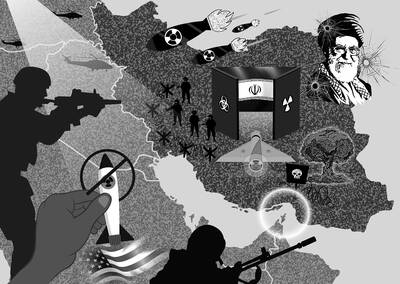
When was the last time you heard a meaningful proposal to prevent Iran from developing a nuclear arsenal? There has been nothing on the subject since the June Memorandum of Understanding between the US and Iran; the promised 60 days of talks to settle questions around Tehran’s uranium-enrichment program never began and have long since expired. When the war was launched, on Feb. 28, a resolution of the nuclear dispute was prominent among the dizzying array of US and Israeli aims to explain the attack. But as should be clear by now, the attempt was entirely reliant on achieving regime change. That


 RSS
RSS