


Strategies for the future
Chess is a beautiful game, limited to a small board and 16 pieces per side, as opposed to an expansionist, grab-all-you-can game like go.
The Ukraine conflict shows that Russian President Vladimir Putin is playing chess, while US President Barack Obama is playing checkers. Russia dominates Europe’s energy supply, meaning Putin holds all the trump cards.
The Taiwan Solidarity Union (TSU) is proposing sensible policies and reform, especially of the budget and silly laws. The TSU is the only group playing chess against China.
Taiwan’s unique economy would boom if wise leaders started small and medium-sized enterprises.
Any well-informed adult knows that while today’s wars are fought over oil, future wars will be fought over water.
The Baltic Dry Index — cash paid to ship things internationally — is bouncing along the bottom. The global economy is slowing and countries everywhere are facing sovereign debt crises, notably Argentina.
After the US dollar loses its “almighty” status, there will be major changes to the global economic system.
Taiwan needs to become much more self-reliant while there is time, because in a worst-case scenario imports and exports could be cut off, meaning people would have to share what they produce.
Taiwan should leverage the brilliance of its university students to start a program whereby huge, unneeded boats are converted into massive floating solar and Fresnel lens-powered water purifying machines.
Such boats would be invaluable to poverty-stricken Haiti, a diplomatic ally.
Also, Crimea, which voted to rejoin Russia in what appears to be a legitimate election, just lost their water supply from “across the strait” in Ukraine.
Subsidence in Taiwan, where farmers are pumping out aquifers, concerns water. Radioactive waste from the Fukushima Dai-ichi nuclear plant in Japan being pumped, at great expense, into south Taiwanese fish farms concerns water.
I previously predicted that the next crisis would be about oil and indeed the Middle East/Africa conflagration has been raging for decades thanks to former US president Richard Nixon and the CIA, with former British politician and diplomatic adviser Mark Sykes and former French diplomat Francois Georges-Picot also to blame for putting the world on an unavoidable path toward pollution and eventual self-destruction.
Nixon’s co-conspirator, Henry Kissinger, and Obama will go down as the worst Nobel Peace Prize winners in history.
It was a little shocking to learn that a study by the Chinese Ministry of Water Resources found that approximately 55 percent of China’s 50,000 rivers that existed in the 1990s have disappeared.
Investors and entrepreneurs should be looking into ways to provide clean water to those in need, using new technologies and surplus maritime hardware.
If all marine life dies off within the next several years, as I predicted in 2009, fishermen in Suao Township (蘇澳), Yilan County, will need to be retrained for a different industry. Again, Fukushima does not help here.
Playing chess requires players to look beyond the next move and see the future trends.
The oil, air, soil and water trends for Earth do not look good. As an island, Taiwan needs to start now to invest in resilience.
Torch Pratt
New Taipei City

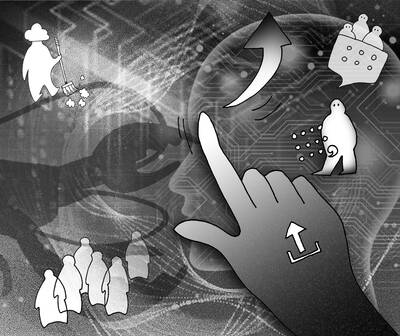
Weeks into the craze, nobody quite knows what to make of the OpenClaw mania sweeping China, marked by viral photos of retirees lining up for installation events and users gathering in red claw hats. The queues and cosplay inspired by the “raising a lobster” trend make for irresistible China clickbait. However, the West is fixating on the least important part of the story. As a consumer craze, OpenClaw — the AI agent designed to do tasks on a user’s behalf — would likely burn out. Without some developer background, it is too glitchy and technically awkward for true mainstream adoption,
A delegation of Chinese Nationalist Party (KMT) officials led by Chairwoman Cheng Li-wun (鄭麗文) is to travel to China tomorrow for a six-day visit to Jiangsu, Shanghai and Beijing, which might end with a meeting between Cheng and Chinese President Xi Jinping (習近平). The trip was announced by Xinhua news agency on Monday last week, which cited China’s Taiwan Affairs Office (TAO) Director Song Tao (宋濤) as saying that Cheng has repeatedly expressed willingness to visit China, and that the Chinese Communist Party (CCP) Central Committee and Xi have extended an invitation. Although some people have been speculating about a potential Xi-Cheng
Chinese Nationalist Party (KMT) Chairwoman Cheng Li-wun (鄭麗文) is leading a delegation to China through Sunday. She is expected to meet with Chinese President Xi Jinping (習近平) in Beijing tomorrow. That date coincides with the anniversary of the signing of the Taiwan Relations Act (TRA), which marked a cornerstone of Taiwan-US relations. Staging their meeting on this date makes it clear that the Chinese Communist Party (CCP) intends to challenge the US and demonstrate its “authority” over Taiwan. Since the US severed official diplomatic relations with Taiwan in 1979, it has relied on the TRA as a legal basis for all
The ongoing Iran conflict is putting Taiwan’s energy fragility on full display — the island of 23 million people, home to the world’s most advanced semiconductor manufacturing, is highly dependent on imported oil and gas, especially that from the Middle East. In 2025, 69.6 percent of Taiwan’s crude oil and 38.7 percent of liquified natural gas were sourced from the Middle East. In the same year, 62 percent of crude oil and 34 percent of LNG to Taiwan went through the Strait of Hormuz. Taiwan’s state-run oil company CPC Corp’s benchmark crude oil price (70 percent Dubai, 30 percent Brent)


 RSS
RSS