


Following his recent meeting with former vice president and former Chinese Nationalist Party (KMT) chairman Lien Chan (連戰), Chinese President Xi Jinping (習近平) gave a four-point speech deserving attention.
It was Xi’s first public speech on the cross-strait situation following the meeting between Mainland Affairs Council (MAC) Minister Wang Yu-chi (王郁琦) and China’s Taiwan Affairs Office (TAO) Minister Zhang Zhijun (張志軍). It was also the first time since Xi came to power that he proposed a more complete view of Taiwan policy and cross-strait relations. This view is likely to serve as a guideline for the Chinese Communist Party’s (CCP) Taiwan policy in the future.
These are the issues in his speech that require close inspection.
First, although Xi continued to play on national sentiment and the idea that the two sides of the Taiwan Strait are part of one big family, he was more careful in his wording. Departing from a more self-centered approach, he used positive language such as “cross-strait mutual understanding,” “efforts,” “sharing” and “beginning.”
He added various features of Taiwan’s history, society, traditions and culture to his discourse to gain Taiwanese recognition and support.
Xi also emphasized that although we cannot choose the past, we can seize the moment and be open to the future.
This approach shows that he is confident and that he understands Taiwan. As he continues to promote the “Chinese dream,” he will also stress the construction of a Taiwanese and a cross-strait dream and their connection to the Chinese dream.
Second, Xi reiterated that, on the basis of peaceful and stable cross-strait relations, the two sides should embrace the so-called “1992 consensus” and oppose Taiwanese independence in order to consolidate the “one China” framework.
Although this call was in the political report of the CCP’s 18th Central Committee, it was the first time that Xi mentioned the “1992 consensus” in a public speech. For more than a year, the world has been worried that Xi might attempt to replace the “1992 consensus” with the “one China” framework.
Today, following the meetings between Wang and Zhang and between Lien and Xi, it seems Beijing also supports the “1992 consensus” that President Ma Ying-jeou’s (馬英九) administration has always upheld. For mutual political trust as well as other cross-strait dialogue, there is still room for interpretation of the “1992 consensus.”
Third, Xi praised the “Wang-Zhang meeting,” saying that it was meaningful for the overall development of cross-strait relations.
Judging from the praise for the meeting from Ma, Xi, Taiwanese in general and the international community, we can expect Zhang to visit Taiwan, as well as further contact and cooperation between the authorities on the two sides of the Taiwan Strait.
In particular, Beijing is hosting this year’s APEC summit.
Regardless of whether a meeting between Ma and Xi takes place at the meeting, the fact that Xi has included the cross-strait dream in the Chinese dream implies that contacts and cooperation will continue between ministerial-level officials in Taiwan and China. Political issues might, of course, also be discussed.
Fourth, when dealing with cross-strait developments, China hopes to get rid of the nightmare presented by Taiwan’s direct presidential election every four years.
Even Xi, a highly confident nationalist leader, will face the CCP’s 19th Central Committee in 2017, which will carry out a review of his Taiwan policy.
Given these circumstances, he has reiterated that Beijing is willing to engage in exchanges with Taiwan’s pan-green camp, so they can work together to push for the peaceful development of cross-strait relations.
As for the Democratic Progressive Party’s (DPP) chairmanship election in May and the direction of the party’s China policy, the CCP may be reluctant to engage in party-to-party exchanges, but hopes to interact with individual members to push for changes in the DPP’s China policy.
Beijing’s expectations in this respect are high.
Xi’s personal leadership characteristics and decisionmaking style and his demonstration that there is a possibility for change in China’s Taiwan policy imply that he might take a more active and aggressive approach.
As Taiwan’s government and opposition focus mainly on the seven-in-one local elections in November, they should also examine possible opportunities and challenges that could result from any such changes.
Andy Chang is director of the Graduate Institute of China Studies at Tamkang University.
Translated by Eddy Chang
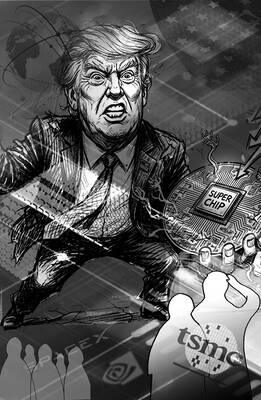
The White House’s decision to take a 9.9 percent stake in Intel Corp is looking like very shrewd business indeed. Since the government bought in at US$20.47 a share last August, the US chipmaker’s surging stock price has delivered the US a US$43 billion return. One of the reasons the investment has so far proved so sound is that the White House has made sure of it. According to The Wall Street Journal, Howard personally pushed deals on Intel’s behalf with some of the most lucrative clients imaginable. They include Nvidia Corp, the company at the heart of the AI
KMT Chairwoman Cheng Li-wun’s (鄭麗文) recent visit to Beijing and her upcoming visit to Washington will serve as a high-level test of her diplomatic mettle. In Beijing, Cheng was received with symbolic gestures, a warm reception, and high-level access. In Washington, she will receive far less pomp and far sharper questions about the KMT’s vision for the future of Taiwan. Her challenge will be to persuade Washington that the KMT’s engagement with China can coexist with strong deterrence. Cheng’s April 7-12 visit to mainland China coincided with an intense period of conflict in Iran. Despite the strategic significance of Cheng’s trip,
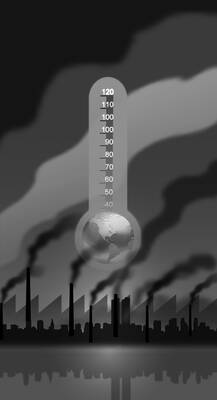
The closure of the Strait of Hormuz has sent the vast Asian chemicals industry into a tailspin. Deprived of the likes of Qatari natural gas and Saudi Arabian oil, the region’s fertilizer and plastics plants are slowing production or even shutting down. Everywhere except China, that is. In petrochemicals, China is unique. As well as a traditional industry that uses oil and gas as feedstock, it has parallel output that relies on its abundant domestic coal. Unsurprisingly, India and other regional powers want to copy and paste the Chinese method. This would not be easy — or climate friendly. The
Indonesian President Prabowo Subianto says he knows how to fix the problems facing Indonesia. Yet his economic mismanagement and authoritarian tendencies are steering the nation toward a familiar mix of currency instability and political chaos. The world’s fourth-most populous nation risks reversing the hard-won democratic and business reforms that came after the Asian Financial Crisis in 1997. At that time, the rupiah collapsed and the political upheaval that followed forced former president Haji Mohamed Suharto from power. Prabowo’s administration is ignoring similar warning signs. That disconnect was apparent in a national address on Wednesday, when Prabowo projected the swagger that has


 RSS
RSS