


Sixteen years after Hong Kong’s return to China, the territory is mired in political gridlock, anti-Beijing sentiment has seeped into everyday life, and prospects for promised democracy are facing a rocky road.
Hong Kong’s reversion to Chinese rule in 1997 was heralded as one of several acts that would end China’s “century of humiliation.” The final act, peaceful reunification with Taiwan, remains a Chinese dream.
Ironically, late Chinese leader Deng Xiaoping (鄧小平) devised the 50-year “one country, two systems” formula now governing Hong Kong as a model for Taiwan, anticipating its eventual reversion to Chinese sovereignty.
However, with China’s clumsy efforts to win the hearts and minds of Hong Kong’s people littered with embarrassments, neither Taiwan nor Hong Kong has been impressed.
Beijing and Hong Kong are now on a collision course over Hong Kong’s future.
Pro-democracy groups and ordinary citizens have been preparing for “Occupy Central,” a large-scale civil disobedience sit-in scheduled for later this year in Hong Kong’s financial district, unless there is an acceptable plan for a one-man, one-vote system for the election of Hong Kong’s next chief executive in 2017.
A recent poll showed that 62 percent of Hong Kong’s people want part of that plan to include the right to nominate candidates, rather than delegating that role to a small, unrepresentative nominating committee that could screen out “unpatriotic” candidates.
Absent an acceptable roadmap within the next six to eight months, Hong Kong faces the prospect of civil disorder, mass arrests, and the international business community’s loss of confidence.
There has even been mention in the local press of deploying the People’s Liberation Army to put down protests, with Beijing’s local propaganda chief recently reminding the city that the central government had the power to impose a “state of emergency” if the Hong Kong government lost control.
As Hong Kong now settles in for a five-month period of consultations aimed at reforming its nomination and election system, it may be a good time for Beijing to think about hitting the reset button. That would mean a new soft power strategy and a fresh team to oversee Hong Kong’s affairs. It would also require that China reorient its “one country, two systems” framework back toward a greater accommodation of Hong Kong’s long-held and growing aspirations for a more democratic and representative governing system.
For the past 16 years, Beijing’s secretive Central Government Liaison Office in Hong Kong has been monitoring the Hong Kong government’s implementation of “one country, two systems” and has increasingly shown a willingness to intervene in purely local affairs that are under the jurisdiction of the Hong Kong government.
Problem is, it has little expertise in foreign affairs or in dealing with foreign societies. And Hong Kong is still “foreign,” despite its overwhelmingly Han Chinese population. As a result, Beijing’s shadow government in the city regularly misreads what drives Hong Kong’s 7 million residents, most of whom cherish freedom, rule of law, and an independent judiciary.
So how did Hong Kong-mainland relations descend to one of their lowest depths since the handover?
Observers point to several misjudgments by the Chinese leadership, but trace the roots of tensions to a pivotal event in 2003, when 500,000 Hong Kong residents took to the streets in protest against Article 23, a now infamous internal security law that Beijing expects Hong Kong to implement in order to fulfill requirements of the Basic Law, Hong Kong’s mini-constitution.
Opponents continue to be concerned that its vague provisions against treason, secession and certain political activities would curtail Hong Kong’s political and personal freedoms, if the article were ever to be adopted.
The size of the 2003 demonstrations took China’s leaders by surprise, and their response sowed the seeds of a gradual but significant shift in Beijing’s governing attitude — from a laissez-faire emphasis on “two systems” to a sharpened focus on patriotism and “one country.”
China’s more interventionist approach in Hong Kong has produced a number of embarrassing missteps that have only highlighted its general lack of understanding of much of the city’s thinking. Its recent failure to impose “national education” is a case in point. Anyone familiar with Hong Kong could have predicted the sit-ins and demonstrations that followed against what was widely perceived as a propagandized curriculum.
Critics castigated the government’s proposed teaching booklet, The China Model, for referring to China’s ruling party as “progressive, selfless, and united,” for criticizing multiparty systems as disastrous, and for whitewashing parts of Chinese history, such as the 1989 Tiananmen Massacre.
Another telling episode took place in October 2012 after two ferries collided in Hong Kong Harbor. When government officials visited victims at a local hospital, it was the Liaison Office’s deputy director who talked to reporters, with Hong Kong’s chief executive standing meekly in the background. Such images heightened concerns that the Hong Kong government was no longer calling the shots, even on purely local matters.
Such displays are not new. By 2008, Beijing had been raising eyebrows with its insensitivities to Hong Kong’s governing system of separation of powers, particularly the city’s cherished independent judiciary.
When then-Chinese vice president Xi Jinping (習近平), now China’s president, visited Hong Kong just prior to the Beijing Olympics, he told local officials, legislators and judges that there should be “solidarity and sincere cooperation within the governance team.”
This prompted a quick rebuke from the Hong Kong Bar Association, which reminded Xi that Hong Kong’s judiciary was independent and not part of any “governance team.”
Critics also condemned Xi for flouting the basic tenets of “one country, two systems.”
That Chinese officials continue to misread Hong Kong, with its own “foreign” Cantonese dialect and alien culture, is now a daily reality for most Hong Kongers.
Some have suggested that those more expert in handling China’s foreign relations should oversee Hong Kong.
However, China’s diplomats are not winning hearts and minds these days either — especially in their own backyard, where the country is facing growing isolation, and a regional arms race is building steam.
With 34 years still remaining under “one country, two systems,” Beijing would do well to return to a policy articulated by former Chinese president Jiang Zemin (江澤民), when he quoted a Chinese proverb reflecting a more hands-off mainland approach to Hong Kong: “Well water does not pollute river water, and river water does not pollute well water.”
To do otherwise risks deepening internecine feuding, a hardening of anti-mainland China sentiment, and years of political paralysis and poor governance.
At the end of the day, a lighter hand in Hong Kong would be a reassuring gesture to Taiwan and positive sign of China’s evolving soft power, still lacking in much of the region, but few here in Hong Kong are counting on it.
Martin Murphy is a former US diplomat and was head of the economic-political section at the US consulate in Hong Kong from 2009 to 2012. A version of this article first appeared in Foreign Policy in Focus, a publication of the Washington-based think tank Institute for Policy Studies.
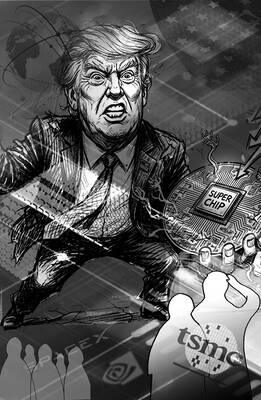
The White House’s decision to take a 9.9 percent stake in Intel Corp is looking like very shrewd business indeed. Since the government bought in at US$20.47 a share last August, the US chipmaker’s surging stock price has delivered the US a US$43 billion return. One of the reasons the investment has so far proved so sound is that the White House has made sure of it. According to The Wall Street Journal, Howard personally pushed deals on Intel’s behalf with some of the most lucrative clients imaginable. They include Nvidia Corp, the company at the heart of the AI
A single photograph can cut through a lot of noise, but it can also be used to misrepresent the truth. At the very least, it can concentrate the mind on something that requires further investigation. On Monday last week, Ma Ying-jeou Foundation CEO Tai Hsia-ling (戴遐齡) and former National Security Council secretary-general King Pu-tsung (金溥聰) held a news conference in which they showed a photograph of former foundation CEO Hsiao Hsu-tsen (蕭旭岑), now Chinese Nationalist Party (KMT) deputy chairman. In the image Hsiao is seated next to Xiamen Taiwan Businessmen Association chairman Han Ying-huan (韓螢煥). The two men were holding
I first met Professor Ray Jiing (井迎瑞) as a film and documentary student at Shih Hsin University’s (SHU) Department of Radio Television and Film in 1988. The following year, he went on to become the director of the Chinese Taipei Film Archive — forerunner of the Taiwan Film and Audiovisual Institute (TFAI). Over his eight-year tenure, Jiing rescued and restored over 200 classic Taiwanese films. In 1997, he established the Graduate Institute of Studies in Documentary and Film Archiving at Tainan National University of the Arts (TNNUA), and I joined the program in his third cohort of students. Beyond a
A recent report concerning a student who is suing his teacher posed the question in its headline: Does failing a student in two subjects constitute bullying? The college student in Chiayi County apparently sought NT$2 million (US$63,603) in state compensation, but a court dismissed the case. The first reaction of many might have been to ask: What has happened to students nowadays? Some say that teachers have lost their authority, while others say students are overindulged. Some even start reminiscing over the days when “whatever the teacher says goes.” However, the real issue might be overlooked if emotional reactions like that are the


 RSS
RSS