


The controversy over US beef imports has yet to be resolved, but the issue has to be dealt with, because Washington has made it clear that it wants Taiwan to allow imports of US beef containing traces of the leanness-enhancing agent ractopamine, and that this will be a precondition for negotiating and resuming talks on the Trade and Investment Framework Agreement (TIFA).
The US beef issue has widespread implications. Aside from questions about food safety and health, its effects encompass economics, politics, diplomacy and Taiwan’s participation in the international community. Therefore, the issue is significant for the nation’s future prospects and development. If the battle lines over the US beef issue are extended indefinitely, it will not be a good thing for Taiwan.
Let us consider the international realities. When the US was negotiating trade agreements with Japan and South Korea, it also bundled up the issue of beef imports with the negotiations. Taking food safety considerations into account, the Japanese and South Korean governments both agreed to allow imports of US beef containing less than 10 parts per billion of ractopamine, and signed free-trade agreements (FTAs) on that basis.
However, Japan maintains a total ban on the use of ractopamine within its own borders and has strengthened various measures for protecting its citizens’ health.
Some people may insist that meat containing ractopamine is completely harmless, but consumer protection groups will definitely not agree.
As media reports have shown, the Democratic Progressive Party is not opposed to importing US beef or doing trade with the US; it is only opposed to importing beef that contains ractopamine. The government’s task then is to communicate better with the public, respecting expertise and assessing the issue according to technical data and risk management.
The government must promise that after it allows imports of beef containing ractopamine, it will set a rigorous standard for the permitted amount of ractopamine, in line with international practice.
It must include ractopamine and growth promoters in the list of substances for which meat has to be tested according to the law and ensure that imported meat is clearly labeled with its country of origin.
This way, suppliers, retailers and restaurant owners can keep consumers fully informed and consumers can refer to the labels when deciding what products to choose or reject. That would serve to protect the health of people living in Taiwan.
South Korea’s experience is that the impact of allowing US beef imports has not been as serious as was originally thought. Although local beef is three times more expensive than US beef, South Koreans still prefer to buy local beef whose safety is guaranteed by the government. Hence, high-quality South Korean beef is not threatened by US imports.
Newly slaughtered beef produced in Taiwan is fresh, sweet and tender. Imported frozen beef cannot compare with it. However, Taiwanese beef accounts for less than 10 percent of the supply, so consumers do not have much opportunity to choose it.
Agricultural policy departments will have to think long and hard about how to ensure that local beef producers can continue to develop sustainably.
Relaxing restrictions on US beef imports will cause many problems for Taiwan’s agriculture. Notably, the US beef issue is tied up with prospects for the TIFA and an FTA. Apart from beef, such agreements may also require Taiwan to lift restrictions on related imports of pork, rice and other products.
In other words, once Taiwan has got a ticket to a TIFA by allowing imports of US beef that contains ractopamine, Taiwanese agriculture will face pressure to liberalize completely.
So, when signing trade agreements, the government should consider the welfare of farmers and the agricultural industry. It should provide more agricultural subsidies, safeguards and complementary measures, as it did when Taiwan joined the WTO. In addition, steps must be taken to make producers more competitive. Even if Taiwan could get out of allowing imports of US beef containing ractopamine, it would not be able to avoid demands from future FTAs with other countries, as well as from the existing Cross-Strait Economic Cooperation Framework Agreement (ECFA) with China. Upgrading the entire structure of Taiwan’s agricultural production is an unavoidable task.
To ensure that pork produced in Taiwan is safe to eat and to inspire consumer confidence, the government should persuade local livestock producers not to use ractopamine and encourage them to provide high-quality meat products that can be differentiated from ractopamine-treated imported meat.
Then consumers will have a choice. That would turn a crisis into an opportunity by establishing an image of Taiwanese livestock products as being healthy and of fine quality.
Doing that and building up consumer awareness are good ways to increase demand for local meat products and reduce meat imports.
Peng Tso-kwei is a chair professor at Asia University and a former minister of agriculture.
Translated by Julian Clegg
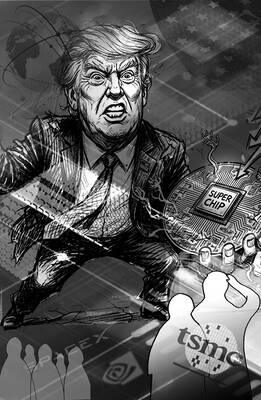
The White House’s decision to take a 9.9 percent stake in Intel Corp is looking like very shrewd business indeed. Since the government bought in at US$20.47 a share last August, the US chipmaker’s surging stock price has delivered the US a US$43 billion return. One of the reasons the investment has so far proved so sound is that the White House has made sure of it. According to The Wall Street Journal, Howard personally pushed deals on Intel’s behalf with some of the most lucrative clients imaginable. They include Nvidia Corp, the company at the heart of the AI
A single photograph can cut through a lot of noise, but it can also be used to misrepresent the truth. At the very least, it can concentrate the mind on something that requires further investigation. On Monday last week, Ma Ying-jeou Foundation CEO Tai Hsia-ling (戴遐齡) and former National Security Council secretary-general King Pu-tsung (金溥聰) held a news conference in which they showed a photograph of former foundation CEO Hsiao Hsu-tsen (蕭旭岑), now Chinese Nationalist Party (KMT) deputy chairman. In the image Hsiao is seated next to Xiamen Taiwan Businessmen Association chairman Han Ying-huan (韓螢煥). The two men were holding
I first met Professor Ray Jiing (井迎瑞) as a film and documentary student at Shih Hsin University’s (SHU) Department of Radio Television and Film in 1988. The following year, he went on to become the director of the Chinese Taipei Film Archive — forerunner of the Taiwan Film and Audiovisual Institute (TFAI). Over his eight-year tenure, Jiing rescued and restored over 200 classic Taiwanese films. In 1997, he established the Graduate Institute of Studies in Documentary and Film Archiving at Tainan National University of the Arts (TNNUA), and I joined the program in his third cohort of students. Beyond a
President William Lai Ching-te’s (賴清德) May 20 second-anniversary address was not just a routine policy review; it was damage control. US President Donald Trump’s remarks — that he did not want to see anyone move toward independence and that the delivery of a major Taiwan arms package could depend on the progress of US-China relations — unsettled Taiwan’s public and created an opening for opposition parties to question whether Taiwan was being treated as a bargaining chip in Washington’s dealings with Beijing. Lai’s speech was designed to close that opening. The address covered the expected ground: sovereignty, cross-strait relations, defense spending,


 RSS
RSS