


Former Chinese Nationalist Party (KMT) chairman Wu Po-hsiung (吳伯雄) on March 22, described the situation across the Taiwan Strait as “one country, two areas” (一國兩區). Is the KMT preparing Taiwan for midterm unification with the People’s Republic of China (PRC), or is it merely fine-tuning its response to Beijing’s ever-increasing global power, by trying to please China without being too specific about the content and concrete implications of this declaration?
The KMT and Democratic Progressive Party (DPP) have long taken into consideration that the military and diplomatic balance in the Taiwan Strait increasingly favors China. While the DPP has called for a cautious, but closer dialogue with China, the KMT has, since 2005, cooperated extensively with the Chinese Communist Party (CCP). Since Ma’s election in 2008, the KMT has justified this as a way to secure cross-strait peace and greater economic opportunities for Taiwan. In point of fact, both parties appear to be gambling with the nation’s future.
The pan-greens are betting that China will accept closer relations without talks on unification. The pan-blues believe they can defend the Republic of China’s (ROC) sovereignty in talks with a regime that refuses to recognize the ROC as a sovereign regime and insists that Taiwan accept its “one China” principle.
In the eyes of the DPP, the KMT’s new formula of “one country, two areas” is equivalent to the PRC’s old “one country, two systems” formula, which both the KMT and the DPP have consistently opposed.
Faced with criticism of its “new” position, the KMT has said the “one country, two areas” concept has been an integral element of the ROC Constitution since 1991, when the constitutional amendments recognized that the territory of the ROC is divided into the “mainland area” and the “Taiwan area,” hoping for eventual unification of the two sides.
Although the KMT denies that this formulation represents anything new, many consider it to be an attempt to appease Beijing. Indeed, it affirms more clearly than ever before that the KMT accepts Beijing’s “one China” principle, even with studied ambiguity over which China that means.
The question is whether Wu simply said something China wanted to hear, while remaining deliberately vague about the meaning of which China is mentioned.
Before the new cross-strait relationship unfolds further in the months and years to come, we might be well-advised to look at the similarities and differences between the geopolitical situations Taiwan faced in the 1680s and now.
With the end of the Rebellion of the Three Feudatories against the relatively new Qing Dynasty in 1681, China underwent a renaissance after decades of decadence in the latter years of the Ming Dynasty.
By then, the Cheng regime, established in Taiwan in 1662 to overthrow the Manchus and reinstate the Ming on the Chinese imperial throne, was a shadow of the powerful insular kingdom it had been earlier, having emptied its coffers in several failed military campaigns in China. At that time, the “Dongning kingdom” of Taiwan faced a Qing court determined to eliminate those it called “sea pirates.”
On July 16, 1683, the balance of power between China’s new rulers and the weakened pro-Ming bastion on Taiwan definitely shifted. The Cheng regime was defeated in a decisive battle at sea by Qing Admiral Shih Lang (施琅).
What followed this event and ultimately led to Taiwan’s incorporation as part of China was a political process, not a military one.
The Cheng regime decided to abandon combat and negotiate with China’s new rulers. It appealed to China by saying exactly what the Qing court most wanted to hear: They would abandon their claim to reinstate the Ming and acknowledge the legitimacy of the Qing.
This is similar to the PRC’s insistence that the ROC did not continue to exist on Taiwan after 1949 and that Beijing is the sole legitimate ruler of China.
As China continues to increase the pressure on Taiwan, the KMT is trying to find ways to protect its stronghold by appeasing Beijing. What we must consider is whether the KMT, like the Cheng regime before it, is prepared to surrender, if negotiations fail.
The two periods are of course very different. Taiwanese politics responds to public opinion, democratically elected leaders are held responsible by the electorate and the nation has a powerful, if not unconditional, international ally — the US.
Despite this, the political process that took hold in the summer of 1683 might still provide some pointers to better understand the intricacies of the current situation.
After opposing the Qing Dynasty for several decades, the Taiwan-based Ming loyalists initially tried, in the summer of 1683, to negotiate the survival of their regime under Qing suzerainty, but the Qing refused: The imperial court’s main aim was to eliminate the Ming--loyalist regime, which symbolized a lasting denial of its legitimacy.
It was not interested in Taiwan and did not want to make it a vassal state. In September 1683, the leaders of the Cheng regime surrendered their official seals and returned to China.
However, the incorporation of Taiwan as part of Qing China was not decided until the next year, after months of debate about the pros and cons of including the “savage island.”
Today, the flexible feudal notion of suzerainty has been replaced by the more inflexible concept of sovereignty, and the events of 1683, which led to Taiwan’s inclusion as part of Chinese territory until 1895, has left in China’s collective memory a deep-seated belief that Taiwan is an integral part of China.
From a geopolitical point of view, the global logic of the two periods looks surprisingly similar: in the way a resurgent China is pressuring Taiwan to accept Beijing’s authority — then, over just China, but now, over both China and Taiwan.
In addition, a resurgent China then called into question the independence of the Dongning kingdom and now makes it more difficult for the ROC to protect its independence.
Pro-independence parties are even weaker in resistance than the KMT; they plead for more talks with China, hoping that Beijing will ultimately accept that a very close relationship between two independent neighbors has undeniable advantages over a forced inclusion that would create instability. However, this is not China’s view and strategy: By developing cross-strait economic relations Beijing seeks to buy unification by smoothing opposition to such an outcome.
The KMT is highly divided on this issue, because most party members and cadres are Taiwanese. However, the KMT is once again headed by mainlanders and the second-generation of that political elite is reshaping the party’s policy at the top, against the wishes of the vast majority of Taiwanese who oppose unification.
Even if this “new old” KMT is not ready to surrender to China, it clearly longs for unification. It has just done what the Cheng regime did in July 1683, namely accept that the regime in China is the legitimate ruler of China.
As with the Cheng family, the KMT’s top leaders come from China and remain imbued with a Chinese moral code.
In order to do what cannot be achieved at the ballot box in Taiwan — progressing toward unification — the KMT dares not say what it does, and is reluctant to do what it says.
We should be aware that the conclusion of this process could well be the end of a democratic experience in Asia and of the free expression of a very rich pluralistic identity in Taiwan — as well as the last source, after Hong Kong, of a very well-informed and usefully unconventional knowledge about China itself.
Stephane Corcuff is an associate professor of political science at Lyon’s Institute of Political Studies and a researcher at the Institute of East Asia, Lyon.
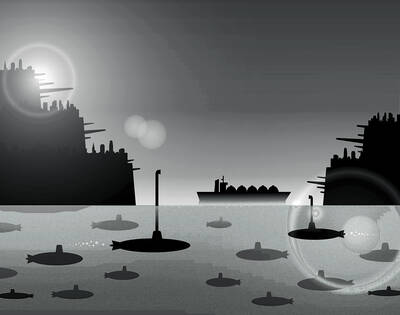
In the event of a war with China, Taiwan has some surprisingly tough defenses that could make it as difficult to tackle as a porcupine: A shoreline dotted with swamps, rocks and concrete barriers; conscription for all adult men; highways and airports that are built to double as hardened combat facilities. This porcupine has a soft underbelly, though, and the war in Iran is exposing it: energy. About 39,000 ships dock at Taiwan’s ports each year, more than the 30,000 that transit the Strait of Hormuz. About one-fifth of their inbound tonnage is coal, oil, refined fuels and liquefied natural gas (LNG),
To counter the CCP’s escalating threats, Taiwan must build a national consensus and demonstrate the capability and the will to fight. The Chinese Communist Party (CCP) often leans on a seductive mantra to soften its threats, such as “Chinese do not kill Chinese.” The slogan is designed to frame territorial conquest (annexation) as a domestic family matter. A look at the historical ledger reveals a different truth. For the CCP, being labeled “family” has never been a guarantee of safety; it has been the primary prerequisite for state-sanctioned slaughter. From the forced starvation of 150,000 civilians at the Siege of Changchun
The two major opposition parties, the Chinese Nationalist Party (KMT) and the Taiwan People’s Party (TPP), jointly announced on Tuesday last week that former TPP lawmaker Chang Chi-kai (張啟楷) would be their joint candidate for Chiayi mayor, following polling conducted earlier this month. It is the first case of blue-white (KMT-TPP) cooperation in selecting a joint candidate under an agreement signed by their chairpersons last month. KMT and TPP supporters have blamed their 2024 presidential election loss on failing to decide on a joint candidate, which ended in a dramatic breakdown with participants pointing fingers, calling polls unfair, sobbing and walking
In the opening remarks of her meeting with Chinese President Xi Jinping (習近平) in the Great Hall of the People in Beijing on Friday, Chinese Nationalist Party (KMT) Chairwoman Cheng Li-wun (鄭麗文) framed her visit as a historic occasion. In his own remarks, Xi had also emphasized the history of the relationship between the KMT and the Chinese Communist Party (CCP). Where they differed was that Cheng’s account, while flawed by its omissions, at least partially corresponded to reality. The meeting was certainly historic, albeit not in the way that Cheng and Xi were signaling, and not from the perspective


 RSS
RSS