


During the 2008 presidential election, the Chinese Nationalist Party’s (KMT) campaign materials jokingly said voters were being forced to choose between the lesser of two evils — a moron or a scoundrel for president. Pan-blue voters naturally prefer a fool to a miscreant, and swing voters sympathized with the idiot; thus, in the end, the fool was the victor.
The irony of it all is that the scoundrel is not really a crook, but the idiot has indeed proven to be the fool we thought he was all along. Pan-blue voters are clear about his stupidity, and loathe his “I love Taiwan” propaganda, but they still voted for him even as they were crying about it.
The nightmare of this incompetent fool running the nation has become our reality, and even People First Party (PFP) Chairman James Soong (宋楚瑜), who had already ostensibly retired from electioneering, has risen again, commencing the battle between the two candidates who claim China’s Hunan Province as their ancestral home.
Former premier Hau Pei-tsun (郝柏村) has called Soong’s comeback monkey business, thus giving pan-blue supporters their fool fighting their own monkey. However, the deep-blue camp has raised the stakes, saying supporters should continue to support this idiot even if they detest him.
The orthodox deep-blue supporters have forgotten where they come from.
They must have never read The Four Books and Five Classics (四書五經), a collection of Confucian writings dating back to 300 BC, and neither do they understand the importance of selecting a wise and capable candidate according to what the Chinese philosophers Confucius (孔子) and Mencius (孟子) wrote about choosing one’s leaders.
It is no wonder Soong has called them gangsters. He started out in the KMT, so of course he is well aware of the party’s dark underbelly and really hit the nail on the head with this one — the KMT is a party of gangsters.
While “the gangster boss” is now calling Soong a “troublemaker,” he is also suspected of betraying Taiwan with his peace accord proposal, and has uttered some balderdash about “the cardinal sin of being a Mainlander” in an attempt to manipulate those of his supporters who are not satisfied with his performance.
This gangster mentality and the constant attempts to bully Taiwanese into identifying with China instead of Taiwan has always been the KMT’s greatest sin. However, our foolish president’s cardinal sin is his inability to realize how difficult life is for the average person, and wasting taxpayers’ hard-earned money with this corrupt and inept system.
While these gangsters and their sins are remnants of the past, democracy provides us with choices concerning our future.
A great deal of mud was slung at the Democratic Progressive Party (DPP) in the previous presidential election, but DPP Chairperson Tsai Ing-wen’s (蔡英文) party reforms have been a sight for sore eyes. She is extremely capable and her policies give voters who are seeking social justice renewed hope for the future.
The little pig fighting against the big bad wolf symbolizes the healthy attitude of people standing up for themselves, as well as their overall joy and willingness to participate in the political process.
Why should voters who have tears in their eyes and hate in their hearts hold their noses and force themselves to vote for these gangsters when they are perfectly capable of standing up for themselves and being happy with their choices?
James Wang is a commentator based in Taipei.
Translated by Kyle Jeffcoat
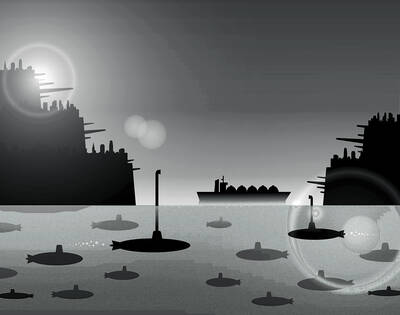
In the event of a war with China, Taiwan has some surprisingly tough defenses that could make it as difficult to tackle as a porcupine: A shoreline dotted with swamps, rocks and concrete barriers; conscription for all adult men; highways and airports that are built to double as hardened combat facilities. This porcupine has a soft underbelly, though, and the war in Iran is exposing it: energy. About 39,000 ships dock at Taiwan’s ports each year, more than the 30,000 that transit the Strait of Hormuz. About one-fifth of their inbound tonnage is coal, oil, refined fuels and liquefied natural gas (LNG),
On Monday, the day before Chinese Nationalist Party (KMT) Chairwoman Cheng Li-wun (鄭麗文) departed on her visit to China, the party released a promotional video titled “Only with peace can we ‘lie flat’” to highlight its desire to have peace across the Taiwan Strait. However, its use of the expression “lie flat” (tang ping, 躺平) drew sarcastic comments, with critics saying it sounded as if the party was “bowing down” to the Chinese Communist Party (CCP). Amid the controversy over the opposition parties blocking proposed defense budgets, Cheng departed for China after receiving an invitation from the CCP, with a meeting with
Chinese Nationalist Party (KMT) Chairwoman Cheng Li-wun (鄭麗文) is leading a delegation to China through Sunday. She is expected to meet with Chinese President Xi Jinping (習近平) in Beijing tomorrow. That date coincides with the anniversary of the signing of the Taiwan Relations Act (TRA), which marked a cornerstone of Taiwan-US relations. Staging their meeting on this date makes it clear that the Chinese Communist Party (CCP) intends to challenge the US and demonstrate its “authority” over Taiwan. Since the US severed official diplomatic relations with Taiwan in 1979, it has relied on the TRA as a legal basis for all
To counter the CCP’s escalating threats, Taiwan must build a national consensus and demonstrate the capability and the will to fight. The Chinese Communist Party (CCP) often leans on a seductive mantra to soften its threats, such as “Chinese do not kill Chinese.” The slogan is designed to frame territorial conquest (annexation) as a domestic family matter. A look at the historical ledger reveals a different truth. For the CCP, being labeled “family” has never been a guarantee of safety; it has been the primary prerequisite for state-sanctioned slaughter. From the forced starvation of 150,000 civilians at the Siege of Changchun


 RSS
RSS