


The massive volatility and sharp equity-price correction now hitting global financial markets signal that most advanced economies are on the brink of a double-dip recession. A financial and economic crisis caused by too much private-sector debt and leverage led to a massive releveraging of the public sector in order to prevent Great Depression 2.0. However, the subsequent recovery has been anemic and sub-par in most advanced economies given painful deleveraging.
Now a combination of high oil and commodity prices, turmoil in the Middle East, Japan’s earthquake and tsunami, eurozone debt crises and the US’ fiscal problems (and now its rating downgrade) have led to a massive increase in risk aversion. Economically, the US, the eurozone, the UK and Japan are all idling. Even fast-growing emerging markets (China, emerging Asia and Latin America), and export-oriented economies that rely on these markets (Germany and resource-rich Australia), are experiencing sharp slowdowns.
Until last year, policymakers could always produce a new rabbit from their hat to reflate asset prices and trigger economic recovery. Fiscal stimulus, near-zero interest rates, two rounds of “quantitative easing,” ring-fencing of bad debt and trillions of dollars in bailouts and liquidity provision for banks and financial institutions: Officials tried them all. Now they have run out of rabbits.
Fiscal policy currently is a drag on economic growth in both the eurozone and the UK. Even in the US, state and local governments, and now the federal government, are cutting expenditure and reducing transfer payments. Soon enough, they will be raising taxes.
Another round of bank bailouts is politically unacceptable and economically unfeasible: Most governments, especially in Europe, are so distressed that bailouts are unaffordable; indeed, their sovereign risk is actually fueling concern about the health of Europe’s banks, which hold most of the increasingly shaky government paper.
Nor could monetary policy help very much. Quantitative easing is constrained by above-target inflation in the eurozone and UK. The US Federal Reserve will likely start a third round of quantitative easing (QE3), but it will be too little, too late. Last year’s US$600 billion QE2 and US$1 trillion in tax cuts and transfers delivered growth of barely 3 percent for one quarter. Then growth slumped to below 1 percent in the first half of this year. QE3 will be much smaller, and will do much less to reflate asset prices and restore growth.
Currency depreciation is not a feasible option for all advanced economies: They all need a weaker currency and better trade balance to restore growth, but they all cannot have it at the same time. So relying on exchange rates to influence trade balances is a zero-sum game. Currency wars are thus on the horizon, with Japan and Switzerland engaging in early battles to weaken their exchange rates. Others will soon follow.
Meanwhile, in the eurozone, Italy and Spain are now at risk of losing market access, with financial pressures now mounting on France, too. However, Italy and Spain are both too big to fail and too big to be bailed out. For now, the European Central Bank will purchase some of their bonds as a bridge to the eurozone’s new European Financial Stabilization Facility (EFSF). However, if Italy and/or Spain lose market access, the EFSF’s 440 billion euro (US$627 billion) war chest could be depleted by the end of this year or early next year.
Then, unless the EFSF pot were tripled — a move that Germany would resist — the only option left would become an orderly but coercive restructuring of Italian and Spanish debt, as has happened in Greece. Coercive restructuring of insolvent banks’ unsecured debt would be next. So, although the process of deleveraging has barely started, debt reductions will become necessary if countries cannot grow or save or inflate themselves out of their debt problems.
So Karl Marx, it seems, was partly right in arguing that globalization, financial intermediation run amok and redistribution of income and wealth from labor to capital could lead capitalism to self-destruct (though his view that socialism would be better has proven wrong). Firms are cutting jobs because there is not enough final demand. However, cutting jobs reduces labor income, increases inequality and reduces final demand.
Recent popular demonstrations, from the Middle East to Israel to the UK, and rising popular anger in China — and soon enough in other advanced economies and emerging markets — are all driven by the same issues and tensions: growing inequality, poverty, unemployment and hopelessness. Even the world’s middle classes are feeling the squeeze of falling incomes and opportunities.
To enable market-oriented economies to operate as they should and can, we need to return to the right balance between markets and provision of public goods. That means moving away from both the Anglo-Saxon model of laissez-faire and “voodoo economics” and the continental European model of deficit-driven welfare states. Both are broken.
The right balance today requires creating jobs partly through additional fiscal stimulus aimed at productive infrastructure investment. It also requires more progressive taxation; more short-term fiscal stimulus with medium and long-term fiscal discipline; lender-of-last-resort support by monetary authorities to prevent ruinous runs on banks; reduction of the debt burden for insolvent households and other distressed economic agents; stricter supervision and regulation of a financial system run amok; and breaking up too-big-to-fail banks and oligopolistic trusts.
Over time, advanced economies will need to invest in human capital, skills and social safety nets to increase productivity and enable workers to compete, be flexible and thrive in a globalized economy. The alternative is — like in the 1930s — unending stagnation, depression, currency and trade wars, capital controls, financial crisis, sovereign insolvencies and massive social and political instability.
Nouriel Roubini is chairman of Roubini Global Economics and a professor of economics at the Stern School of Business, New York University.
COPYRIGHT: PROJECT SYNDICATE
Taiwanese pragmatism has long been praised when it comes to addressing Chinese attempts to erase Taiwan from the international stage. “Taipei” and the even more inaccurate and degrading “Chinese Taipei,” imposed titles required to participate in international events, are loathed by Taiwanese. That is why there was huge applause in Taiwan when Japanese public broadcaster NHK referred to the Taiwanese Olympic team as “Taiwan,” instead of “Chinese Taipei” during the opening ceremony of the Tokyo Olympics. What is standard protocol for most nations — calling a national team by the name their country is commonly known by — is impossible for
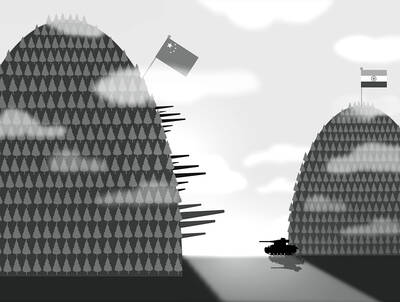
India is not China, and many of its residents fear it never will be. It is hard to imagine a future in which the subcontinent’s manufacturing dominates the world, its foreign investment shapes nations’ destinies, and the challenge of its economic system forces the West to reshape its own policies and principles. However, that is, apparently, what the US administration fears. Speaking in New Delhi last week, US Deputy Secretary of State Christopher Landau warned that “we will not make the same mistakes with India that we did with China 20 years ago.” Although he claimed the recently agreed framework
The Office of the US Trade Representative (USTR) on Wednesday last week announced it is launching investigations into 16 US trading partners, including Taiwan, under Section 301 of the Trade Act of 1974 to determine whether they have engaged in unfair trade practices, such as overproduction. A day later, the agency announced a separate Section 301 investigation into 60 economies based on the implementation of measures to prohibit the importation of goods produced with forced labor. Several of Taiwan’s main trading rivals — including China, Japan, South Korea and the EU — also made the US’ investigation list. The announcements come
Taiwan is not invited to the table. It never has been, but this year, with the Philippines holding the ASEAN chair, the question that matters is no longer who gets formally named, it is who becomes structurally indispensable. The “one China” formula continues to do its job. It sets the outer boundary of official diplomatic speech, and no one in the region has a serious interest in openly challenging it. However, beneath the surface, something is thickening. Trade corridors, digital infrastructure, artificial intelligence (AI) cooperation, supply chains, cross-border investment: The connective tissue between Taiwan and ASEAN is quietly and methodically growing


 RSS
RSS