


The Ministry of National Defense gave a lame excuse for why it decided to publish a comic book history of the Republic of China’s (ROC) military that omitted any mention of former presidents Lee Teng-hui (李登輝) and Chen Shui-bian (陳水扁).
As the government body in charge of the military, the ministry needs to stand above politics as an institution loyal to the ROC — it should not be loyal to any political party. In the recent comic book debacle, however, the ministry did exactly the opposite, showing itself to be beholden to the Chinese Nationalist Party (KMT).
The comic book was drawn up and published to commemorate 100 years of the ROC military. By skipping the Lee and Chen presidencies, the ministry brushed aside nearly 20 years of that 100-year history. That’s nearly 20 percent of the history of the ROC military that the ministry simply flushed down the memory hole because the two former presidents in question have pan-green leanings.
Not only is that a large chunk of time to simply erase, but it was also a very important period in Taiwan’s development. During those 20 years, Taiwan developed into a fully fledged democracy, albeit with a few growing pains. Society was demilitarized and the populace of the country tasted the true fruits of freedom for the first time. The military more or less withdrew into its bases and conscripted service was slashed, leaving young people to spend more of their time to pursue their careers, academic interests or just live their lives. That sounds like a momentous enough change to at least mention in a comic book history.
Moreover, under Lee, Taiwan’s military was modernized during the late 1980s and early 1990s. The navy bought a number of Perry-class frigates and close-range weapons systems such as the Phalanx CIWS and the bulk of today’s air force, including F-16 fighter jets, was established. Although the Chen administration was hobbled by a KMT-dominated legislature that obstructed the purchase of weapons from the US, it still managed to amend laws making the military answerable to the nation as opposed to a political party. This act alone addressed a major flaw in the ROC military that had been a major factor in prolonging the White Terror era and military rule for many decades.
Because of the length of their respective administrations and the impact they had on the military, it is obvious that Lee and Chen should have been included in the comic book. There is no excuse for their exclusion, but that didn’t stop the ministry.
Ministry of National Defense spokesman Lo Shao-ho (羅紹和) said comic books are not meant to be as detailed as normal books, adding that the number of pages were limited, so it was impossible to mention every president.
Lo is obviously not an avid reader of comic books. It is quite possible to add amazing amounts of detail in the limited space of a comic book, as the cartoon format allows for the omission of words and the inclusion of events.
Take, for example, US cartoonist Larry Gonick’s Cartoon History of the Universe. In the 350 pages of the first volume, Gonick covers events from prehistoric times to the Greek and Roman empires and beyond. Despite the “limitations” of the comic book style, Gonick does so in a historically accurate, educationally didactic, humorous and satirical way.
Of course, Gonick is a master of the comic medium and the ministry is, well, a government ministry, but it still needs to come up with a better excuse than space limitations when it decides to wipe out 20 years of history.
Minister of Labor Hung Sun-han (洪申翰) on April 9 said that the first group of Indian workers could arrive as early as this year as part of a memorandum of understanding (MOU) between the Taipei Economic and Cultural Center in India and the India Taipei Association. Signed in February 2024, the MOU stipulates that Taipei would decide the number of migrant workers and which industries would employ them, while New Delhi would manage recruitment and training. Employment would be governed by the laws of both countries. Months after its signing, the two sides agreed that 1,000 migrant workers from India would
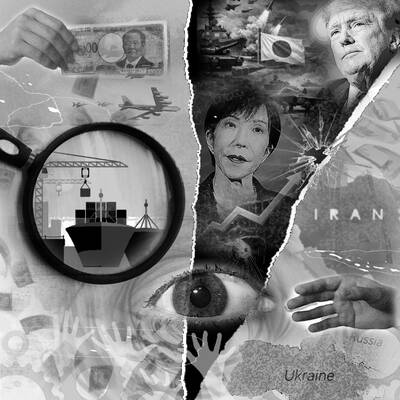
Japan’s imminent easing of arms export rules has sparked strong interest from Warsaw to Manila, Reuters reporting found, as US President Donald Trump wavers on security commitments to allies, and the wars in Iran and Ukraine strain US weapons supplies. Japanese Prime Minister Sanae Takaichi’s ruling party approved the changes this week as she tries to invigorate the pacifist country’s military industrial base. Her government would formally adopt the new rules as soon as this month, three Japanese government officials told Reuters. Despite largely isolating itself from global arms markets since World War II, Japan spends enough on its own
On March 31, the South Korean Ministry of Foreign Affairs released declassified diplomatic records from 1995 that drew wide domestic media attention. One revelation stood out: North Korea had once raised the possibility of diplomatic relations with Taiwan. In a meeting with visiting Chinese officials in May 1995, as then-Chinese president Jiang Zemin (江澤民) prepared for a visit to South Korea, North Korean officials objected to Beijing’s growing ties with Seoul and raised Taiwan directly. According to the newly released records, North Korean officials asked why Pyongyang should refrain from developing relations with Taiwan while China and South Korea were expanding high-level
When 17,000 troops from the US, the Philippines, Australia, Japan, Canada, France and New Zealand spread across the Philippine archipelago for the Balikatan military exercise, running from tomorrow through May 8, the official language would be about interoperability, readiness and regional peace. However, the strategic subtext is becoming harder to ignore: The exercises are increasingly about the military geography around Taiwan. Balikatan has always carried political weight. This year, however, the exercise looks different in ways that matter not only to Manila and Washington, but also to Taipei. What began in 2023 as a shift toward a more serious deterrence posture


 RSS
RSS