


Amid all of the public “sympathy” for the Chinese Nationalist Party (KMT) on the night of Nov. 26 and during the elections the following day, it was easy to miss the major implications the shooting of Sean Lien (連勝文) had for Taiwan.
After the shooting death of Huang Yun-sheng (黃運聖) and the wounding of Lien, the KMT orchestrated a wonderful media blitz campaign which, although far from subtle to most knowledgeable observers, appears to have had a major effect on the election results.
Although the shooting may not have claimed the elections in Taipei, Sinbei and Taichung, it almost certainly widened the margins of victory that the KMT enjoyed.
It is quite obvious that the KMT gained from politicizing the tragic event (while simultaneously warning the Democratic Progressive Party (DPP) not to make the tragedy a political issue). It is also disgraceful how certain groups in society tried to shame the DPP — for making the exact same appeal.
In my estimation, the media — as well as the DPP — both missed a key aspect of the shooting. Instead of spending so much time and effort mourning the loss of an individual and the injury to another, the DPP and the media should have taken some time to assess the threat posed to the real victim in this situation: the broader Taiwanese public.
True, this approach would have been hard for society to swallow.
Indeed, I’m sure stating the reality of the situation would have sounded insensitive, heartless, cruel and all those other adjectives that are used to make the truth sound evil.
It is difficult to describe society as a victim when a single individual is dead and his family mourns him. It is hard to call society a casualty when another individual is shot through the face and his father weeps bitterly for the entire world to see.
However, the reality of the situation is, before the election, at least to my knowledge, neither the DPP nor the media asked the really difficult questions that were on every interested, knowledgeable and concerned observer’s mind: just what in the hell are gang members and others with gang affiliation doing at a KMT political rally, and just what are KMT politicians doing having relations with gang members?
Some, of course, passed it off as a DPP political ploy from the beginning, comparing it to the “staged” political violence of March 19, 2004, when former president Chen Shui-bian (陳水扁) was shot.
By this line of reasoning, the DPP orchestrated the shooting to win political support and public sympathy for then-candidate Chen.
The ironic twist when comparing the two shootings is that last month’s incident involved the DPP “conspiring” to shoot a KMT candidate. The argument, then, loses all credibility as it makes the acts contradictory and at least one of them counterproductive.
It seems the DPP can be blamed for everything. The DPP injures its own and injures (and kills) others, all for its political amusement. The DPP destroyed Taiwan’s economy. The DPP upset China. And, contrary to all historical evidence, it is in fact the DPP that has the strongest ties to the Taiwanese (and, for that matter, Chinese) underworld.
This is all preposterous, but arguably the most preposterous of all is the claim by some KMT supporters that the DPP’s hands are the deepest of all in the underworld grime. It is of course possible that the shootings of both March 19, 2004, and Nov. 26, this year, were organized and carried out by the DPP and/or its supporters.
Just about anything is possible in politics, but the fact of the matter is that DPP involvement in either case is highly unlikely.
Indeed, the KMT itself is known worldwide as one of the most corrupt political parties ever to have existed. This doesn’t make the KMT itself or its individual members and supporters evil. But it does make the KMT quite frightening.
Cooperation between gangs and the KMT can be traced at least as far back as the period before the Shanghai White Terror in 1927, also known as the Great Purge, where Chiang Kai-shek (蔣介石) and the KMT made use of underworld informants, terrorists and executioners, most of whom were members of the Green Gang, in an attempt to clear the metropolis of Communists.
These hooligans were then, after Shanghai was for all intents and purposes rid of leftists, turned on the business community to extract funds for state use.
Writing in this period, Herbert Owen Chapman states that “Wealthy Chinese would be arrested in their homes or mysteriously disappeared from the streets; and those who reappeared came back as poorer men, but could in no case be induced to ... inform on their oppressors,” even “Millionaires were arrested as ‘communists’!”
Chiang had become acquainted with the Green Gang criminal organization sometime between 1915 and 1923 while living in Shanghai.
In fact, the KMT and the Green Gang shared the profits of the drug trade after the establishment of the Opium Suppression Bureau.
Such cooperation certainly didn’t end with the suppression of the Communists in 1927. The KMT used the Green Gang to retain order in Shanghai throughout the “Nanking Decade.” What is more, the KMT depended to some extent on the Green Gang when the Japanese invaded Shanghai in 1937.
This of course does not necessarily implicate the KMT today, but the fact that the party has a long history of cooperation with gangs and still has strong ties to many of the largest triad groups in Taiwan today should make journalists, opposition politicians and society in general suspicious whenever the KMT invokes the “DPP and pro-DPP gangs dunnit” explanation. Indeed, it should make the KMT politically suspect in general.
Taiwan should mourn the loss of Huang. It should be saddened by the injuries sustained by Lien. It should be enraged at senseless gang-related violence, but it should also start asking the difficult, uncomfortable questions that need to be asked if Taiwan’s society is not itself to become a casualty.
Asking questions like “Just what exactly are people affiliated with gangs doing having relations with well-known KMT members and their families?” and “What are these KMT politicians and their family members with gang affiliation doing running for office?” is an excellent place to start.
However, these questions need to be asked soon. Otherwise, I’m afraid Taiwan’s society is already a casualty and Taiwan’s democracy is merely farce.
Nathan Novak studies China and the Asia-Pacific region with a particular focus on cross-strait relations at National Sun Yat-sen University.
Minister of Labor Hung Sun-han (洪申翰) on April 9 said that the first group of Indian workers could arrive as early as this year as part of a memorandum of understanding (MOU) between the Taipei Economic and Cultural Center in India and the India Taipei Association. Signed in February 2024, the MOU stipulates that Taipei would decide the number of migrant workers and which industries would employ them, while New Delhi would manage recruitment and training. Employment would be governed by the laws of both countries. Months after its signing, the two sides agreed that 1,000 migrant workers from India would
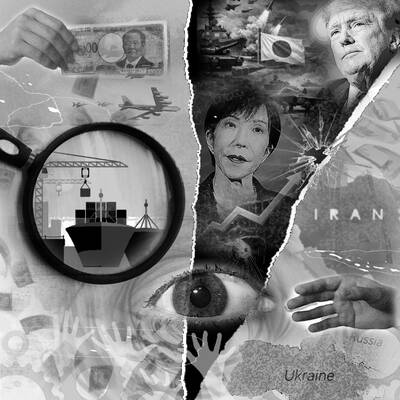
Japan’s imminent easing of arms export rules has sparked strong interest from Warsaw to Manila, Reuters reporting found, as US President Donald Trump wavers on security commitments to allies, and the wars in Iran and Ukraine strain US weapons supplies. Japanese Prime Minister Sanae Takaichi’s ruling party approved the changes this week as she tries to invigorate the pacifist country’s military industrial base. Her government would formally adopt the new rules as soon as this month, three Japanese government officials told Reuters. Despite largely isolating itself from global arms markets since World War II, Japan spends enough on its own
On March 31, the South Korean Ministry of Foreign Affairs released declassified diplomatic records from 1995 that drew wide domestic media attention. One revelation stood out: North Korea had once raised the possibility of diplomatic relations with Taiwan. In a meeting with visiting Chinese officials in May 1995, as then-Chinese president Jiang Zemin (江澤民) prepared for a visit to South Korea, North Korean officials objected to Beijing’s growing ties with Seoul and raised Taiwan directly. According to the newly released records, North Korean officials asked why Pyongyang should refrain from developing relations with Taiwan while China and South Korea were expanding high-level
When 17,000 troops from the US, the Philippines, Australia, Japan, Canada, France and New Zealand spread across the Philippine archipelago for the Balikatan military exercise, running from tomorrow through May 8, the official language would be about interoperability, readiness and regional peace. However, the strategic subtext is becoming harder to ignore: The exercises are increasingly about the military geography around Taiwan. Balikatan has always carried political weight. This year, however, the exercise looks different in ways that matter not only to Manila and Washington, but also to Taipei. What began in 2023 as a shift toward a more serious deterrence posture


 RSS
RSS