


It rightly made news when China suddenly emerged as Greece’s economic savior of sorts. It happened around the time when credit ratings agency Moody’s had downgraded the country’s rating to junk level, which means that investing in Greece or lending it money was a high-risk proposition.
Even though the EU and IMF had thrown it a credit line to bolster its credit-worthiness, the markets were not convinced.
In Germany, the EU’s biggest economy, the move to bail out Greece wasn’t popular at all. The country faced economic ruin leading to political and social instability.
The austerity regime imposed on Greece by the EU and IMF was creating turbulence and Greece’s socialist government was (and still is) at its wit’s end.
It was against this backdrop that China entered into a series of bilateral agreements with Greece to further broaden China’s economic horizon, that, in turn, will help Greece at a very difficult time.
It must be noted that China is not engaging in such economic deals out of a sense of philanthropy, but because they make political and economic sense. Chinese Vice Premier Zhang Dejiang (張德江) made two visits to Athens in one month, to finalize deals worth billions of dollars in shipping, tourism, telecommunications and more.
It is reported that the 14 deals with Greece amounted to the biggest single investment by China in Europe, though no official figure has been announced.
As for Greece, it bolsters its economic situation at a critical time. By investing in Greece in such a public and dramatic way, China has expressed its confidence in Athens’ capacity to successfully deal with its debt situation.
“I am convinced that Greece can overcome its current economic difficulties,” Zhang said. Such a vote of confidence was sorely needed by Greece in its current economic travails.
Of course, it also provides China with a useful conduit to expand its economic and political tentacles into other countries in the EU, especially Portugal, Spain, Ireland and the Balkans.
Even the UK is not looking good, with a budget deficit of around 11 percent of GDP, close to that of Greece. Its total debt is believed to be the second-biggest in the EU after Ireland.
Although China’s economy has its own problems, it does have large foreign currency reserves from trade surpluses, particularly with the US. It is estimated to have more than US$2 trillion in foreign currency reserves, and rising.
China’s annual trade surplus with the US is rising at more than US$200 billion a year, and another US$100 billion with the rest of the world. Which means that its reserves are growing at the rate of more than US$300 billion a year. China, is able to play politics with its money to expand its political and economic reach into Europe.
Although China has large foreign exchange reserves, it still has a fairly serious problem of indebtedness. The official figure of its debt at 20 percent of GDP is simply, like its other statistics, not believable. Victor Shih of Northwestern University in Illinois, reportedly predicts China’s debt — including the debts of local instrumentalities and state-funded debts — will be about 96 percent of China’s GDP by next year.
However, like in Japan, China’s debt is mostly internally funded, through the low interest-bearing savings of its hard-working and thrifty people. It is still debt, though. If there were to be a loss of faith in the government, this could lead to a run on government banks and other related agencies.
Be that as it may, China’s large foreign exchange reserves are an important part of its wide reach and unless the EU puts its house in order, China will have ample opportunities to use its financial power to create serious mischief.
For instance, China is already exploiting the resources of many African countries through investments in mining, oil, gas and other extractive industries. In return, these countries pledge their commodities to China over many years, to pay for the Chinese debt.
In other words, these African countries will remain poor and destitute for many years to come even after their mines and oil fields become operational and profitable.
This was once called colonialism, and still is even if the perpetrator, China, once suffered and railed against such inequities.
Europe might not suffer in the same way as China’s African targets. But exchanging one kind of debt for another (even if it is called investment) from China does not alter the fact, however, that such relationships entrench economic dependency and hence exploitation.
With its long historical memories of how it was all but dismembered by Western colonial powers, China might not be averse to now lording it over the same European countries.
Europe apart, China is everywhere in Latin America. For instance, it has supplanted the US as Brazil’s biggest trading partner. China’s trade with Brazil has reportedly risen from US$10 billion a year in 2000 to more than US$100 billion today.
Like in Africa, Latin American exports to China are commodities and minerals and they are increasingly becoming an important source of revenue. With growing economic dependence on China, these countries are losing the ability to develop an equitable relationship.
At the same time, China is exploiting its economic power to push exports of manufactured goods into these countries, with its artificially depressed wages aided by its undervalued currency.
Under these circumstances, such countries will be unable to develop their own manufacturing base and where it does exist in a small way, that too will be destroyed in the face of China’s onslaught.
China is developing into a neocolonial power and its entrenchment in the US’ backyard brings with it all sorts of dangers for the US and the region.
Sometimes, it seem as if China is seeking to contain or encircle the US. The only thing missing is that it doesn’t yet have the military power to enforce its writ.
That is the next step, however and China will need a much bigger military machine to enforce compliance on its economic dependencies.
But there are two important constraints here. First, China has too many internal problems to reckon with. Therefore, a large and disproportionate diversion of national resources to the military might further upset the internal balance.
As it is, China’s spending on health, education and social welfare are hopelessly inadequate.
Second, by elevating the armed forces and trusting them to guard and expand China’s imperial interests, the military might become a threat to the Chinese Communist Party’s political supremacy.
Therefore, there are inbuilt internal constraints on China’s emerging imperial overstretch. At the same time, the promotion of national chauvinism would appear to be a calculated move by the Chinese Communist Party to underpin its legitimacy.
Sushil Seth is a writer based in Australia.

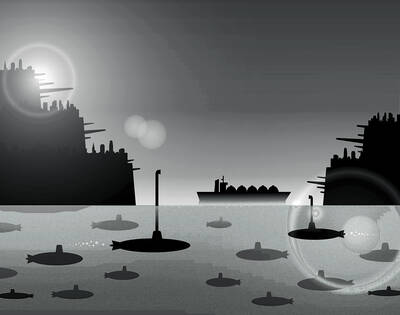
In the event of a war with China, Taiwan has some surprisingly tough defenses that could make it as difficult to tackle as a porcupine: A shoreline dotted with swamps, rocks and concrete barriers; conscription for all adult men; highways and airports that are built to double as hardened combat facilities. This porcupine has a soft underbelly, though, and the war in Iran is exposing it: energy. About 39,000 ships dock at Taiwan’s ports each year, more than the 30,000 that transit the Strait of Hormuz. About one-fifth of their inbound tonnage is coal, oil, refined fuels and liquefied natural gas (LNG),
On Monday, the day before Chinese Nationalist Party (KMT) Chairwoman Cheng Li-wun (鄭麗文) departed on her visit to China, the party released a promotional video titled “Only with peace can we ‘lie flat’” to highlight its desire to have peace across the Taiwan Strait. However, its use of the expression “lie flat” (tang ping, 躺平) drew sarcastic comments, with critics saying it sounded as if the party was “bowing down” to the Chinese Communist Party (CCP). Amid the controversy over the opposition parties blocking proposed defense budgets, Cheng departed for China after receiving an invitation from the CCP, with a meeting with
Chinese Nationalist Party (KMT) Chairwoman Cheng Li-wun (鄭麗文) is leading a delegation to China through Sunday. She is expected to meet with Chinese President Xi Jinping (習近平) in Beijing tomorrow. That date coincides with the anniversary of the signing of the Taiwan Relations Act (TRA), which marked a cornerstone of Taiwan-US relations. Staging their meeting on this date makes it clear that the Chinese Communist Party (CCP) intends to challenge the US and demonstrate its “authority” over Taiwan. Since the US severed official diplomatic relations with Taiwan in 1979, it has relied on the TRA as a legal basis for all
To counter the CCP’s escalating threats, Taiwan must build a national consensus and demonstrate the capability and the will to fight. The Chinese Communist Party (CCP) often leans on a seductive mantra to soften its threats, such as “Chinese do not kill Chinese.” The slogan is designed to frame territorial conquest (annexation) as a domestic family matter. A look at the historical ledger reveals a different truth. For the CCP, being labeled “family” has never been a guarantee of safety; it has been the primary prerequisite for state-sanctioned slaughter. From the forced starvation of 150,000 civilians at the Siege of Changchun


 RSS
RSS