


Monopoly is the world’s most-played board game that both young and old can enjoy. Although it simulates how people seek to amass a fortune by dominating assets or properties to maximize gains, the game was originally designed to teach us how monopolies would end up bankrupting the many while giving extreme wealth to one or two individuals.
Lessons learned from the board game, although it is just for fun, can be very real and close to reality in the world of business.
Far from business reality, however, as Tuesday’s fifth round of cross-strait negotiations in Chongqing, China, to ink the Economic Cooperation Framework Agreement (ECFA), as well as the previous rounds of talks between Taiwan and China.
The developments surrounding the negotiations leading up to the signing have been so surreal that some have even said that the final signing venue and date could be bad omens. Rarely in the history of humankind have nation-to-nation negotiations on issues pertaining to economic and market access been wrapped up in such a festive mood, along with the one-way generosity from China to Taiwan being put on display.
If Beijing is so generous in its nature, why hasn’t it backed down in the face of mounting international pressure over its currency? The reason is that China understands that if it lets its guard down too soon, it will have a huge bill to pay.
In the case of the ECFA, China will always be the larger business winner than Taiwan, given that past decades have shown an exodus of capital to China and that Taiwan is too small a market to matter for Chinese capital.
So in a post-ECFA era, the worst fear for Taiwan may be that China can easily overtake Taiwan with Taiwanese money, although conventional wisdom says that China might ease its military threat against Taiwan if it has business interests here.
So let’s take heed of former deputy defense minister Lin Chong-pin’s (林中斌) comments on Tuesday, when he warned that China has U-turned in its strategy toward Taiwan from its hawkish and hostile stance at the turn of the century.
China understands “it is cheaper to buy up Taiwan than to overtake Taiwan by force,” he said.
Thus, our “former” rival has learned to be a wiser player by hiding its true colors and resorting to mind games.
In this game, the more China gives away economic benefits to Taiwan, the more it expects to win the heart of Taiwanese, Lin said.
However, further behind this scene is China flexing its muscles to pressure Washington into halting arms sales to Taiwan, he warned.
For now, it is hard to believe that Washington would naively buy into the current mirage of peaceful relations between Taiwan and China and suddenly cease arms sales to Taipei without taking its own priorities and interests into consideration.
However, the chance that Taiwan could go “militarily bankrupt” still cannot be ruled out, since the nation’s future is being tugged at by the hands of superpowers.
So what price will Taiwan be paying in return for the many business gifts China has agreed to give under the ECFA?
That is a question that, from now on, our government needs to ponder constantly. The government also needs to be prepared to react quickly to any unthinkable consequences that may further put the country in the hands of monopolists.
Minister of Labor Hung Sun-han (洪申翰) on April 9 said that the first group of Indian workers could arrive as early as this year as part of a memorandum of understanding (MOU) between the Taipei Economic and Cultural Center in India and the India Taipei Association. Signed in February 2024, the MOU stipulates that Taipei would decide the number of migrant workers and which industries would employ them, while New Delhi would manage recruitment and training. Employment would be governed by the laws of both countries. Months after its signing, the two sides agreed that 1,000 migrant workers from India would
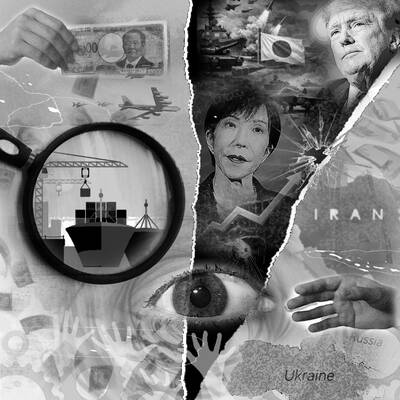
Japan’s imminent easing of arms export rules has sparked strong interest from Warsaw to Manila, Reuters reporting found, as US President Donald Trump wavers on security commitments to allies, and the wars in Iran and Ukraine strain US weapons supplies. Japanese Prime Minister Sanae Takaichi’s ruling party approved the changes this week as she tries to invigorate the pacifist country’s military industrial base. Her government would formally adopt the new rules as soon as this month, three Japanese government officials told Reuters. Despite largely isolating itself from global arms markets since World War II, Japan spends enough on its own
On March 31, the South Korean Ministry of Foreign Affairs released declassified diplomatic records from 1995 that drew wide domestic media attention. One revelation stood out: North Korea had once raised the possibility of diplomatic relations with Taiwan. In a meeting with visiting Chinese officials in May 1995, as then-Chinese president Jiang Zemin (江澤民) prepared for a visit to South Korea, North Korean officials objected to Beijing’s growing ties with Seoul and raised Taiwan directly. According to the newly released records, North Korean officials asked why Pyongyang should refrain from developing relations with Taiwan while China and South Korea were expanding high-level
When 17,000 troops from the US, the Philippines, Australia, Japan, Canada, France and New Zealand spread across the Philippine archipelago for the Balikatan military exercise, running from tomorrow through May 8, the official language would be about interoperability, readiness and regional peace. However, the strategic subtext is becoming harder to ignore: The exercises are increasingly about the military geography around Taiwan. Balikatan has always carried political weight. This year, however, the exercise looks different in ways that matter not only to Manila and Washington, but also to Taipei. What began in 2023 as a shift toward a more serious deterrence posture


 RSS
RSS