


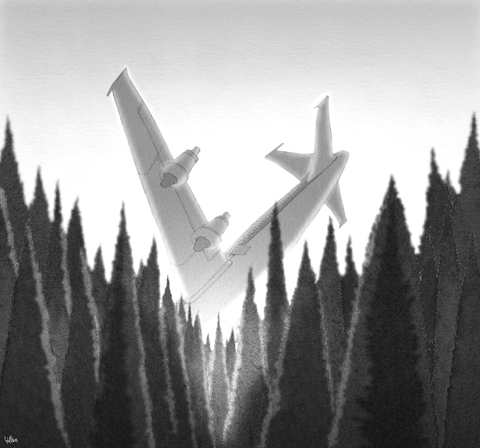
People cannot be beheaded twice. But a nation can. Twice in less than a century, Poland’s elite — political, military, ministerial — came to a terrible death in the woods around Smolensk. Ordinary Poles with history in their bones can’t be blamed for fearing, on that fateful weekend, that the beheading ax was swung by the same hands.
But it was an accident. The fact that Polish president Lech Kaczynski and his retinue had flown to commemorate the 70th anniversary of the Katyn massacre, only a few kilometers away, was one of those malign coincidences that haunt Polish history. And it happened at a moment when Russia and Poland were trying, with some success, to put their long and dreadful past behind them. The spontaneous, great-hearted grief of ordinary Russian people in the days after the air crash amazed and then moved the Poles.
Maybe the old icons of hate and suspicion were losing their power at last. Even Katyn.
To understand why Katyn has been the unhealed wound between Poland and Russia, two stories need telling. One is what really happened in 1940 in that forest — and what it was part of. The other is the 60-year cover-up, the big Soviet and Russian lie which the UK and US governments at first endorsed. Grief for the dead lasts all of a life. But thirst for the truth, the pain of being lied to, burns on for generations.
Since the middle ages, when the mighty Polish Commonwealth tried to dominate the infant Russian state, Russia had regarded Poland not as a rival but as a deadly enemy. Then Poland grew weaker, between the two aggressive military tyrannies of Prussia and Russia. At the end of the 18th century, Poland was invaded and partitioned. In “Russian Poland,” in spite of desperate and unsuccessful rebellions, the Polish language, the Catholic religion and the very notion of Polish identity were persecuted. In 1918, Poland regained its independence, only to be briefly invaded by Bolshevik Russia in 1920. Stalin and Hitler looked on the revival of Poland as a criminal “abortion,” and the secret clauses of the Nazi-Soviet pact in 1939 agreed on a new partition to wipe Poland off the map for ever.
Hitler invaded Poland on Sep. 1, 1939. On Sep. 17, without warning, the Soviet armies entered Poland from the east, taking the retreating Polish forces by surprise. Last year, the late president Kaczynski called this, accurately, “a stab in the back.” Thousands were taken prisoner, and eastern Poland was annexed into the Soviet Union.
Now comes a blank, a missing piece in the story. We do not know whether the Nazis and the Soviets agreed in detail on how to crush the Poles, but officers from the NKVD (predecessor of the KGB) and the Gestapo had regular meetings at Zakopane in Poland, between late 1939 and early 1940. Soon, the Germans were to launch their own “beheading” program in their part of Poland, starting with the execution of the academic staff of Krakow University and going on to target the priesthood and intellectuals.
Stalin had a double problem. In the annexed territories, the men of active age were now almost all either prisoners of war or had escaped into Romania or Hungary. That left a large civilian population composed mostly of women, children and the old. It was decided to deport the Polish civilians en masse, leaving the region to its Ukrainian and Belorussian inhabitants. The Polish families were herded into cattle trucks and sent to the labor camps of the Arctic or the barren steppes of Kazakhstan where, it was assumed, they would either die out or mature into loyal Soviet citizens. The figures aren’t certain, but the deportees seem to have numbered about 1.25 million. Two years later, only about 800,000 were still alive.
This left the question of the 14,700 prisoners of war, and of the 11,000 Poles held in prisons because they were judges, intellectuals, landowners or police officers. Stalin and Lavrentiy Beria, head of the NKVD, were quite right to see that their very existence ensured that somewhere, some day, a free and anti-Soviet Poland would resurrect itself. Stalin decided to kill them all, immediately.
Astonishingly, the order itself has survived. It is a four-page document, signed in pencil by Stalin, with the signatures of Voroshilov, Molotov, Mikoyan, Kalinin and Kaganovich underneath.
It reads in part: “In the NKVD camps for war prisoners and in prisons ... is currently detained a large number of ex-officers of the Polish army, ex-members of the Polish police and intelligence services, members of Polish nationalist and counter-revolutionary parties, members of organizations exposed as counter-revolutionary and insurrectionist, fugitives and others. All are persistent enemies of Soviet power, and full of hatred for the Soviet outlook ... To be treated in the special mode with the application in their case of the ultimate measure of punishment — shooting.”
The order is dated March 5, 1940. In April, the executioners began their work, and Beria went on to kill many thousands of other Poles in other parts of the Soviet Union. The main killings were done in three different locations. The prisoners of war from the Kozielsk camp were killed at Smolensk or in Katyn forest and buried there. Those from Ostashkino were shot at Tver (buried at Mednoye); those from Starobielsk in Kharkov (buried at Piatykhatky). Decades later, this mass grave was found by children playing with dozens of Polish army buttons.
The NKVD killers handcuffed their victims or tied their hands behind their backs with wire, then shot them in the back of the head. At Katyn, the dying Poles fell into a huge trench dug by bulldozers in the forest. In Tver, they were pushed one by one into a soundproof room and shot, their bodies shoved through a hatch into the back of a truck outside. The NKVD men found it hard work because of the sheer numbers. The department’s champion executioner, Vassily Mikhailovich Blokhin, said he killed 6,000 men in 28 days.
Was it genocide? Of course. It was not the extermination of an entire ethnic group, on the scale of the Jewish Holocaust or Rwanda. But it was the selective, deliberate murder of a nation’s elite, with the intention of castrating its political and creative energy for the future.
Measured in numbers, other horrors of the time out-scale Katyn. In German-occupied Poland, about 5.4 million people died in camps or mass executions, 3 million of them Jews. Nazi policy towards the main Polish population at first resembled the “beheading” tactic favored by Stalin, but later widened into indiscriminate slaughter. Again, the Polish death toll caused by the NKVD’s civilian deportations in 1940-41 was perhaps 10 times that of Katyn. And yet the crime of Katyn retains a special foulness all its own. It was a true atrocity, in every shade of the word’s meaning.
Why is this so? In the first place, because of its black treachery, beginning with the secret clauses of the Nazi-Soviet pact and ending in the betrayal of helpless men who assumed they had the protection granted to prisoners of war. But the second reason for Katyn’s lasting infamy, for the way its pain refuses to be anesthetized by time, is the lie under which it was buried.
The lying began almost at once. When Hitler attacked the Soviet Union in 1941, the Poles imprisoned and enslaved there were “amnestied” (as if they had committed a crime) and allowed to form the nucleus of an army. Soon it became clear that thousands of prisoners of war, mostly officers, were missing.
Stalin affected surprise when General Sikorski, the Polish exile leader, told him so.
“That’s impossible. They have fled ... To Manchuria, for instance,” he said.
In July 1941, the advancing Germans reached Smolensk. It was not until 1943 that a Russian peasant led them to the nearby Katyn woods, where they found mass graves containing the bodies of more than 4,000 Polish officers. Their uniform pockets still contained letters and papers whose final dates were in April 1940. Joseph Goebbels, Hitler’s propaganda minister, grabbed his opportunity. The continent’s media and an “international forensic commission” were summoned to witness the exhumations. Nazi propaganda trumpeted the evidence of a “bestial Bolshevik crime.”
The impact was devastating and, as Goebbels had intended, shook the whole anti-Hitler alliance. Sikorski’s government in London demanded an International Red Cross inquiry. Moscow retorted furiously that Katyn was a German atrocity, and in July broke off relations with the Polish government.
The Allied reaction was mixed. The British public, admiring the Russians as “our gallant ally,” were inclined to believe them. The British government, including Churchill, privately assumed that the USSR was guilty, but moved harshly to suppress anybody who said so in public. When the eccentric poet Count Potocki de Montalk sold his own Katyn Manifesto around London, he was immediately arrested and imprisoned. In the US, where President Roosevelt genuinely believed that Katyn was a German crime, reports demonstrating Soviet guilt were being suppressed as late as 1945.
The Poles, however, knew the truth and made themselves unpopular by trying to tell it. Even Polish communists were secretly disgusted by the 1944 Soviet “Burdenko Commission,” which used planted evidence and dummy witnesses to “prove” Nazi responsibility. In 1948, Soviet prosecutors shamelessly added Katyn to the indictment against Nazi leaders at the Nuremberg Tribunal.
The leaders of the post-war Polish communist regime, like all their unwilling subjects, knew perfectly well what had happened. But they criminalized all mention of Katyn except as a Nazi war crime. This did not stop Polish people from erecting “Katyn crosses” in the cemeteries on All Souls’ Day, or prevent teachers whispering to their pupils that they shouldn’t believe the official version of who had murdered the flower of Poland’s officers.
Probably apocryphal is the story that Warsaw tram-conductors used to sing out: “Katyn forest!” as the tram stopped by the Palace of Culture, Stalin’s monstrous “gift to the Polish people.” But awareness of this great lie remained the regime’s Achilles heel. I never met a communist official in Poland whose eyes did not flinch when I mentioned Katyn.
During the Cold War, the West changed its mind and enthusiastically added Katyn to its stock of anti-communist ammunition. But even as the Cold War came to an end, Mikhail Gorbachev was remarkably reluctant to come clean, admitting Soviet responsibility but implying that the NKVD chief Beria had acted on his own, without state authority. It was his successor Boris Yeltsin, knowing that Gorbachev had taken secret files with him when he left the Kremlin, who forced him to surrender the key document: Stalin’s unambiguous order to shoot the Poles.
In 1992 Yeltsin went to Warsaw and handed the document to then Polish president Lech Walesa. He knelt to kiss the wreath at the Katyn Memorial, and then promised to pay reparations and punish the surviving murderers. Neither promise has been kept.
But Russian-Polish relations have warmed in the past couple of years. Russian Prime Minister Vladimir Putin has said that he wants freedom “from the ghosts of the past.” The Smolensk air crash, like a terrible human sacrifice to end an ancient clan feud, has released a passion for reconciliation between the two peoples.
Will it last? The sources of suspicion remain: Russia’s scheming with Germany “behind Poland’s back,” Poland’s interest in drawing Ukraine westwards, Russian paranoia about Poland’s role in NATO and its taste for US missiles. Russian nationalists, who don’t do apologies, will go on denying Katyn. Yet the Polish and Russian governments now have a chance to exploit the new mood, confess to those suspicions and launch a program to defuse them. Then the second blood sacrifice at Katyn will not have been in vain.
Jaw Shaw-kong (趙少康), former chairman of Broadcasting Corp of China and leader of the “blue fighters,” recently announced that he had canned his trip to east Africa, and he would stay in Taiwan for the recall vote on Saturday. He added that he hoped “his friends in the blue camp would follow his lead.” His statement is quite interesting for a few reasons. Jaw had been criticized following media reports that he would be traveling in east Africa during the recall vote. While he decided to stay in Taiwan after drawing a lot of flak, his hesitation says it all: If
When Democratic Progressive Party (DPP) caucus whip Ker Chien-ming (柯建銘) first suggested a mass recall of Chinese Nationalist Party (KMT) legislators, the Taipei Times called the idea “not only absurd, but also deeply undemocratic” (“Lai’s speech and legislative chaos,” Jan. 6, page 8). In a subsequent editorial (“Recall chaos plays into KMT hands,” Jan. 9, page 8), the paper wrote that his suggestion was not a solution, and that if it failed, it would exacerbate the enmity between the parties and lead to a cascade of revenge recalls. The danger came from having the DPP orchestrate a mass recall. As it transpired,
Elbridge Colby, America’s Under Secretary of Defense for Policy, is the most influential voice on defense strategy in the Second Trump Administration. For insight into his thinking, one could do no better than read his thoughts on the defense of Taiwan which he gathered in a book he wrote in 2021. The Strategy of Denial, is his contemplation of China’s rising hegemony in Asia and on how to deter China from invading Taiwan. Allowing China to absorb Taiwan, he wrote, would open the entire Indo-Pacific region to Chinese preeminence and result in a power transition that would place America’s prosperity
Sitting in their homes typing on their keyboards and posting on Facebook things like, “Taiwan has already lost its democracy,” “The Democratic Progressive Party is a party of green communists,” or “President William Lai [賴清德] is a dictator,” then turning around and heading to the convenience store to buy a tea egg and an iced Americano, casually chatting in a Line group about which news broadcast was more biased this morning — are such people truly clear about the kind of society in which they are living? This is not meant to be sarcasm or criticism, but an exhausted honesty.


 RSS
RSS