


In Saturday’s legislative by-elections, generally seen as a warm-up for the year-end direct municipality elections, the Democratic Progressive Party (DPP) took three of the four legislative seats, therefore winning four local elections in a row.
The Chinese Nationalist Party (KMT) was defeated in both pro-KMT Taoyuan and Hsinchu counties, and only managed a narrow win in pro-KMT Hualien County. This showed that KMT Chairman Ma Ying-jeou (馬英九) and KMT Secretary-General King Pu-tsung (金溥聰) were unable to address and suppress internal struggles between the party’s local factions.
Despite holding 75 legislative seats, the KMT suffers from poor local mobilization and administrative performance. It is unable to take advantage of its status as the ruling party and it does not understand what the public wants.
The defeats further damaged the party’s rule, making the direct municipality elections more unpredictable.
The successful integration of local factions has always been fundamental to the KMT’s victories and the factions have also been a cornerstone of the party’s rule.
To promote local reform, Ma and King carefully picked candidates and formed campaign teams that launched swift and fierce attacks. However, voter turnout in by-elections normally stands at about 40 percent. Since such elections are only held in very few districts around the nation, it is difficult to set an agenda that attracts the public. Obviously, the KMT’s electoral strategy crumbled under electoral pressure.
Members of the KMT’s local factions have long filled important positions and those social resources have been used to promote social mobilization. Given this longstanding systemic advantage, it should be easy for the KMT to manipulate elections, but once national and local party leaders disagree on nomination issues, local governance often collapses and conflict appears.
Taoyuan, Hsinchu and Hualien counties are pro-blue, but Ma and King were still unable to handle the superficial integration of local factions. Nor were they able to awake voter support and passion.
If the system is the foundation of the KMT’s rule, it only highlights the success of the party’s propaganda, but it fails to explain the party’s underachievement since regaining power.
Recently, Ma was ranked 37th in a Reader’s Digest survey on the credibility of Taiwanese public figures. The low ranking echoed his unsatisfactory support ratings, showing that while he may be trusted by the deep pan-blues, he is not trusted by the general public. The problem is not election technique or local factions — it is Ma’s poor performance that has killed the passion voters showed during the 2008 presidential campaign, as their expectation turned into disappointment and even desperation.
The most obvious impression the public has is of an uncompetitive bureaucratic system that ignores their complaints. The government’s policy implementation has been too lax, as it has been unable to resolve domestic social pressure created by the economic downturn. Internationally, Taiwan’s global competitiveness is stumbling, as the trade-oriented nation fails to handle industrial transformation.
In the face of domestic and international pressures, Taiwan is worse off than South Korea, which has left the financial crisis behind and is moving forward. Moreover, as Taiwan leans toward China, will the imbalanced development result in the polarization of rich and poor?
As the direct municipality elections approach, searching for the best way to rule the nation is key to winning back public trust.
Liu Dsih-chi is an associate professor at Asia University’s Department of International Business.
TRANSLATED BY EDDY CHANG
Minister of Labor Hung Sun-han (洪申翰) on April 9 said that the first group of Indian workers could arrive as early as this year as part of a memorandum of understanding (MOU) between the Taipei Economic and Cultural Center in India and the India Taipei Association. Signed in February 2024, the MOU stipulates that Taipei would decide the number of migrant workers and which industries would employ them, while New Delhi would manage recruitment and training. Employment would be governed by the laws of both countries. Months after its signing, the two sides agreed that 1,000 migrant workers from India would
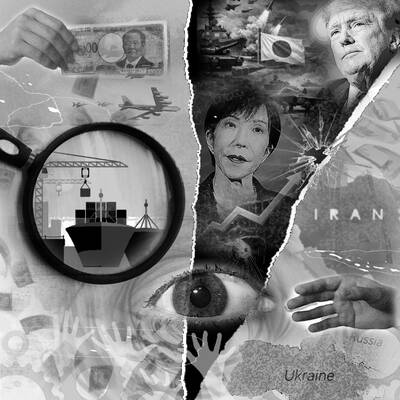
Japan’s imminent easing of arms export rules has sparked strong interest from Warsaw to Manila, Reuters reporting found, as US President Donald Trump wavers on security commitments to allies, and the wars in Iran and Ukraine strain US weapons supplies. Japanese Prime Minister Sanae Takaichi’s ruling party approved the changes this week as she tries to invigorate the pacifist country’s military industrial base. Her government would formally adopt the new rules as soon as this month, three Japanese government officials told Reuters. Despite largely isolating itself from global arms markets since World War II, Japan spends enough on its own
On March 31, the South Korean Ministry of Foreign Affairs released declassified diplomatic records from 1995 that drew wide domestic media attention. One revelation stood out: North Korea had once raised the possibility of diplomatic relations with Taiwan. In a meeting with visiting Chinese officials in May 1995, as then-Chinese president Jiang Zemin (江澤民) prepared for a visit to South Korea, North Korean officials objected to Beijing’s growing ties with Seoul and raised Taiwan directly. According to the newly released records, North Korean officials asked why Pyongyang should refrain from developing relations with Taiwan while China and South Korea were expanding high-level
When 17,000 troops from the US, the Philippines, Australia, Japan, Canada, France and New Zealand spread across the Philippine archipelago for the Balikatan military exercise, running from tomorrow through May 8, the official language would be about interoperability, readiness and regional peace. However, the strategic subtext is becoming harder to ignore: The exercises are increasingly about the military geography around Taiwan. Balikatan has always carried political weight. This year, however, the exercise looks different in ways that matter not only to Manila and Washington, but also to Taipei. What began in 2023 as a shift toward a more serious deterrence posture


 RSS
RSS