


Rethinking education
Minister of Education Wu Ching-chi (吳清基) recently said that the “ultimate goal of education is to help students become independent learners and care about other people.” (“Ministry to help universities make top 100,” Oct. 13, page 2) This is the ideal goal of education, as defined by Wu. However, reflecting on Taiwan’s education system, many will agree that it is doubtful Taiwan can achieve this goal given its focus on examinations.
Many parents in Taiwan admire the Finnish education system. Finland scored highly and reached second place in the Programme for International Student Assessment in 2003 and 2006.
In Taiwan, students are frustrated by the endless series of examinations. Students are expected to explore and broaden their knowledge in schools; but in Taiwan, they spend most of their time taking tests instead of doing research or enjoying their studies. What is the purpose of these examinations?
Finnish students are happy to study. This is in sharp contrast to Taiwanese students, who get increasingly depressed by the endless exams. It doesn’t mean Finnish children do not have examinations. The purpose of conducting exams in Finnish schools is to help children strive and make progress at the same time.
Finnish teachers give students room to improve by giving them more opportunities. Students learn the value of self-reflection and gradually grow in confidence. They are also allowed to practice in their field of interest through project-based learning. Self-regulated learning and a proper learning attitude are established through the project.
Other than admiring the Finnish education system, we should rethink what the core value of education is. Getting high scores and entering a good university are the goals that most Taiwanese parents and teachers set for the kids. If we cannot change this focus on examinations, we can never reform our education system. The losers are the students, who fail to grasp the value of learning as it only becomes a means for scoring high in exams.
Change cannot happen overnight. We should seriously rethink what our goal is and how we — the ministry, parents and teachers — can work together to achieve it. I believe that schools in Taiwan can also cultivate independent learners like the Finnish system.
IRENE WANG
Taipei
Corruption misperception
I was surprised to read Transparency International (TI) Taiwan chairman Hung Yung-tai (洪永泰) say: “Taiwan appears to have rebounded from 39th position last year — the worst TI corruption rating the country had ever received.” (“Anti-corruption ranking rises: report,” Nov. 19, page 3).
As TI has explained in its report, Corruption Perceptions Index 2009, in which Taiwan’s ranking improved to 37th this year, changes in the country ranking do not say much about perceptions of corruption in a country.
As a matter of fact, Taiwan’s corruption perceptions index fell to 5.6 in the 2009 report, from 5.9 in 2006. Since higher scores indicate lower perceived corruption, the new report actually contradicts the TI Taiwan chairperson’s statement.
CHRISTIAN SCHAFFERER
Taichung
Minister of Labor Hung Sun-han (洪申翰) on April 9 said that the first group of Indian workers could arrive as early as this year as part of a memorandum of understanding (MOU) between the Taipei Economic and Cultural Center in India and the India Taipei Association. Signed in February 2024, the MOU stipulates that Taipei would decide the number of migrant workers and which industries would employ them, while New Delhi would manage recruitment and training. Employment would be governed by the laws of both countries. Months after its signing, the two sides agreed that 1,000 migrant workers from India would
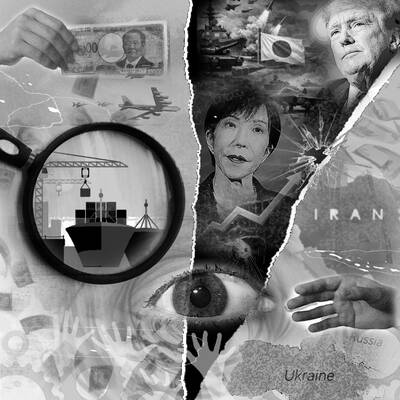
Japan’s imminent easing of arms export rules has sparked strong interest from Warsaw to Manila, Reuters reporting found, as US President Donald Trump wavers on security commitments to allies, and the wars in Iran and Ukraine strain US weapons supplies. Japanese Prime Minister Sanae Takaichi’s ruling party approved the changes this week as she tries to invigorate the pacifist country’s military industrial base. Her government would formally adopt the new rules as soon as this month, three Japanese government officials told Reuters. Despite largely isolating itself from global arms markets since World War II, Japan spends enough on its own
On March 31, the South Korean Ministry of Foreign Affairs released declassified diplomatic records from 1995 that drew wide domestic media attention. One revelation stood out: North Korea had once raised the possibility of diplomatic relations with Taiwan. In a meeting with visiting Chinese officials in May 1995, as then-Chinese president Jiang Zemin (江澤民) prepared for a visit to South Korea, North Korean officials objected to Beijing’s growing ties with Seoul and raised Taiwan directly. According to the newly released records, North Korean officials asked why Pyongyang should refrain from developing relations with Taiwan while China and South Korea were expanding high-level
When 17,000 troops from the US, the Philippines, Australia, Japan, Canada, France and New Zealand spread across the Philippine archipelago for the Balikatan military exercise, running from tomorrow through May 8, the official language would be about interoperability, readiness and regional peace. However, the strategic subtext is becoming harder to ignore: The exercises are increasingly about the military geography around Taiwan. Balikatan has always carried political weight. This year, however, the exercise looks different in ways that matter not only to Manila and Washington, but also to Taipei. What began in 2023 as a shift toward a more serious deterrence posture


 RSS
RSS