

Perhaps the best way to understand the extraordinary transformation of former US president Al Gore is to study the changing rhetoric of his enemies.
A mere nine years ago, back when George W. Bush was just a cheeky rogue with an adorable line in malapropisms, presidential candidate Gore was famously derided as wooden and dull. Having failed to win the presidency — though of course that depends, as ever, on your definition of the word “win” — he next became a pitiable loser, then a laughable climate-change wonk, then the Oscar-winning, peace prize-winning, Live Earth-organizing darling of liberal Hollywood.
And so it says something hugely flattering about his present-day stature, surely, that the new official anti-Gore line is that he is quite simply evil: an anti-American hypocrite, a supporter of world government and, like US President Barack Obama, probably a communist or a fascist, or both.
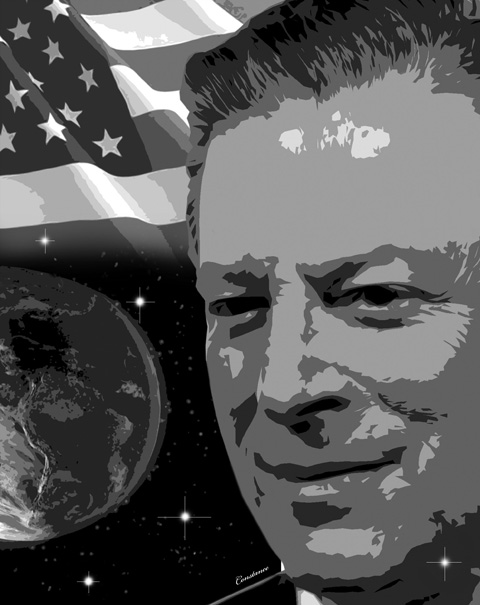
A recent documentary about Gore made by Irish global warming denialists, Not Evil Just Wrong, made the mistake of diverging from this stance, prompting fury among parts of its intended audience in the US. Not evil? Get real.
In person, Gore is neither wooden nor, in any obvious way, evil. What he is, is reserved. Settling back into an armchair at a fancy hotel in Los Angeles, he answers questions obligingly and at length — sometimes at very great length — but without the effort to connect that seems to be a compulsion of most politicians. He is trim, strikingly handsome, in a dark blue suit and black cowboy boots, and looks mysteriously unsleepy, despite having just flown in from a three-day trip to China. (After Los Angeles, he’s due home for one night in Nashville, then off on a book tour that will take him to South Africa and Egypt. Denialists enjoy attacking Gore’s personal carbon footprint, even though, as denialists, it’s not clear what they’re objecting to.)
Not long ago, Time magazine called him “improbably charismatic,” which is accurate, though this may be a consequence of his new incarnation. For a successful politician, Gore comes across as surprisingly distant, but as professorial climate change experts go, he’s a rock star.
Gore, optimistically, attributes the hardening tone of his critics to “the sunset phenomenon, where there’s a spectacle just before the subsiding.” As the remaining climate change doubters and vested interests begin to realize that the game is up, he suggests, they’re bound to make one last stand.
“This self-interest on the part of some of the carbon polluters — who are becoming a bit intense in their efforts — reflects their awareness that public opinion has been shifting very significantly,” he said. “When I say ‘they,’ I don’t mean to indict all of them, because the business community is now very much split ... but that realization has produced a desire on the part of some of these carbon polluters to dig in their heels.”
He points to the US Chamber of Commerce’s new hardline stance against action on the environment, which prompted several major US corporations to resign from it (including Apple, on whose board Gore sits, though he says he first heard of that decision when he read about it in the paper).
“They’re calling for a new Scopes trial,” said Gore, referring to the chamber’s efforts to liken a belief in global warming to creationism. “Ha! The Scopes trial happened in my home state, and I can tell you, one was quite enough.”
But many firms are beginning to take a different approach, he notes, for example those who have joined the 10:10 campaign in the UK. Gore called 10:10 “brilliant” and sees no reason why it couldn’t work in the US, too.
Gore’s new book, Our Choice: A Plan to Solve the Climate Crisis, gives global warming deniers short shrift and shows little concern for displays of political bipartisanship. He likens the doubters to the “birthers” intent on proving that Obama is a Kenyan — not just mavericks, but fantasists who inhabit a different version of reality.
“The golden thread of reason that used to be stretched taut to mark the boundary between the known and the unknown is now routinely disrespected,” he writes in a typically Goreish sentence, immediately prior to quoting Theodor Adorno, King Solomon and Aesop.
Primarily, though, Our Choice is a sumptuously illustrated coffee-table book of potential solutions, explaining both Gore’s favorites (geothermal energy, biochar, “smart” electrical grids) and those about which he is deeply skeptical (nuclear power, carbon capture and pumping sulphur dioxide into the stratosphere, a plan he describes as “insane”).
When making his Oscar-winning 2006 documentary, An Inconvenient Truth, Gore arguably had it easy. It’s fairly straightforward to grip an audience when you’re portraying scenes of apocalyptic destruction.
FEAT
The new book pulls off a considerably more impressive feat. It focuses on solving the crisis, yet manages to be absorbing on a topic that is all too often — can we just come clean about this, please? — crushingly boring. Importantly, it seeks to enlist readers as political advocates for the cause, rather than just urging them to turn down the heating.
“It’s important to change lightbulbs,” he said in a well-burnished sound bite, “but more important to change policies and laws.”
Or perhaps to break laws instead. Peaceful occupations of the kind witnessed recently in the UK, he predicts, are only going to become more widespread.
“Civil disobedience has an honorable history, and when the urgency and moral clarity cross a certain threshold, then I think that civil disobedience is quite understandable, and it has a role to play. And I expect that it will increase, no question about it.” People sometimes express incredulity that Gore, who was groomed for the presidency almost since birth, seems so resolved that he’ll never return to electoral politics. But here’s a vivid example of the benefits of life on the outside: How many serving politicians would feel able to come so close to urging people to commit trespass?
Gore is particularly compelling on psychology: his book addresses head-on the fact that merely repeating grave pronouncements about the climate crisis isn’t a remotely effective way to get governments or individuals to act.
Instead, he explores ways to link long-term environmental goals to everyday incentives that people and businesses can actually get their heads around, most obviously by putting a price on carbon via cap-and-trade and other mechanisms.
“If the only tool we use to analyze what’s valuable is a price tag, then those things that don’t have price tags begin to look like they have no value,” he writes.
He’s also passionate about the potential psychological impact of Dscovr, the NASA satellite project he proposed while serving as Bill Clinton’s vice president (former vice president Dick Cheney mothballed the project; Obama has resurrected it). Among other things, it would provide a continuous view of the sunlit side of the Earth, available via the Internet — a sort of real-time version of the famous Earthrise photograph, serving as a constant reminder and update on the fragile state of our planet.
But it is, naturally, the state of Gore’s personal psychology that interests people just as much. Everyone has their hypotheses. They want to know if his environmental campaigning has somehow brought him peace after the almost unimaginable disappointment of the 2000 election. Or they speculate that he feels guilty for not focusing sufficiently on the climate during that campaign, and is making up for lost time, or guilty for not fighting harder over Florida, given all that subsequently happened under Bush. Our Choice, like An Inconvenient Truth, declares that we are at an historic decision point at which we can choose to hesitate, with disastrous consequences, or rise to the occasion — which is virtually an invitation to engage in armchair psychoanalysis. Didn’t Gore himself blink, at an analogous crucial moment, with momentous results for himself and the world?
In the years immediately following the disputed presidential election — after growing a beard and gaining weight — Gore drew on deadpan humor to help process the experience and to put audiences at ease.
“You win some, you lose some, and then there’s that little-known third category,” he would say.
Or: “I don’t want you to think I lie awake at night, counting and recounting sheep.”
But these days the gags have subsided.
“To place the disappointment, which I felt keenly, into some perspective, there are millions upon millions of people who have suffered infinitely larger losses than I suffered,” he says now. “They move on with their lives, and if they can, I certainly can. If we walked through the lobby of this hotel and down the sidewalk outside, we’d run into a lot of people who, without us knowing it, are carrying enormous burdens of loss and disappointment. It’s part of the human condition.”
It does seem, though, as if taking on the biggest conceivable global challenge has helped heal the wound, and perhaps even provided him with a satisfaction that being vice president didn’t.
“It’s a blessing to have work that feels fulfilling,” he said. “There’s a passage in the Bible — not that I wear religion on my sleeve; I do not — but there’s a passage that’s long had meaning for me: ‘Whatsoever thy hand findeth to do, do it with thy might’ ... There’s that wonderful old English movie, Chariots of Fire, when the runner says at one point, ‘When I run, I feel God’s pleasure.’ He was expressing a universal human emotion that I think is applicable.”
UNLIKELY
It is easy to forget exactly how unlikely it is that Gore should be doing anything at this point other than serving as an elected politician. The son of the Tennessee senator Albert Gore, he was born in Washington and grew up immersed in politics. By the time he went to Harvard, he’d gone public with his ambition to become president.
He met his future wife, Tipper, at his high school prom in 1965, and served in Vietnam as an army journalist despite opposing the war. By 1977 he was a congressman, aged 29. He upgraded to the Senate in 1985, where he played a key role in securing funding for the nascent Internet — even if he didn’t quite invent it, as some critics falsely alleged that he’d claimed — and ran unsuccessfully to be the Democrats’ presidential nominee in the 1988 election.
In 1989, his son Albert, then six, was hit by a car while crossing the road and nearly died. Gore said the experience transformed him, and put him off running for president; instead, he joined Clinton’s ticket in 1992. In 2007 and last year, it was frequently suggested that he should run again — indeed, that he had a moral duty to run again — and he never quite fully dismissed the notion until he endorsed Obama. More than any other living figure on the US national stage, perhaps, Capitol Hill and the White House have dominated his life.
Yet here he is, aged 61, living in Nashville in an 18-room mansion that has been retrofitted to rely entirely on renewable energy, shuttling across the globe, positioning himself cleverly both as the ultimate insider and an activist willing to go far further than the insiders would dare.
He serves as an adviser to Google, as well as an Apple board member, chairs a sustainable investment fund and is a partner in Kleiner Perkins Caufield & Byers, a venture capital fund with environmental interests. (He is, as a result, often accused of a conflict of interest, but responds that all his profits go to his nonprofit organization, the Alliance for Climate Protection.)
“He’s got access to every leader in every country, the business community, people of every political stripe,” Tipper Gore told Time magazine. “He can do this his way, all over the world, for as long as he wants. That’s freedom. Why would anyone give that up?”
OPTIMISTIC
Contrary to the general consensus among activists and journalists, Al Gore remains optimistic about next month’s Copenhagen talks — optimistic that the US Senate will pass a bill to clarify Washington’s position, arming Obama with much-needed moral authority, and thus optimistic that a worthwhile agreement, which hinges on a US commitment, will emerge from the gathering itself.
“I was in China two days ago, and the premier of China asked me, in essence, why I’m optimistic that the Senate will pass legislation when the conventional wisdom says otherwise. And the answer is that I have been a part of conversations between Democrats and Republicans that give me a very different view from what the consensus is in the journalistic community,” Gore said.
He refers to the op-ed article by Republican Senator Lindsey Graham and Democratic Senator John Kerry in the New York Times calling for legislation to pass.
“There are other surprises like that in store,” he said.
Of the potential Copenhagen deal, Gore said: “I expect it to be far weaker than the one I would like to see. However, the important achievement [will be] to put a price on carbon and reset expectations among business, government, NGOs and others.”
He likens the situation to the Montreal Protocol on the ozone layer: “The world acted fairly quickly, but the agreement they reached was criticized for being insufficient.”
Yet, he points out, when the treaty was revised, “many of the businesses that had opposed [it] were there to argue in favor of toughening it significantly. Because once they began to comply ... they realized that it was not as difficult as they had feared. And once they’d made the commitment to the change, they were eager to get on with it.”
It made more sense, financially and in public relations terms, to go all the way instead of halfway.
Is it important for Obama to go to Copenhagen himself?
“Oh yes. And I expect that he will. He hasn’t told me that he will, and no one representing him has told me that he will. But I feel certain that he will,” Gore said.
In Gore’s position, of course, optimism infused with urgency is the only rational stance to take in public. Unless you either don’t believe in human-caused global warming or you think it’s too late to do anything about it, there’s no real upside to saying anything other than that the situation is grave yet addressable.
But Gore, you get the feeling, really is an optimist, all the way through. His repeated references to president John F. Kennedy’s promise to put a man on the moon may not, as a climate change analogy, bear close scrutiny: Putting a man on the moon didn’t require the average American to do anything at all. Still, the crisis needs its Kennedy, and Gore — for all his improbable, un-Kennedy-like brand of charisma — seems to be that man.
“We have a tendency as human beings to confuse the unprecedented with the improbable,” he said. “If something has never happened before, we tend to assume it will not happen in the future ... [but] throughout history, there have been examples of human societies confronting dire threats and finding, in their response, that they were capable of more than they thought they were capable of.”
What everything depends on now, he said, is “how soon we reach a critical mass of political awareness that can ... give us the ability to use the rule of law as an instrument of human redemption.”
We will win or we will lose. Outside of dodgy Floridian elections, there actually isn’t a third category.
The most troubling message coming out of Washington for Taipei is not any single statement but the cumulative effect of a series of signals suggesting that US President Donald Trump is rethinking Taiwan’s strategic value while viewing the US-China relationship through the lens of a transactional great-power bargain. The danger behind Trump’s new softness toward Beijing is a potential US-China bargain that undermines Taiwan’s core interests. During Chinese President Xi Jinping’s (習近平) recent state visit to Washington, Trump and Xi appeared to rewrite the history of World War II. In a Sept. 25 fact sheet on Xi’s visit, the White House said,
Southeast Asian food delivery platform Grab Holdings Ltd in March applied to acquire Delivery Hero SE’s Foodpanda operations in Taiwan, with the Fair Trade Commission (FTC) scheduled to announce its decision on Oct. 27. On the surface, the deal is a business merger — but in substance, it involves personal data, national geospatial information and digital sovereignty. It cannot be assessed solely in terms of market share and price competition. Grab has extensive and long-standing connections to Chinese capital. In 2015, Chinese ride-hailing firm Didi Chuxing and China Investment Corp, a sovereign wealth fund, invested in Grab. Grab invested in Chinese autonomous-driving
The official English name for Democratic Progressive Party (DPP) Legislator and Taipei mayoral candidate Puma Shen’s (沈伯洋) campaign is “the Taipei Current.” It comes from the Chinese term yangliu (洋流), a direct translation of which would be “ocean current,” using the last character of Shen’s name, yang (洋, “ocean”). The Chinese term is a reference to the 2018 campaign for Kaohsiung mayor that swept a hitherto marginal player within the Chinese Nationalist Party (KMT), Han Kuo-yu (韓國瑜), who is now legislative speaker, whose successful campaign then was termed the “Han Wave” (韓流). Shen’s usage of the Chinese term is intentional.
Early this month, the Chinese Nationalist Party (KMT) held two large election campaign rallies in Taichung and New Taipei City on the same day. However, KMT Chairwoman Cheng Li-wun (鄭麗文) was marginalized at the rallies. Cheng shouted herself hoarse campaigning onstage for the mayoral candidates, but neither candidate was onstage at the time. In the morning of that day, the KMT’s Taichung mayoral candidate, Deputy Legislative Speaker Johnny Chiang (江啟臣), entered the venue accompanied by Legislative Speaker Han Kuo-yu (韓國瑜), Taichung Mayor Lu Shiow-yen (盧秀燕) and New Taipei City Mayor Hou You-yi (侯友宜). That afternoon, the party’s New Taipei City


 RSS
RSS